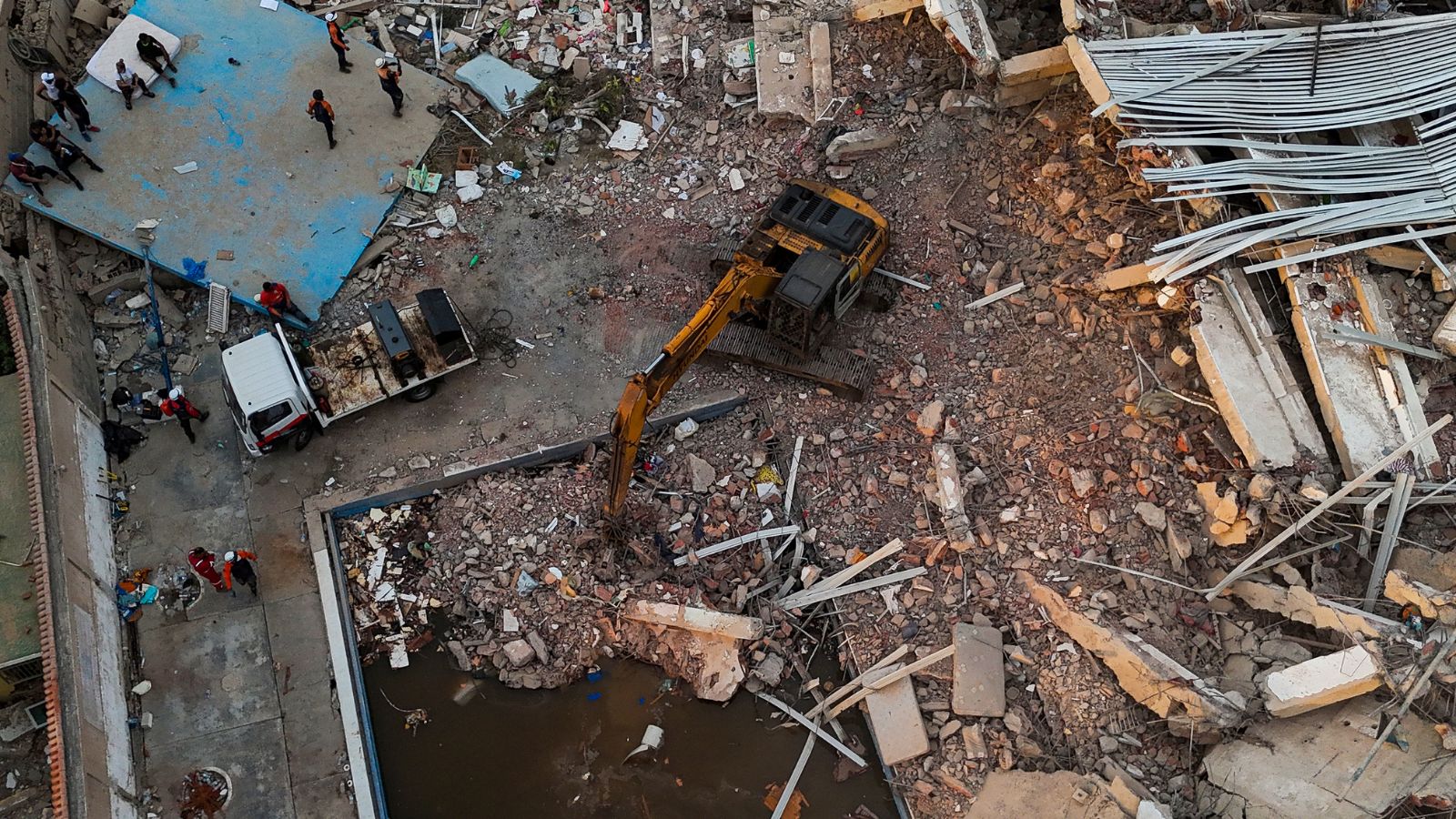
The sound did not come from the earth. It came from the walls.
When a house decides to give up its structural integrity, it makes a sound like a wet branch snapping, amplified ten thousand times. It is a wet, heavy crack that ripples through concrete blocks, shatters glass windows into tiny cubes, and drops the ceiling directly into the living room. For those who survive the initial collapse, the silence that follows is not peaceful. It is thick with pulverized lime, choked with gray dust that tastes like old iron, and punctuated by the steady, rhythmic drip of broken water pipes. Also making waves in this space: The Weight of Shouted Words Across the Mediterranean.
By the time the tremors finally stopped, the official ledger had begun its grim, mechanical tally. The numbers climb daily. One thousand seven hundred and nineteen dead. The figure sits on news tickers, flat and frozen, a statistic designed to help people thousands of miles away grasp the scale of a catastrophe.
But numbers are an illusion. They flatten the jagged edges of reality. To understand what actually happened when the earth shifted, you have to look at a single pair of hands clawing through the debris of a neighborhood that, just minutes prior, smelled of fried plantains and cheap coffee. More information on this are explored by BBC News.
The Weight of Twelve Seconds
Consider a hypothetical survivor. Let us call her Elena, a composite of the mothers and grandmothers currently sleeping on plastic tarps in the plazas of Caracas and the coastal towns. Before the tremor, her world was bounded by a corrugated tin roof, a three-burner gas stove, and the exact knowledge of which floorboard squeaked when her grandson crept out in the morning.
When the tectonic plates ground against each other miles beneath the surface, that entire world collapsed into an area the size of a shipping crate.
Earthquakes are often described as sudden, but for those caught inside them, time stretches out into a bizarre, elastic nightmare. Twelve seconds of heavy shaking feels like an hour when you are trapped under two tons of unreinforced masonry. The mind does something strange in those moments. It does not think about global aid packages or international logistics. It focuses entirely on the small pocket of air between your face and the concrete slab above you.
This is the invisible reality of the Venezuelan aftershocks. The primary quake destroys the buildings; the aftershocks destroy the hope of digging out whoever is left inside. Every time the ground rumbles anew—even a minor four-point-two tremor—the unstable piles of rubble shift. A gap that was keeping a teenager alive suddenly closes. A staircase that was leaning precariously against a neighboring wall finally slides down, sealing a basement forever.
The Chemistry of Scarcity
The real tragedy of a disaster in a nation already hollowed out by economic instability is that the infrastructure is fragile long before the ground moves.
When the water system fails in a modern, wealthy metropolis, fleets of trucks arrive within hours. In the communities worst hit by this disaster, the water system was already a ghost. People were already storing water in blue plastic barrels on their roofs. When those roofs collapsed, they didn't just lose their shelter; they lost their entire reserve of hydration.
Now, the air temperature hits ninety degrees by noon. The dust is everywhere. It settles in the throats of the rescue workers, dries out the eyes of the volunteers, and mixes with the sweat of people who have been digging with their bare fingers for forty-eight hours straight.
The international aid efforts are intensifying, as the headlines say. But what does that look like on the ground? It looks like a massive bottleneck. Cargo planes land at distant airports, filled with high-tech search equipment and pallets of bottled water. But between that tarmac and the mountain communities where the hillsides slid into the valleys, there are roads choked with boulders, bridges with cracks so wide you can see the rushing river below, and an acute shortage of fuel to keep the delivery trucks moving.
It is a logistical puzzle where every missing piece costs a human life. If a crane cannot get past a ruined overpass by nightfall, the people trapped under the collapsed schoolhouse do not survive until morning. It is that simple. That brutal.
The Anatomy of an Aftershock
We tend to think of aftershocks as mere footnotes to the main event. This is a profound misunderstanding of seismic physics and human psychology.
When the earth moves the first time, adrenaline takes over. People run. They grab their children. They jump from windows. But the aftershocks arrive when the adrenaline has burned out, leaving behind a profound, bone-deep exhaustion. You are sitting on a sidewalk, wrapped in a donated blanket, trying to process the fact that your entire life is now contained in a pile of gray rubble, and suddenly the concrete beneath your feet begins to vibrate again.
The panic is cumulative. It builds a permanent state of hyper-vigilance.
Children scream at the sound of a passing motorcycle. Grown men refuse to walk under the awning of a grocery store that survived the initial shock. The sky becomes the only safe ceiling, leading to thousands of people sleeping in public parks, vulnerable to the torrential tropical rains that are now turning the disaster zones into seas of orange mud.
The mud brings its own problems. Landslides do not need a massive earthquake to trigger them; they just need a hillside that has been loosened by seismic activity and saturated by rain. Whole rows of self-built brick houses, stacked precariously on the hillsides of the barrios, are sliding downward like decks of cards dropped on a tilted table.
The Invisible Ledger
The red cross and the white helmets are moving through the ruins now, their bright vests coated in the ubiquitous gray dust. They bring body bags, water purification tablets, and heavy-duty satellite phones. They are doing the essential, exhausting work of triage—deciding who can be saved and who must be left behind because the machinery required to lift a specific slab will not arrive for three days.
The true toll of this week will never be captured by the number 1,719.
The real cost will be counted in the months to come. It will be found in the families that have been permanently scattered, the children who will never return to a classroom because their school is now a cemetery, and the old men who sit on the curbs of broken streets, staring at their empty hands.
The aid will eventually slow down. The news cameras will pack up their tripods and move to the next crisis, the next sudden explosion of human misery somewhere else on the globe. The tickers will stop updating.
But under the tropical sun, long after the world has looked away, the concrete will still smell of lime and old iron. The people will still be there, walking softly, constantly listening to the walls, waiting to see if the ground beneath their feet has finally finished speaking.