The limestone of Washington, D.C., is supposed to feel eternal. For centuries, the city’s architecture has functioned as a silent code, whispering messages of permanent, institutional weight. The neo-classical columns, the sprawling marble plazas, the strictly enforced low-rise skyline—they all tell a story of a republic built to outlast any single human being.
Then came the arch.
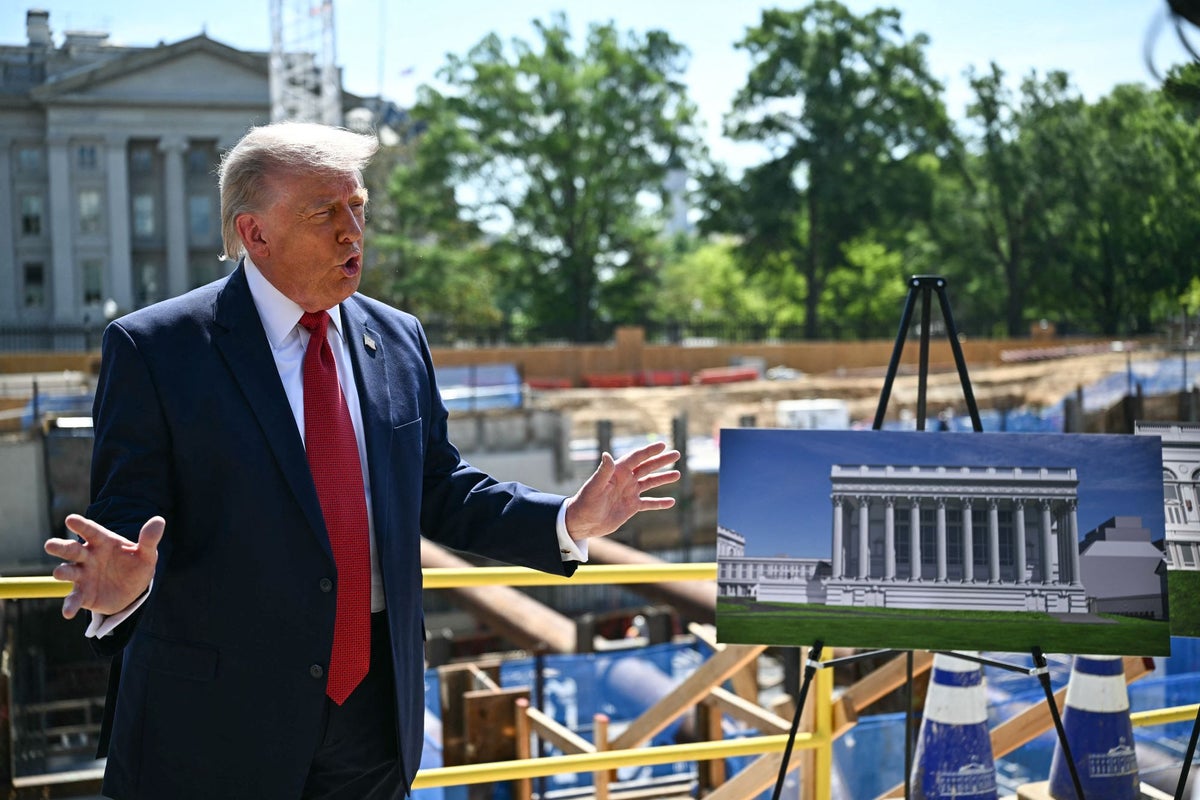
It rose near the National Mall, a massive, temporary 250-foot monument of steel and scaffolding, disrupting the sacred geometry of the capital. Shortly after, a towering Ultimate Fighting Championship (UFC) octagon rig materialized, casting a literal shadow toward the White House. To the tourists snapping photos, it looked like a massive production crew had simply lost its way on the road to Las Vegas. To those who study the theater of American power, it was something entirely different. It was a declaration.
Washington is undergoing a profound, physical rewrite. The city is being stripped of its traditional bureaucratic solemnity and dressed in the loud, high-stakes aesthetic of modern entertainment. This is not merely a change in administration. It is a fundamental shift in how power visualizes itself, transforming a capital built on institutional permanence into a stage built for immediate, visceral spectacle.
The Architect of the Ephemeral
To understand this transformation, look closely at the workers assembling these structures. Imagine a union crane operator, a native Washingtonian who has spent three decades helping maintain the city's monuments. For thirty years, his job was about preservation. He patched stone, reinforced historical foundations, and ensured that everything stayed exactly as the Founders intended.
Now, his days are spent erecting massive, temporary installations that look like they belong at a stadium rock concert. He hoists heavy steel trusses into the humid D.C. air, watching them blot out the view of the Washington Monument. He is building structures designed to be seen by millions on screen for forty-eight hours and then vanished overnight.
This is the new reality of the capital. Power is no longer expressed through the slow, deliberative engraving of names into marble. It is expressed through the rapid deployment of massive, temporary landmarks. The 250-foot arch does not care about the next century. It cares about the next news cycle. It demands eyes, right now, through sheer, unadulterated scale.
Historically, Washington used architecture to project stability. The Romans did it; the Greeks did it; the early Americans copied them to prove the young democracy wasn't a fleeting experiment. But the current architectural ethos rejects the idea that permanence equals power. Instead, it embraces the logic of the television set. The city has become a studio backlot where the backdrop can be swapped out to match the mood of the director.
Octagons and Oval Offices
Consider the juxtaposition of the UFC rig towering near the Executive Mansion. For decades, the area surrounding the White House was treated with a specific kind of architectural reverence. Even the protests that gathered there conformed to a certain aesthetic tradition of hand-painted signs and human chains.
The introduction of an elite combat sports apparatus into this space changes the conversation entirely. The octagon is not an accidental choice. It is a symbol of raw, unapologetic competition, of survival, of a world divided strictly into winners and losers. By planting that specific brand of aesthetic directly into the line of sight of the presidency, the administration signals a new philosophy of governance.
Politics has always been a blood sport, but it used to pretend it wasn’t. It hid behind the polite language of subcommittees, policy briefs, and diplomatic protocol. The new Washington strips away the pretense. It brings the cage directly to the lawn.
This aesthetic shift creates a strange friction for the people who inhabit the city. Congressional staffers in Brooks Brothers suits walk past steel riggings designed for cage fighters. Foreign diplomats step out of limousines and find themselves staring at structures that look like the staging ground for a pay-per-view mega-event. The message to these institutionalists is clear: the old rules of decorum are as temporary as the scaffolding.
The Screen-First Capital
Why build a 250-foot arch if it isn't meant to last? The answer lies in how we consume reality.
In the past, Washington was built for the person standing in it. The scale of the Lincoln Memorial is meant to overwhelm you when you look up from its base. The vastness of the National Mall is designed to make the individual feel small in the presence of the collective state.
The new monuments are built for a different audience. They are built for the lens.
A 250-foot arch looks impressive from the ground, but it looks truly spectacular from a drone camera cutting to a commercial break. The UFC rig is positioned not for the pedestrian on Pennsylvania Avenue, but for the millions watching a broadcast feed where the White House serves as a perfectly framed, blurred-out background asset.
This is the gamification of the American landscape. The physical city is no longer just a place where laws are made; it is an intellectual property asset to be leveraged for maximum visual impact. The stakes are no longer measured in the endurance of stone, but in the metrics of engagement, viewership, and dominant optics.
But this reliance on the temporary creates an underlying sense of anxiety. When the buildings that symbolize your government can be put up in a weekend and torn down on a Monday, it introduces a subtle, haunting question into the collective psyche: what else is temporary? If the physical markers of our democracy can be swapped out like theatrical props, it becomes much easier to believe that the institutions themselves are equally fragile, equally disposable.
The Cost of the Show
Every construction project in Washington requires a massive logistical dance. Permits must be signed, security perimeters must be redrawn, and traffic must be diverted. When these projects are permanent, the disruption is viewed as an investment in the city’s future. A new museum or a restored monument is a gift to the next generation.
The current transformation offers no such return. The residents of the District find their daily commutes upended not for a new public space, but for a transient spectacle. Streets are closed, security checkpoints are erected, and public land is privatized for days at a time to facilitate an elite broadcast.
The city is becoming less of a living, breathing community and more of a closed set. For the people who live in the neighborhoods beyond the monuments—in Anacostia, in Columbia Heights, in Capitol Hill—the constant construction of these massive, temporary stages feels like a circus that has taken over the town square without asking permission. They watch the steel go up, they hear the bass from the soundchecks echoing through their windows at night, and then they watch the flatbed trucks haul it all away, leaving behind nothing but empty patches of grass and the lingering scent of diesel exhaust.
There is a vulnerability in admitting how much this hurts to watch for those who love the old, boring Washington. There was a comfort in the bureaucratic dullness of the city. The endless rows of grey federal buildings, the predictable geometry of the streets, the absolute lack of flashiness—it was a visual promise that the machine of state would keep grinding along, indifferent to the whims of celebrity or the madness of the crowd.
That comfort is evaporating. The machine has discovered show business, and it likes the applause.
The cranes continue their work. Another truck rolls down Constitution Avenue, loaded with aluminum beams and high-definition LED screens. The operators climb into their cabs, pull their levers, and lift another piece of the new capital into place.
On the ground below, a crowd gathers to watch. They don't look at the Capitol dome or the White House. They look at the steel rising into the sky, waiting to see what kind of show is about to begin. The old stone structures stand by, silent, grey, and increasingly out of place in a city that has traded the heavy burden of history for the blinding light of the stage.