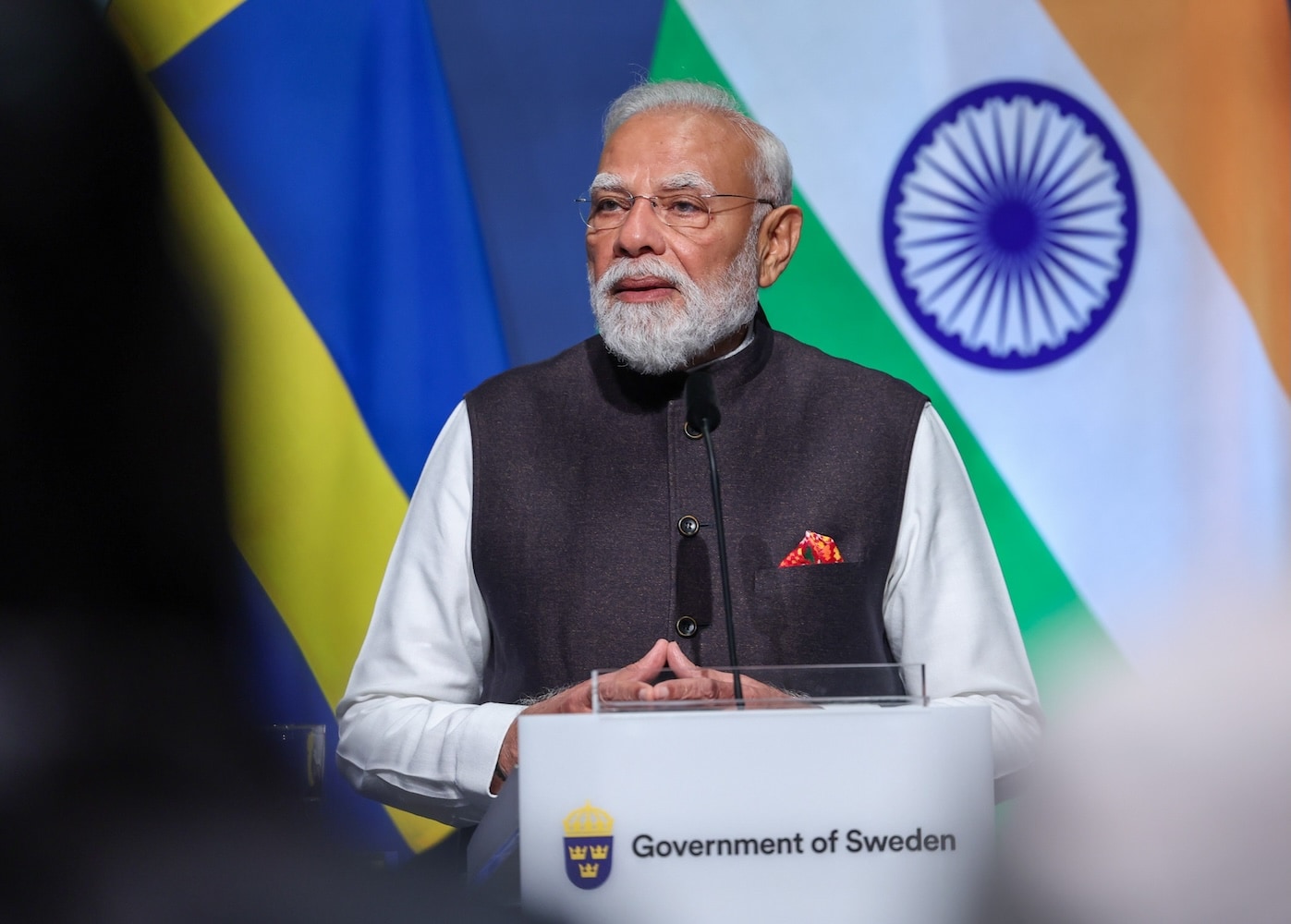
Rain slicked the cobblestones of Stockholm as the motorcade hummed toward the Rosenbad. Inside those sleek, armored shells, the air was thick with something more potent than mere protocol. Diplomacy is often painted as a series of stiff handshakes and rehearsed smiles, but look closer. It is a high-stakes gamble on the future. When Prime Minister Narendra Modi met with Swedish Prime Minister Stefan Löfven, they weren't just checking off a laundry list of bilateral trade targets. They were trying to solve a puzzle that haunts every modern nation: How do you stay relevant in a world where data is the new oil and geography is becoming obsolete?
The "dry facts" tell you that India and Sweden signed a Joint Action Plan. They tell you about a "Joint Declaration on Innovation Partnership." But they don't tell you about the engineer in Bengaluru who wonders if her startup will survive the next decade, or the manufacturer in Gothenburg looking for a way to make steel without choking the planet.
The Midnight Sun and the Monsoon
Sweden is a small country with a massive shadow. It is a nation that figured out how to be a global titan of industry while maintaining a social fabric that doesn't fray at the edges. India is a subcontinent of contradictions, a place where bullock carts occasionally share the road with tech moguls. On the surface, they are opposites. One is quiet, orderly, and sparsely populated. The other is a cacophony of 1.4 billion dreams.
Yet, they found a common language. It wasn't English, though they spoke it. It was the language of survival through innovation.
Consider the "Innovation Bridge." It sounds like a metaphor. It isn't. It is a deliberate, structural attempt to connect the raw, unfiltered energy of Indian startups with the refined, precision-engineered expertise of Swedish giants like Ericsson and ABB. Imagine a young coder in a cramped office in Pune. He has an algorithm that can predict crop failures before the first leaf turns yellow. He has the math. He has the vision. What he doesn't have is the industrial scale to test it. On the other side of the world, a Swedish ag-tech firm has the hardware but lacks the massive, diverse data sets that only a country like India can provide.
When these two worlds touch, things change.
The Silent Corridor
The centerpiece of this meeting was the establishment of a dedicated "AI Corridor." This isn't a physical hallway. It’s a digital highway designed to bypass the bureaucracy that usually kills good ideas before they reach the prototype stage.
Why Artificial Intelligence? Because AI is the ultimate equalizer. For India, AI isn't about making smarter vacuum cleaners or better targeted ads. It’s about survival. It’s about managing a healthcare system that serves millions with a fraction of the necessary doctors. It’s about optimizing a power grid that struggles under the weight of a growing middle class.
Sweden understands this. They have spent decades perfecting the art of "Green Industry." They make things that last, and they make them clean. By linking India’s massive scale with Sweden’s sustainable technology, they aren't just boosting trade figures. They are building a buffer against a future that looks increasingly volatile.
Trade targets were set at five billion dollars. A number. A goal. But numbers are hollow without the human intent behind them. That five billion represents thousands of jobs, millions of hours of research, and a fundamental shift in how these two nations view one another. They moved from being "buyer and seller" to being "co-creators."
The Defense of the Future
Then there is the matter of security. Not just soldiers and borders, but the invisible security of the 21st century. Cyber warfare. Data sovereignty. The Swedish "Gripen" fighter jet often dominates the headlines when these leaders meet, and for good reason. It is a marvel of engineering. But the deeper conversation was about the "Make in India" initiative.
Sweden didn't just want to sell planes. They signaled a willingness to transfer technology, to share the "how" and not just the "what." This is a rare currency in international relations. Most countries guard their blueprints like crown jewels. Sweden’s openness suggests a level of trust that goes beyond a standard diplomatic partnership. It suggests a belief that an empowered India is a stabilizing force in a world that feels like it’s tilting off its axis.
Think of a hypothetical worker in a new defense plant in Uttar Pradesh. He isn't just bolting wings onto a fuselage. He is learning a standard of precision that was perfected in the sub-arctic workshops of Linköping. He is being integrated into a global supply chain that values his skill as much as the engineer’s design. This is the human face of a "strategic partnership."
The Invisible Stakes
We often ignore these state visits. They feel distant, wrapped in the protective layers of official communiqués and grainy C-SPAN footage. But the stakes are intensely personal.
The world is currently dividing into tech blocs. There is the frantic, profit-driven model of Silicon Valley. There is the state-controlled, surveillance-heavy model of the East. And then, there is this third way—the Nordic-Indian synthesis. It’s a model that asks: Can we be innovative without being predatory? Can we grow our economies without burning our future?
The "Strategic Partnership" is a bet that the answer is yes.
It is a gamble that a country known for its "Jugaad"—the Indian art of frugal innovation—can find a soulmate in a country known for its "Lagom"—the Swedish philosophy of "just the right amount."
As the leaders stepped out into the Swedish evening, the headlines began to circulate. They spoke of "AI Corridors" and "trade growth." They focused on the ink on the paper. But the real story wasn't in the signatures. It was in the sudden, sharp realization that neither nation can afford to go it alone anymore.
The bridge is built. The data is flowing. The silence of the Nordic woods has met the roar of the Indian street, and in that friction, something entirely new is being born.
The rain stopped. The motorcade moved on. But the corridor remained open, a ghost-road of light and logic connecting two worlds that finally realized they were breathing the same air.