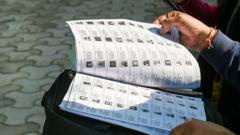
The bureaucracy of belonging has a body count. In the humid riverine stretches of the Brahmaputra valley, nearly two million people have been transformed into "ghosts" by a clerical exercise of unprecedented scale. While global headlines often skim the surface of India’s National Register of Citizens (NRC), the ground reality in the border state of Assam reveals a more terrifying mechanism. It is not just about losing a vote; it is about the systematic erasure of legal personhood through a digital-first process that failed a paper-based population.
The Algorithm of Exclusion
For decades, the political narrative in Assam was fueled by the "foreigner" issue. The fear was simple: illegal migration from neighboring Bangladesh was altering the demographic fabric of the state. To solve this, the Indian government greenlit an update to the NRC, a list of verified citizens. The criteria were brutal. To prove you belonged, you had to produce "legacy data"—documents dating back to 1971 or earlier showing your ancestors lived in India. In similar developments, take a look at: The Ledger of Broken Glass.
The crisis hit a fever pitch when the final list excluded roughly 1.9 million people. This was not a random error. It was the result of a massive technological experiment. The state used complex software to match family trees across generations. If a single name was spelled differently on a 1966 land record versus a 2015 voter ID—a common occurrence in a region with low literacy and phonetic name translations—the system flagged the individual as a "mismatch."
These people did not just lose their right to choose a representative. They lost their right to have rights. NPR has analyzed this important subject in great detail.
The Limbo of the D-Voter
Before the NRC reached its current impasse, the state had already pioneered a unique category of purgatory: the "Doubtful Voter" or D-Voter. Since 1997, the Election Commission of India has marked hundreds of thousands of residents with a "D" in the electoral rolls.
Being marked with a "D" is a civil death sentence. You cannot vote. You cannot apply for a passport. You are barred from government schemes. Most critically, the burden of proof is flipped. In any standard legal system, the state must prove you are a foreigner. Here, a low-level border police officer can flag you based on "suspicion," and you must then spend your life savings in a Foreigners’ Tribunal to prove you are who you say you are.
The NRC was supposed to be the "final" solution to this. Instead, it created a new class of the disenfranchised. Many who were cleared by the Tribunals found themselves excluded from the NRC anyway, while others included in the NRC were still pursued as D-Voters by the police. The machinery of the state is effectively competing with itself, and the individual is the one caught in the gears.
The Economics of Citizenship
Citizenship in Assam is an expensive commodity. For the tea garden workers and subsistence farmers living on the "chars" (shifting silt islands), the NRC was a financial catastrophe.
- Legal Fees: Even the most basic representation at a Tribunal costs more than a year’s wages for a daily laborer.
- Documentation Travel: Families often had to travel hundreds of kilometers to attend "verification hearings" on 24-hour notice, losing wages and selling livestock to afford the bus fare.
- Corruption: Reports of local officials demanding bribes to "verify" valid documents became an open secret in the rural districts of Goalpara and Dhubri.
The tragedy is that the vast majority of those excluded are not "infiltrators." They are the poor. They are people whose birth certificates were washed away in the annual floods of the Brahmaputra. They are women who were married off as minors and have no "linkage documents" to their father’s house. The state demanded a digital trail from a population that lives in a prehistoric cycle of monsoon and mud.
The Strategic Silence of the State
What happens to 1.9 million people who are no longer citizens? The Indian government has reached a stalemate. Bangladesh has repeatedly stated it will not take back a single person, as it does not recognize them as its citizens. This leaves the "excluded" in a permanent state of statelessness.
The political utility of this crisis is too high to solve. For the ruling parties, the existence of a "threat" is a potent electoral tool. By keeping millions in limbo, the state maintains a permanent lever of control over the minority population. If you can be declared a foreigner at any moment, you are unlikely to protest against the government or demand better wages.
The NRC has become a "frozen conflict." The list has not been officially notified by the Registrar General of India, meaning the 1.9 million excluded people cannot even begin their official appeals process. They are stuck in a legal waiting room that has no exit.
The Human Cost of Data Integrity
The obsession with "clean" data has ignored the messy reality of human life. In detention centers across Assam—parts of which are housed within regular jails—individuals wait for a resolution that may never come. Some have died behind bars. Others have taken their own lives, driven to despair by the sight of their neighbors receiving "legacy" approval while their own applications were rejected due to a stray character in a software field.
The Indian border state is not just experiencing turmoil; it is a laboratory for a new kind of digital authoritarianism. When citizenship is treated as a database entry rather than a human right, the system will always find a reason to delete a record.
The 1.9 million are still there. They still work the fields. They still raise children. But in the eyes of the state, they have already vanished. The real crisis isn't that they can't vote. It's that they have been stripped of the legal armor that protects a human being from the whims of a bureaucracy. This isn't just an Indian problem. It is a warning to any society that believes "better data" is a substitute for justice.
The machinery of exclusion is now fully built. All it needs is a reason to turn the key.