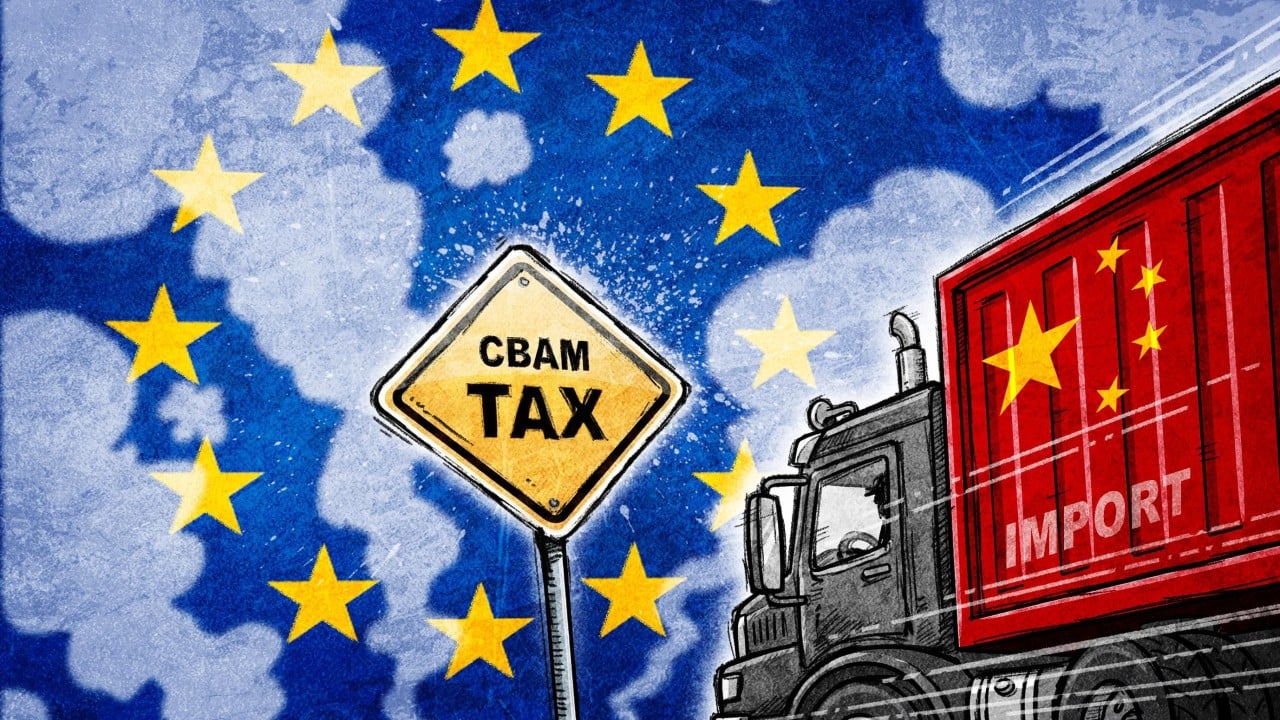
Western media is weeping for Chinese steel executives.
Open any mainstream financial publication and you will find the same lazy, regurgitated narrative: the European Union’s Carbon Border Adjustment Mechanism (CBAM) is an unmitigated disaster for Chinese industry. They call the rules "absurd." They claim Beijing is in a state of sheer panic over bureaucratic havoc. They paint a picture of helpless eastern foundries suffocating under the weight of Brussels’ green tape.
It is a comforting bedtime story for European policymakers. It is also completely wrong.
The consensus view misses the structural reality of global heavy industry. CBAM is not a death sentence for Chinese steel. It is a state-sanctioned weeding-out process that Beijing has desperately wanted to execute for a decade. The trade mechanism does not break China's industrial machine; it accelerates its dominance by crushing inefficient domestic competitors and forcing an upgrade cycle that the West is ill-prepared to match.
The Efficiency Myth and the Real Math of Emissions
The fundamental flaw in the "havoc" narrative lies in treating Chinese steel as a monolith.
Mainstream analysts love to quote average emissions data. They point out that China still relies on coal-fired blast furnaces for roughly 90% of its steel production, compared to Europe’s heavy use of scrap-metal recycling and electric arc furnaces (EAF). They calculate the theoretical tariff penalty, gasp at the billions of dollars in projected costs, and declare the trade route dead.
This is spreadsheet journalism at its worst.
Global trade does not operate on averages. It operates on margins. China’s top-tier producers—like China Baowu Steel Group and Hesteel—are not average. I have watched western consultants spend millions trying to benchmark Chinese production costs using outdated models from the early 2010s. They consistently underestimate the sheer speed of capital deployment in Hebei and Jiangsu.
Consider the mechanical reality of CBAM. The tariff calculates the embedded emissions of imported goods, charging a fee equivalent to the EU’s internal carbon price under its Emissions Trading System (ETS).
If you are a bloated, third-tier foundry running an un-optimized blast furnace in a landlocked province, yes, you are locked out of Europe. But you were never exporting to Europe anyway. The mills servicing the premium EU market are highly sophisticated operations. They are already diverting their cleanest production lines to export contracts while shifting higher-carbon output to domestic infrastructure or less regulated markets in Southeast Asia and Africa.
This is basic resource shuffling. It requires no technological miracles, just a clever accounting ledger.
Dismantling the Victim Narrative
Let us address the questions currently circulating in industry forums, which are built on entirely false premises.
Does CBAM destroy the competitiveness of Chinese exports?
No. It establishes a dual-track market where premium, low-carbon Chinese steel captures the high-margin European sector while the rest of the world absorbs the traditional output. Western buyers think they are forcing China to pay a penalty. In reality, they are guaranteeing that the only Chinese steel entering Europe is high-end, technologically superior material that challenges local EU mills on quality, not just price.
Will the tariff force China to scrap its blast furnaces?
Eventually, but on Beijing’s timeline, not Brussels’. China is already building massive EAF capacity and investing heavily in hydrogen-metallurgy pilots. Baowu's project in Xinjiang is a prime example. The EU tariff merely provides the external pressure Beijing needs to kill off zombie state-owned enterprises that have resisted consolidation for years.
The Hidden Weapon: Data Control and Verification Wars
The real battlefield of CBAM is not carbon; it is data. This is where the competitor narratives completely lose the plot. They focus on the logistical nightmare of tracking emissions from the iron ore mine to the port. They label the EU data collection requirements "absurd" and "unworkable."
They fail to understand that data friction is a two-way street.
The European Commission expects foreign entities to hand over granular, verifiable data regarding their energy consumption, supply chains, and production methodologies. For a Chinese steel mill, this is not just a compliance headache; it is a national security concern. Beijing is highly protective of its industrial data.
[EU Compliance Demands] ---> Intersects with ---> [China Data Security Laws]
                                                    |
                                                    v
                                    The Deadlock: Western auditors
                                    denied access to Chinese factory floors.
The true friction point is an incoming geopolitical gridlock over third-party verification. The EU requires independent verifiers to validate emissions data. China possesses strict data security laws that heavily restrict foreign firms from auditing domestic industrial systems.
I have seen compliance projects stall for months because European auditors were legally barred from accessing the very software platforms required to prove emissions reductions.
This deadlock does not hurt China. It freezes the European supply chain. When EU manufacturers realize they cannot source critical high-grade steel components because the verification process is stuck in a bureaucratic standoff between Brussels and Beijing, inflation wins. The tariff backfires, driving up costs for European automotive and aerospace companies while Chinese producers simply redirect their focus.
Why the West is Unprepared for the Backlash
Europe believes it holds the moral and economic high ground. The prevailing assumption is that the EU market is too lucrative to lose, so foreign producers will naturally bend to its rules.
This view ignores the downside of the contrarian reality: Europe is deindustrializing itself while China automates.
While European steelmakers struggle with high natural gas prices, regulatory uncertainty, and agonizingly slow permitting processes for new green infrastructure, their Chinese counterparts operate under a centralized mandate. If Beijing decides a region needs a green hydrogen pipeline for steel manufacturing, that pipeline is built in months, not decades.
By creating a trade barrier based purely on carbon metrics, the EU has laid down a challenge that plays directly into China's industrial strengths: scale, speed of capital deployment, and supply chain integration.
Imagine a scenario where the EU succeeds in pricing out traditional Chinese steel completely. European domestic production cannot scale fast enough to fill the void at a competitive price point. The result? A massive surge in imports from secondary countries like India or Vietnam—countries that often purchase crude Chinese steel slabs, process them slightly, and export the finished product to Europe.
The carbon footprint remains identical or increases due to transportation logistics, but the paperwork looks clean. The EU achieves a paper victory while its industrial base bleeds capital.
The Ultimate Irony of Green Protectionism
The ultimate flaw in the consensus viewpoint is the belief that protectionism protects the protector.
CBAM is designed to prevent "carbon leakage"—the relocation of production to countries with lax climate policies. But protectionism breeds complacency. By shielding domestic EU steel producers behind a tariff wall, Europe reduces the immediate, brutal market pressure required to force genuine technological breakthroughs.
Meanwhile, Chinese mills are forced into a crucible. They must innovate, optimize, and streamline their operations to maintain access to premium global markets. They are learning to navigate complex carbon accounting systems, upgrading their furnace efficiency, and locking down green energy contracts at a scale that dwarfs anything happening in the West.
The tariff is a catalyst. It accelerates the stratification of global manufacturing. It separates the agile, well-capitalized mega-mills from the stagnant players.
When the dust settles, the European market will not be free of Chinese steel. It will be dependent on a highly refined, low-carbon variant of Chinese steel that European mills cannot produce at the same volume or price point. Brussels thinks it built a moat to keep foreign competitors out. Instead, it built a training ground that will produce the most formidable, carbon-efficient industrial giants the world has ever seen.
Stop looking at the quarterly compliance costs. Look at the structural realignment. The EU tariff is not a roadblock for China; it is a blueprint for its next phase of industrial dominance.