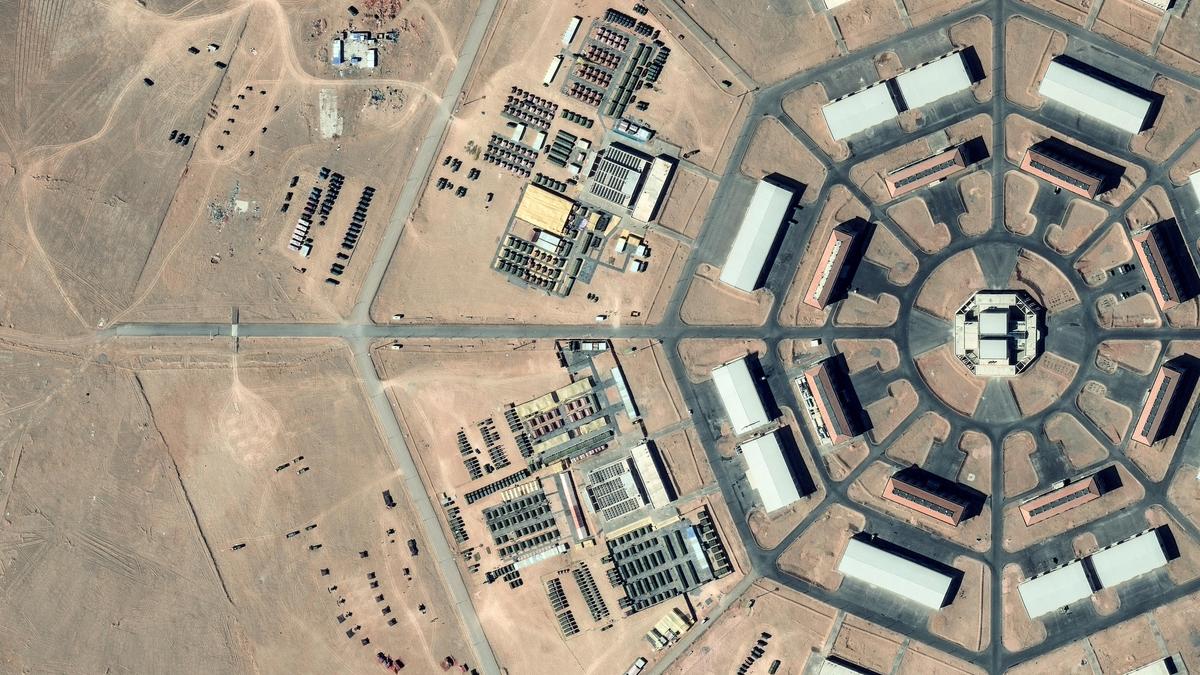
Think China relies solely on underground silos to protect its nuclear deterrence? Think again. Beijing is currently rewriting the rules of strategic defense in its remote northwestern desert. Satellite imagery has exposed a massive, unpredicted military buildup surrounding the country's most isolated intercontinental ballistic missile fields. This isn't just about digging more holes in the ground. It's a calculated effort to ensure that no foreign first strike can disable Beijing's ability to retaliate.
Recent intelligence reports show that China is constructing a massive web of over 80 concrete launch pads, hardened bunkers, airfields, and command facilities right next to its primary nuclear missile silo fields in Hami, Xinjiang. This infrastructure spans thousands of square kilometers of barren terrain. It is designed to solve a fatal flaw in land-based nuclear strategy: static targets are easy to kill. By surrounding permanent silos with highly mobile support structures, Beijing is forcing military planners in Washington to second-guess their targeting math.
Decoding the Octagons in the Xinjiang Desert
At the heart of this newly discovered network are two massive, octagon-shaped military installations built over the last six years. These aren't temporary outposts. One sits roughly 140 kilometers southwest of the Hami silo fields, while the second is positioned about 230 kilometers away. Satellite images show both complexes feature heavily fortified storage areas, personnel housing, and specialized bays built for oversized military vehicles.
What makes these octagons highly dangerous is how they connect to the surrounding landscape. A web of dirt roads and underground conduits radiates outward from the central hubs, leading to dozens of reinforced concrete pads tucked away in rocky outcrops and dry creekbeds. Experts from the Federation of American Scientists note that these conduits likely carry fiber-optic communication lines. This allows the central command to talk to deployed units without using radio frequencies that Western electronic intelligence satellites can intercept.
The scale has stunned seasoned defense analysts. Hans Kristensen, director of the Nuclear Information Project at the Federation of American Scientists, called the project an extraordinary effort, noting he has never seen anything quite like it. This construction changes the tactical equation. It provides a highly resilient, distributed web where mobile launchers can hide, sprint, and fire.
The Illusion of the Sitting Duck Silo
For decades, the standard critique of silo-based ICBMs was simple. They are targets. Since their coordinates are known to the meter, an adversary could theoretically wipe them out in a surprise pre-emptive strike. China knows this. The Hami, Yumen, and Jilantai silo fields represent the core of the land-based People's Liberation Army Rocket Force, housing long-range missiles capable of hitting any major city in the United States.
To protect these assets, China relies on a multi-layered defense strategy rather than just thick concrete doors.
- Early Warning Systems: China's Huoyan-1 satellite network can detect an adversary's ICBM launch within 90 seconds. Warning data reaches command centers in under four minutes, giving Beijing a razor-thin window to launch a retaliatory strike before enemy warheads impact.
- Mobile Air Defense: The newly discovered desert launch pads are perfect positions for long-range surface-to-air missile batteries like the HQ-9 or Russian-made S-400 systems to intercept incoming warheads or bomber aircraft.
- Electronic Warfare Nodes: Many of the 80 concrete pads are slated to hold mobile jamming units designed to disrupt GPS tracking, radar guidance systems, and military satellite communication during an attack.
- The Shell Game: Some of the larger concrete pads can support road-mobile ICBM launchers like the DF-41. This creates a shell game where an attacker cannot be sure if a nuclear weapon is sitting inside a fixed silo or rolling between dozens of hidden desert pads.
How Beijing Distances Itself from US and Russian Doctrines
The United States and Russia still possess far larger nuclear stockpiles, but their defense philosophy is fundamentally different. Washington and Moscow rely on sheer numbers, geographic isolation, and heavily reinforced concrete structures to keep their land-based nuclear legs survivable. They accept that silos are fixed targets and build their strategies around the certainty that enough missiles will survive or that submarines will deliver the true second strike.
China is taking a different route. Beijing maintains a strict "no first use" policy, meaning its entire strategy hinges on surviving a nuclear strike and firing back. Because its arsenal is smaller—the Pentagon estimates China will field roughly 1,000 warheads by 2030—every single missile matters.
Nuclear Defense Strategies Compared:
- United States: Massive volume, hardened fixed silos, early warning systems.
- Russia: Large numbers, heavy reliance on rail-mobile and road-mobile ICBMs nationwide.
- China: Hybrid approach pairing fixed silo fields with regional, highly fortified mobile launch webs.
By surrounding its silo fields with a dense, protected network of mobile launch pads, China is building an active defense zone. They are making the airspace and terrain around their nuclear assets incredibly lethal to approach and nearly impossible to target effectively.
What the Desert Buildup Means for Global Security
This massive infrastructure project shows that the nuclear competition between global powers is moving away from basic warhead counts and toward survivability. It isn't enough to have the bomb. You have to prove you can use it after taking a hit. Recent military exercises captured by satellites in April and May around the northern octagon facility confirm that the Chinese military is actively training to operate large vehicles and mobile systems under camo nets and temporary tents in these exact desert sectors.
For defense analysts and policy makers, the message written into the Xinjiang desert is clear. Beijing is systematically eliminating the vulnerability of its land-based nuclear forces. This complicates the strategic calculus for any adversary attempting to enforce a deterrence framework through conventional or nuclear intimidation.
The next step for military intelligence agencies is tracking the deployment of specific hardware to these 80 desert pads. Watch for the arrival of long-range air defense units and electronic warfare vehicles at the Hami perimeter. That movement will signal that China's active defense shield is fully operational.
For an analyst's visual breakdown of how these remote desert networks are identified and mapped via satellite, take a look at this intelligence summary outlining the China Desert Launch Pad Network.