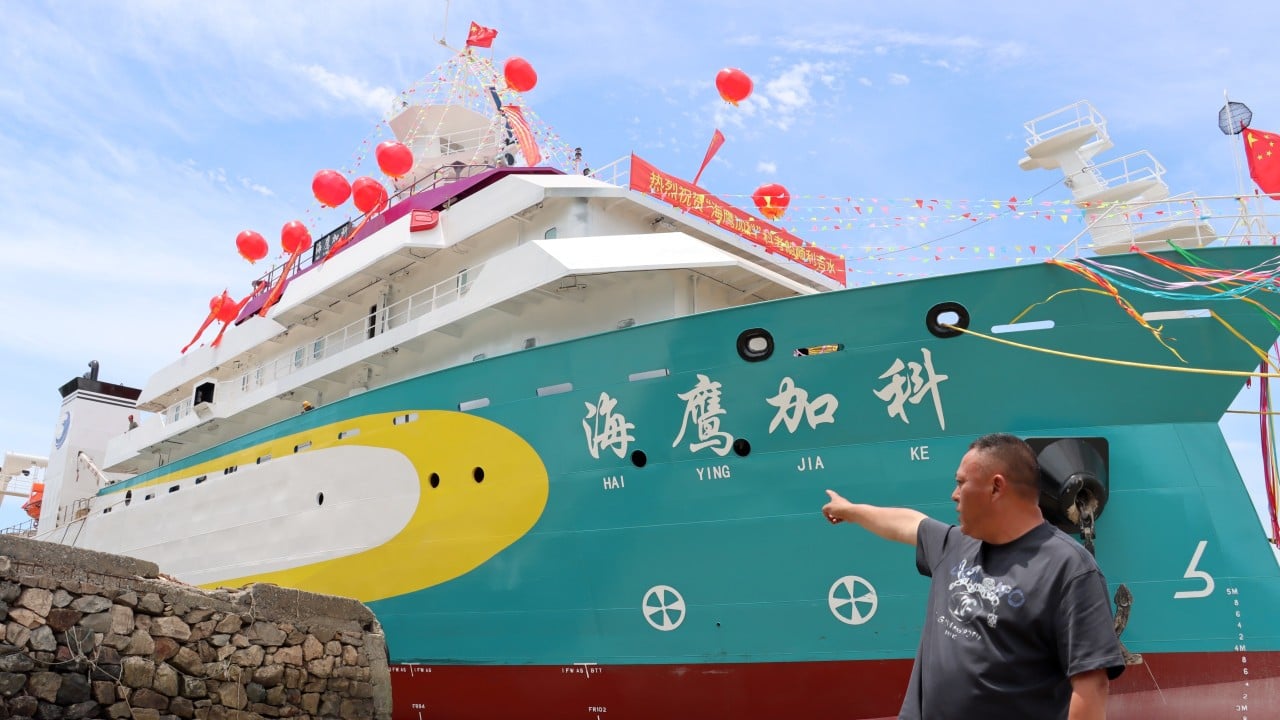
The maritime press is currently obsessed with a ghost ship. Specifically, the Dong Fang Hong 3 and similar high-profile, privately funded Chinese research vessels that are supposedly sitting idle, bleeding cash, and failing to secure commercial charters. Mainstream analysts look at the empty order books for China’s first wave of privately owned oceanographic hulls and see a massive miscalculation. They point to high daily operational costs, a lack of international trust, and stiff competition from state-backed institutional fleets as proof that private scientific vessels are a dead end.
They are asking the wrong question. They want to know why no one is chartering these ships. They should be asking who these ships were actually built to serve.
The lazy consensus assumes that a commercial vessel's success is measured by traditional utilization rates and open-market charter revenue. In the world of high-stakes marine technology and dual-use infrastructure, that assumption is not just naive—it is completely wrong. These vessels are not failing to find a market. They are waiting for their true market to mature.
The False Premise of the Stranded Asset
Standard maritime analysis treats a private research vessel like a dry bulk carrier or a cruise ship: if the transponders show it sitting at a pier in Qingdao or Zhoushan for six months, the asset is deemed a failure. This view ignores the fundamental mechanics of how speculative capital operates in state-directed economies.
When a private entity in China builds a complex, acoustically quiet research vessel packed with multi-beam echo sounders, deep-sea winches, and modular lab spaces, they are not chasing the meager budgets of university marine biology departments. They are playing a longer, much more lucrative game.
I have spent years analyzing maritime supply chains and watching private operators burn through capital while outsiders mock their business models. The outsiders almost always miss the pivot. In this sector, building the hardware before the regulatory or state framework explicitly demands it is a proven method to capture massive state contracts down the line. The ship is not a stranded asset. It is an unexercised call option on national marine infrastructure projects.
Dismantling the Charter Market Myth
Let's address the premise that these ships cannot compete with established players like the Schmidt Ocean Institute’s Falkor (too) or the academic fleets run by the National Oceanic and Atmospheric Administration (NOAA). Critics claim that international researchers avoid Chinese private hulls due to data security concerns and geopolitical friction.
That is entirely true, and it completely irrelevant.
The domestic market within East Asia alone represents an astronomical volume of upcoming deep-sea work. Consider the sheer scale of planned offshore wind integration, subsea data cable deployment, and methane hydrate exploration scheduled over the next decade.
- Offshore Wind: Surveying deep-water foundations requires high-resolution sub-bottom profiling that standard survey launches cannot handle.
- Subsea Cables: Routing fiber-optic networks through complex trench topography demands prolonged, high-endurance bathymetric surveying.
- Resource Mapping: Identifying rare earth elements in seabed sediments requires specialized heavy-coring capabilities.
To claim a ship is a failure because Western universities refuse to book it is like claiming a defense contractor is failing because civilians aren't buying fighter jets. The target demographic was never the global academic community.
The Economics of Intentional Idleness
To understand why a private owner is willing to let a sophisticated hull sit idle, you have to look at the underlying financial engineering.
Imagine a scenario where a private logistics firm constructs a $70 million oceanographic vessel using heavily subsidized domestic loans. The interest rates are negligible, and the local government provides tax abatements simply for housing high-tech maritime assets in their port district. The monthly carrying cost of that idle vessel is vastly lower than a Western operator can comprehend.
Furthermore, the operational risk of a bad charter is higher than the financial cost of sitting still. If an operator locks a vessel into a low-rate, multi-year commercial contract for routine hydrographic surveying, they lose the agility required to bid on high-priority state tasks. When a state agency suddenly needs a fleet of auxiliary vessels to map a specific quadrant of the South China Sea or conduct urgent deep-sea mineral surveys, they do not wait for commercial charters to expire. They contract the hulls that are ready to sail tomorrow.
Idleness is not stagnation; it is operational readiness.
The Data Sovereignty Trap
There is a glaring contradiction in how the industry discusses these vessels. On one hand, critics argue that the ships are useless because international clients fear their data will be shared with state authorities. On the other hand, those same critics argue that the ships are purely commercial failures because they cannot secure international clients.
This is a classic blind spot. The data security architecture that scares away a European energy company is precisely what makes the vessel viable for domestic state-adjacent enterprises.
In modern marine operations, data is the ultimate commodity. A privately owned vessel operating under domestic regulatory frameworks can handle sensitive bathymetric mapping that would be legally and logistically impossible for a foreign-flagged or internationally crewed ship. By building vessels that strictly comply with domestic data security mandates, these private owners are locking out international competition from the regional continental shelf. They are creating a localized monopoly by default.
Stop Looking at Cash Flow, Look at Capacity
The real metric to watch is not the quarterly revenue of the vessel owners, but the aggregate civilian tonnage capable of deep-ocean operations.
While Western nations struggle to replace aging research fleets due to bureaucratic procurement cycles and budget fights, private capital in Asia has created a surplus of modern, ice-strengthened, dynamically positioned hulls. These ships feature advanced diesel-electric propulsion systems that reduce hydrodynamic noise, making them ideal platforms for sensitive acoustic arrays.
The downside to this contrarian reality is obvious: for the private investors involved, the short-term financial pain is real. Cash flow is tight, and some smaller players will inevitably go bankrupt or be forced to sell their assets. But in a consolidated market, those hulls do not vanish. They get acquired at a discount by larger, state-backed conglomerates. The capacity remains in the water, ready to be deployed.
The maritime analysts weeping over empty logs are missing the forest for the waves. The first privately owned Chinese research vessels are not a cautionary tale about capital flight or market rejection. They are the advance guard of a massive, privately financed infrastructure play that will dominate regional subsea operations long after the current news cycle is forgotten.
Stop waiting for the charter announcements. Watch the asset transfers.