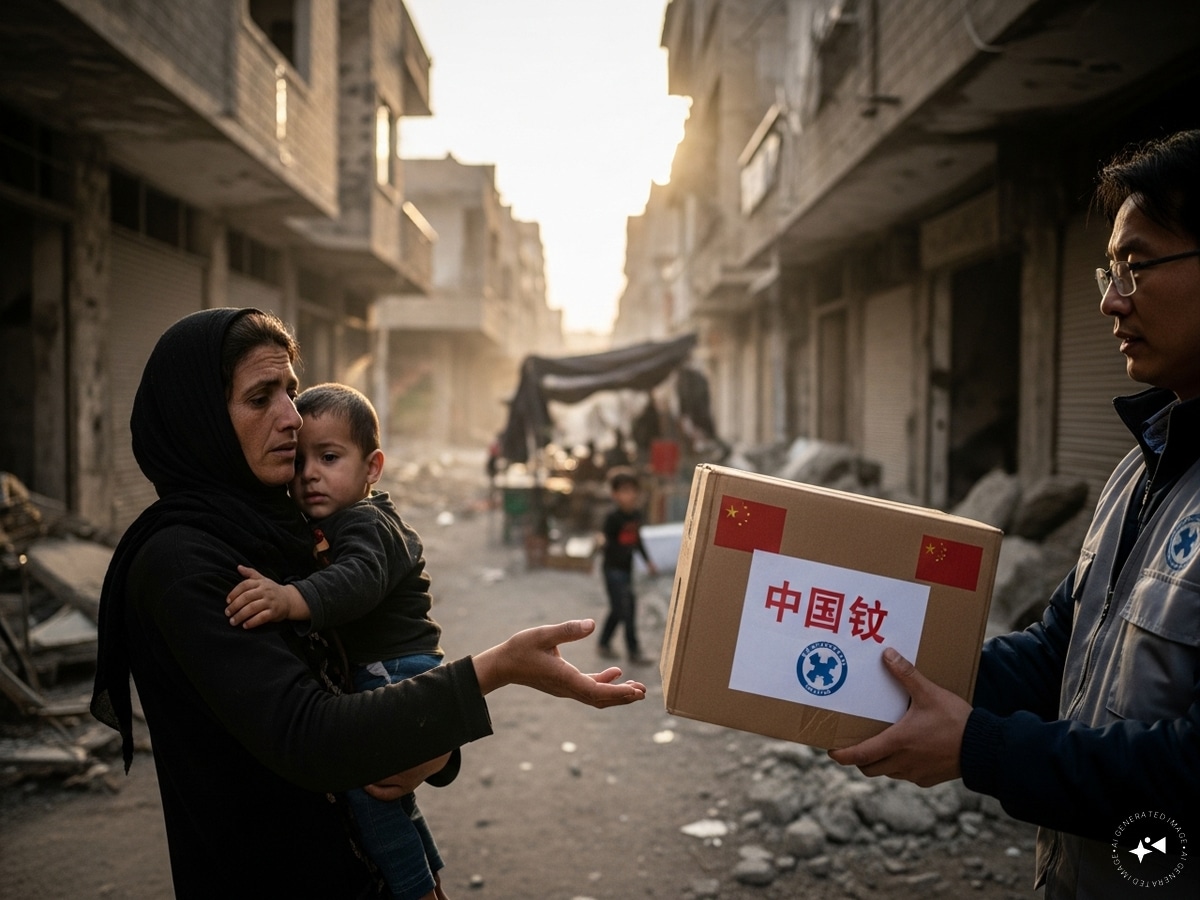
The mainstream press is eating out of Beijing’s hand again. When the headlines announce that China is stepping up to provide "humanitarian aid" to war-hit Iran and Lebanon, the consensus instantly solidifies. Naive commentators paint it as a bid for global moral leadership, an attempt to fill a vacuum left by Western diplomatic gridlock, or a simple act of altruistic diplomacy.
It is none of those things.
Calling China’s recent shipments of medical supplies, tents, and emergency food to Tehran and Beirut "humanitarian aid" is a fundamental misunderstanding of modern geopolitical finance. This is not charity. It is a highly calculated, low-cost capital deployment designed to underwrite infrastructure protection, lock in heavily discounted energy flows, and secure strategic supply lines.
If you view international relations through the lens of pure philanthropy, you are asking the wrong questions. You look at a cargo plane landing in Beirut and ask, "How many people will this feed?"
The real question is: "What asset did Beijing just secure ownership of in exchange for that grain?"
The Mechanics of the Humanitarian Discount
Let’s strip away the diplomatic fluff. In strict economic terms, emergency state-sponsored aid to heavily sanctioned or war-torn regimes functions exactly like distressed-debt investing.
When a nation's economy is on the brink of collapse due to conflict—as is the case with Lebanon’s compounding banking crisis or Iran’s suffocating sanctions regime—the cost of entry for foreign influence plummets. Western capital is restricted by compliance frameworks and secondary sanctions. This leaves the market entirely open to alternative suitors.
Beijing does not operate a traditional foreign assistance model. Western nations routinely pour billions into multilateral organizations like the UN or USAID, often tied to governance metrics or structural adjustment programs that yield zero tangible financial return for the donor state. Beijing’s framework is aggressively transactional.
When China sends emergency shipments to Iran, it is servicing a broader, binding $400 billion, 25-year strategic accord signed in 2021. That agreement guarantees China a steady, heavily discounted supply of Iranian crude oil in exchange for infrastructure development.
When war disrupts those supply chains, Beijing faces a choice: let its strategic partner falter, or inject just enough basic goods to keep the local economy from total systemic failure.
- The Input: A few million dollars worth of medical equipment and staple foods.
- The Output: Preserving a pipeline network that guarantees hundreds of thousands of barrels of oil per day at a fraction of Brent crude market prices.
This is a masterclass in risk management. The financial downside is capped at the cost of a few cargo flights; the upside is the long-term stabilization of a critical, non-Western energy source.
Dismantling the Global Benevolence Narrative
The immediate counter-argument from traditional foreign policy analysts is predictable. They point to official press releases from the China International Development Cooperation Agency (CIDCA) and argue that Beijing is merely trying to project a softer image to the Global South.
This argument ignores the operational reality of how this aid is distributed.
Why the "Soft Power" Argument Fails
True soft power relies on cultural alignment, institutional trust, and grassroots goodwill. China’s aid delivery mechanisms deliberately bypass civilian civil society organizations. Instead, shipments are routed directly through state apparatuses or ruling factions.
In Lebanon, aid does not filter down through independent NGOs working on the ground in Beirut. It goes straight to state ministries, where it is used by entrenched political actors to shore up their own domestic legitimacy.
This is not about winning the hearts and minds of the local population. It is about buying the absolute loyalty of the political elites who control the infrastructure.
The Infrastructure Playbook
Consider the port of Tripoli in northern Lebanon. For years, Chinese state-owned enterprises have quietly expressed interest in expanding and managing this facility as an alternative eastern Mediterranean hub.
When a country is hit by conflict, its infrastructure value drops on paper, but its strategic location remains unchanged. By positioning itself as the sole reliable provider of emergency relief during a crisis, Beijing builds the necessary political leverage to ensure that when reconstruction contracts are eventually handed out, Chinese firms sit at the front of the line.
I have watched state planners use this exact blueprint for a decade across sub-Saharan Africa and Central Asia. You throw a lifeline to a government during its darkest hour, and five years later, you walk away with a 99-year lease on a deep-water port or a strategic railway line. It is a highly effective, deeply cynical, and incredibly successful strategy.
The True Cost of "No Strings Attached" Capital
The primary selling point of Chinese aid to governments in the Middle East is that it comes with "no strings attached." Unlike the World Bank or the International Monetary Fund, Beijing does not demand fiscal austerity, anti-corruption overhauls, or currency devaluations.
But there is no such thing as free capital. The strings are simply financial and geopolitical, rather than regulatory.
+------------------------------------+------------------------------------+
| Western Foreign Assistance Model   | Chinese Strategic Relief Model     |
+------------------------------------+------------------------------------+
| Tied to governance reforms, IMF    | Disbursed directly to state elites |
| compliance, and institutional text | with zero domestic policy mandates |
+------------------------------------+------------------------------------+
| High administrative overhead via   | Low overhead, rapid physical       |
| multilateral NGO networks          | delivery of goods and materials    |
+------------------------------------+------------------------------------+
| Goal: Systemic integration into    | Goal: Resource securing and        |
| the global financial order         | infrastructure equity acquisition  |
+------------------------------------+------------------------------------+
When you accept emergency relief under these terms, you are trading your long-term economic autonomy for short-term political survival.
For Iran, relying on Beijing as its primary economic and humanitarian backstop means locking itself into a monopsony. China becomes the only major buyer of its oil and the only major supplier of its industrial goods. This completely strips Tehran of any bargaining power, forcing it to accept whatever price Beijing dictates for its natural resources.
For Lebanon, it means further alienation from Western capital markets and Gulf Arab investors, ensuring that the country remains permanently dependent on alternative financial networks.
The Flawed Premise of Western Alarmism
Every time a shipment of Chinese aid lands in the Middle East, Western think tanks trigger a wave of panic. They warn of a complete displacement of Western influence and the rise of a new axis of power.
This alarmism is just as flawed as the humanitarian narrative. It assumes that Beijing wants to assume full responsibility for the security and stability of the Middle East.
It does not.
The United States has spent trillions of dollars over the last three decades attempting to police the region, enforce political outcomes, and underwrite regional security. The return on that investment has been disastrous.
Beijing has zero intention of repeating that mistake. Its foreign policy is explicitly built around avoiding direct security entanglements.
By providing just enough humanitarian aid to keep these regimes functional, China keeps the regional balance of power destabilized enough to tie up Western military and diplomatic resources, while avoiding the massive financial and human costs of direct intervention.
It is the ultimate geopolitical free-rider strategy. The US pays the immense cost of keeping global sea lanes open and patrolling international waters, while China uses those same sea lanes to ship aid, secure energy, and build commercial monopolies.
Stop Misreading the Board
If you want to understand the modern Middle East, you need to stop reading the humanitarian press releases and start tracking the commodity flows.
China is not acting out of malice, nor is it acting out of mercy. It is acting out of a cold, calculated need to fuel its own domestic economy and secure its borders.
The shipments of flour and medicine arriving in Tehran and Beirut are not signs of global leadership. They are the premium payments on a geopolitical insurance policy designed to keep cheap oil flowing east and Western policy makers permanently distracted.
The next time you see a headline about Beijing’s generosity in a war zone, look past the pallets of blankets. Look for the oil tankers, the port leases, and the mineral rights being signed away in the back room while the cameras are focused on the cargo bay.