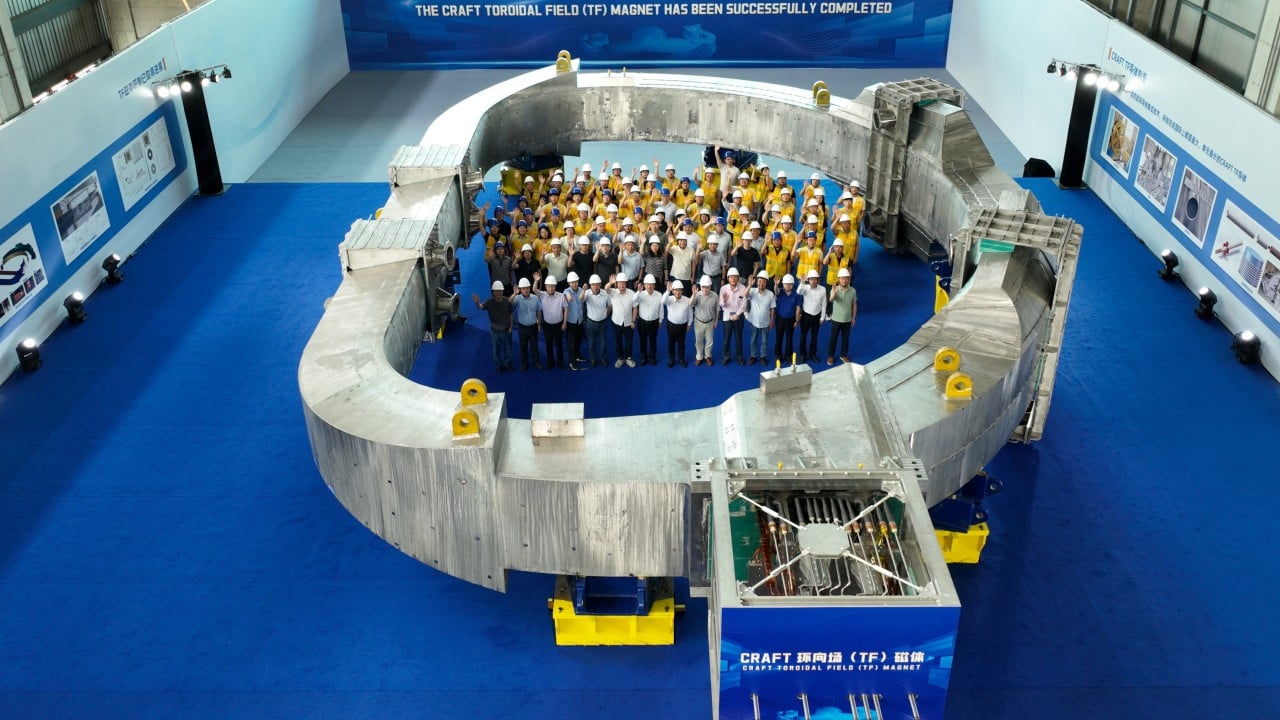
The global media is currently swooning over China’s latest engineering milestone: firing up the world’s largest superconducting magnet for a next-generation nuclear fusion project. The headlines read like science fiction triumphs. They promise limitless, clean energy just around the corner, wrapped in a neat package of geopolitical dominance.
It is a beautiful narrative. It is also fundamentally flawed.
Having spent nearly two decades tracking the economics of high-energy physics and watching public consortia burn through billions of dollars of taxpayer capital, I can tell you exactly what this milestone actually represents. It is not a breakthrough in commercial power generation. It is a brilliant, expensive distraction from the harsh engineering realities that make tokamak-style fusion an improbable candidate for the grid in our lifetimes.
The industry has succumbed to a lazy consensus: bigger magnets equal faster paths to commercial fusion. This size-obsessed mentality is actively holding the energy sector back.
The High Field Trap: Size Is a Liability, Not an Asset
The conventional wisdom driving projects like China's Comprehensive Research Facility for Fusion Technology (CRAFT) or the multi-billion-dollar ITER project in France is rooted in a basic scaling law. To confine a plasma hot enough to force hydrogen isotopes to fuse, you need an exceptionally strong magnetic field. The traditional way to get a stronger field has been simple: build a massive, low-temperature superconducting coil, wrap it in a structural matrix the size of an apartment building, and cool it down to near absolute zero using liquid helium.
This approach misses the entire point of commercial scalability.
When you scale a tokamak up to these gargantuan dimensions, you aren't just building a magnet. You are building a thermodynamic nightmare. Consider the structural realities that mainstream coverage conveniently ignores:
- The Stress Threshold: The mechanical forces inside these mega-magnets—specifically the Lorentz force, which tries to rip the magnet apart from the inside out—scale quadratically with the magnetic field strength. When you build a magnet of this size, you require thousands of tons of high-strength structural steel just to keep the machine from self-destructing.
- The Helium Bottleneck: These massive systems rely on liquid helium cooling down to 4.2 Kelvin. Helium is a finite, volatile, and increasingly expensive resource. A grid-scale energy strategy cannot depend on elements that escape Earth's atmosphere the moment a valve leaks.
- Thermal Inertia: Firing up a magnet of this scale takes weeks of precise, agonizingly slow cooling and charging. If the magnet experiences a "quench"—a sudden, catastrophic loss of superconductivity—the thermal stresses can permanently warp the internal structure.
In physics labs, building the "biggest" machine wins you grants and prestige. In industrial energy infrastructure, building the biggest machine wins you an un-maintainable white elephant.
The Net Energy Lie: Q-Plasma vs. Q-Engineering
The public is routinely misled by the term "net energy gain," or $Q$. When a fusion project announces it is chasing a $Q$ greater than 10, the average reader assumes the plant will spit out ten times more electricity than it pulls from the grid.
It won't.
There is a massive, deceptive gulf between scientific net energy ($Q_{plasma}$) and engineering net energy ($Q_{engineering}$).
$$\text{Q}_{\text{plasma}} = \frac{\text{Power out of the plasma}}{\text{Power heating the plasma}}$$
This is the metric labs use to claim victory. They measure the thermal energy produced by the fusion reaction itself and compare it solely to the microwave or laser beams injected directly into the core.
What they leave out of the headline is the input power required to run the massive cryogenic plants cooling the world's biggest superconducting magnets, the power to drive the vacuum pumps, the efficiency losses of turning grid electricity into heating beams, and the subsequent efficiency losses of converting high-energy neutrons back into electricity via steam turbines.
To achieve a true, commercially viable $Q_{engineering}$ greater than 1, where the entire facility puts more juice into the grid than it consumes, the internal $Q_{plasma}$ doesn't just need to be 1 or 2. It needs to be significantly higher than 30.
Building a larger magnet using legacy low-temperature superconductor technology marginally improves plasma confinement, but it exponentially increases the auxiliary power required to keep the facility alive. You are running faster on a treadmill that is accelerating even quicker.
The Materials Wall Nobody Wants to Talk About
Let's engage in a thought experiment. Imagine a scenario where China, or the United States, or any private venture successfully solves the plasma confinement problem tomorrow using these mega-magnets. The plasma is stable, burning bright, and producing high-energy neutrons.
Your reactor is still dead in the water.
The fundamental bottleneck of nuclear fusion is no longer a physics problem; it is a material science problem. The D-T (deuterium-tritium) reaction favored by these large tokamaks releases 80% of its energy in the form of highly destructive, 14.1 MeV neutrons.
There is currently no material on Earth capable of withstanding that level of continuous neutron bombardment without degrading rapidly. These neutrons don't just make the structural walls of the reactor radioactive; they literally displace atoms within the crystalline lattice of the steel, causing the metal to become brittle, swell, and crack within months of operation.
A commercial power plant cannot afford to shut down every six months to completely replace its highly radioactive inner vacuum vessel. The financial math crumbles the moment you factor in the operational downtime and robotic maintenance costs. Chasing record-breaking magnets allows institutions to claim progress while safely kicking the unsolvable materials science can down the road.
The Better, Cynical Alternative: Small and High-Temperature
If the goal is actually commercial power—and not nationalistic chest-thumping—the strategy must pivot away from scale.
The real path forward lies in high-temperature superconductors (HTS), specifically Rare-Earth Barium Copper Oxide (REBCO) tapes. These materials superconduct at liquid nitrogen temperatures (77 Kelvin) instead of liquid helium temperatures, and they can handle vastly higher magnetic fields in a fraction of the physical footprint.
Because magnetic confinement scales to the fourth power of the magnetic field strength ($B^4$), doubling the field strength means you can make the reactor sixteen times smaller while achieving the exact same plasma performance.
| Attribute | Legacy Low-Temp Megaprojects | Next-Gen Compact HTS Units |
|---|---|---|
| Cooling Medium | Liquid Helium (4.2K) - Scarce | Liquid Nitrogen (77K) - Abundant |
| Physical Footprint | Size of a football stadium | Size of a large garage |
| Capital Risk | Multi-billion dollar, single-point failure | Modest millions, rapid iteration |
| Maintenance | Decades-long lifecycles, static tech | Modular cores, easily swappable |
The downside to this contrarian path? It doesn't yield grandiose headlines about building the "world's largest" anything. It requires admitting that twenty years of legacy tokamak design has led us down a blind alley of scale. It requires private companies and state enterprises to abandon their massive, sunk-cost infrastructures and start small.
Stop Asking When Fusion Will Power Our Homes
The public regularly asks: "When will fusion finally get here?"
It is the wrong question. The right question is: "Even if it works, can it ever compete with a solar panel, a wind turbine, or a standard fission reactor?"
The answer, based on our current trajectory of building hyper-complex, mega-scale machines, is a resounding no. A power plant that requires the world's most complex cryogenic infrastructure, unprecedented structural engineering, exotic fuels like tritium that must be bred inside the reactor walls, and frequent replacement of highly radioactive components will never deliver cheap electricity. It will be the most expensive way to boil water ever devised by humanity.
Stop celebrating the raw size of these superconducting magnets. Massive scale is not a sign of a technology maturing; it is the final, desperate gasp of an inefficient design paradigm trying to brute-force a solution to a problem that requires an elegant, compact rethink.
Stop building bigger magnets. Start building smarter architectures.