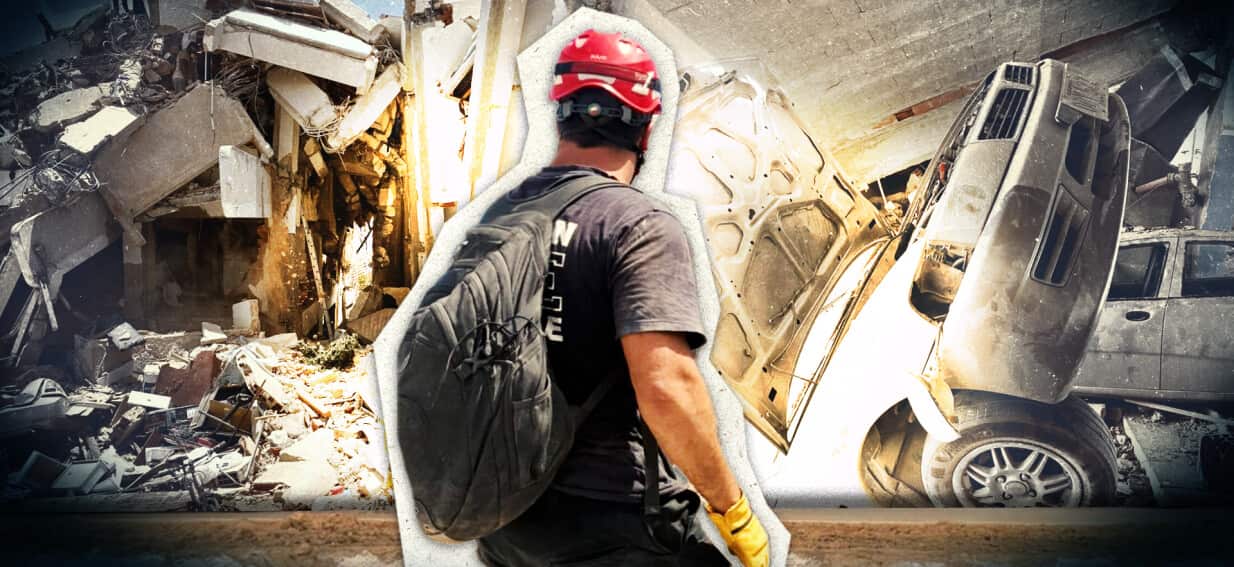
Dropping everything to fly into a disaster zone with no local contacts, zero Spanish, and a suitcase full of specialized gear sounds like a movie plot. For Craig De Meillon, a 43-year-old Gold Coast native and volunteer firefighter, it's just a regular Friday. While most Australians were settling in to watch the Socceroos play Paraguay, De Meillon was messaging his boss in Miami, Florida, asking for sudden leave to head straight into the wreckage of northern Venezuela.
Twin earthquakes struck the country on Thursday, June 25, 2026. Within a minute, back-to-back tremors of magnitude 7.2 and 7.5 flattened entire blocks along the coast. The official death toll has already climbed past 1,450. More than 50,000 people are officially missing. The United Nations warns that 6.8 million people are directly impacted, with total damages already pegged at 6.7 billion dollars.
In the middle of this devastation sits La Guaira, the hardest-hit state. It's hot, chaotic, and dangerously unorganized. For self-funded independent rescuers like De Meillon, navigating this space means bypassing bureaucratic red tape, managing extreme heat, and racing against a ticking clock that stops for no one.
The Myth of the Uniformly Organized Rescue
When a massive disaster hits the news, people imagine a highly coordinated, frictionless arrival of international aid. The reality on the ground is a mess.
Venezuela was already buckled under years of economic hardship and political friction. When the ground roared, the local infrastructure shattered completely. The government quickly restricted access to La Guaira state and deployed the military, establishing a mandatory safe-entry pass system for volunteers.
That single bureaucratic decision created an immediate bottleneck. While thousands of people are entombed in concrete, local volunteers like 27-year-old Carlos Itriago are stuck standing in lines outside concert halls since dawn just to get a permit to save lives. Minutes matter. The first 72 hours are the golden window where trapped victims can survive without water. After that, search operations quickly pivot to a grim body recovery mission.
De Meillon bypassed the standard bureaucratic delays simply by being a solo operator. He doesn't travel with an 80-person contingent or 70,000 pounds of heavy machinery like the elite squads deployed from Los Angeles County or Fairfax County, Virginia. He relies on speed.
"I'm kind of, like, special in the sense that I'll just get there sooner than most people can move," De Meillon said from Caraballeda, the worst-affected zone in La Guaira. "I just kind of dropped everything and got on a flight."
What it Takes to Clear Rubble by Hand
Heavy international rescue teams bring ground-penetrating radar, acoustic listening devices, and trained search canines. But in the first 48 hours of the Venezuela crisis, the heavy lifting was done by locals using shovels, iron bars, and bare hands.
Civilians are digging through flattened apartment complexes out of sheer desperation. In one collapsed building, a local resident named Cedeño clawed through debris looking for his parents and brother. His brother had run back inside the shaking structure to save their parents, only for the building to pancake down on top of them. At least 25 other neighbors remain trapped under that single mound of concrete.
Solo disaster specialists fill the massive void between frantic civilians and massive government teams that take days to deploy. De Meillon brings a decade of disaster relief experience to the table, marking his fourth major earthquake deployment. That experience dictates what works when you don't have heavy excavators:
- Listen through the pipes: Rescuers use hollow metal tubes or existing plumbing lines as makeshift megaphones, yelling down into the gaps of collapsed slabs to listen for faint knocking or cries.
- Identify structural voids: Knowing how buildings pancake allows a rescuer to find survival pockets—spaces under reinforced concrete beams or stairwells where people are most likely to still be breathing.
- Rationing physical energy: The coastal heat in La Guaira is punishing. Independent operators must pace themselves because a dehydrated, heat-exhausted rescuer becomes another liability for an already overwhelmed system.
Despite the chaos, small miracles are keeping the operation alive. On Saturday night, acting President Delcy Rodríguez confirmed that an 11-year-old boy was successfully pulled alive from the rubble in Caraballeda. Just a day earlier, locals in La Guaira managed to extract an infant from a wrecked building. These survival stories are what keep volunteer teams digging even as the 72-hour window slams shut.
The Massive Logistics Behind the Scenes
While independent operators scramble through the immediate wreckage, massive international logistics are finally catching up. The international response has turned the coast of Venezuela into a staging ground for global emergency tactics.
- Airfields and Naval Support: The US military cleared and partially opened one runway at Simon Bolivar International Airport to receive massive C-17 transport planes. Off the coast, a US Navy transport ship has docked, functioning as a floating hospital ready to receive airlifted survivors who need immediate trauma surgery.
- Global Teams on the Dirt: Specialized squads from France, Mexico, Brazil, El Salvador, Turkey, and the UK have arrived. The Fairfax County team from Virginia alone brought 79 rescue workers and six trained dogs to systematically comb through the high-density ruins.
- Community Aid Pipelines: In South Florida, home to a massive Venezuelan diaspora, miles of cars have spent days dropping off food, medical supplies, and sanitation gear. The Global Empowerment Mission has already processed over half a million dollars in supplies to ship directly to the coastal zones.
The immediate crisis is shifting into a long-term humanitarian disaster. The local mortuaries in Caracas are completely overwhelmed, and the UN estimates that nearly 6.76 million people now require emergency shelter, clean water, and basic medical care.
If you want to support the ongoing rescue and relief operations in Venezuela, do not try to travel to the region independently unless you are a certified disaster professional with pre-arranged logistics. The best way to assist right now is by directing financial support or supply donations to established groups like the Global Empowerment Mission or the International Federation of Red Cross and Red Crescent Societies, who are managing the direct distribution of water filtration systems and trauma supplies on the ground.
:max_bytes(150000):strip_icc()/parts-of-a-swamp-cooler-2718628-a477e6f0787b4f8bb62ddf2def31d495.png)
