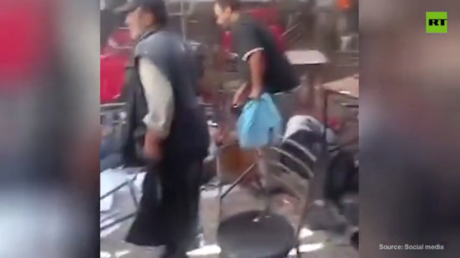
The ground split twice, and a broken nation shattered completely. When the 7.2 and 7.5 magnitude seismic doublet tore through northern Venezuela on June 24, it did not just collapse concrete. It exposed the deep structural rot of an economy already hollowed out by a decade of political gridlock and infrastructure neglect. While official government tallies now place the death toll at 2,295 with more than 11,000 injured, the numbers on the ground tell an even more harrowing story of isolation, makeshift rescue operations, and a desperate race against time. Private aid groups like Operation Blessing are scrambling to feed thousands of survivors huddled in temporary camps, but their efforts face an uphill battle against a logistically paralyzed state apparatus.
The immediate reality is grim. Over 58,000 buildings are damaged or entirely destroyed according to rapid satellite assessments conducted by NASA. In towns balanced precariously between the coastal mountains and the Caribbean Sea, entire neighborhoods have slid into the valleys. Emergency personnel have pulled over 6,400 people from the debris, but as the days press on, the focus is shifting from rescue to mass survival. The UN is already quietly procuring 10,000 body bags, signaling that the worst data has yet to be formally read aloud from the press podiums in Caracas.
The Anatomy of a Seismic Doublet
Earthquakes do not always travel alone. A seismic doublet occurs when two major structural shifts happen close together in both time and space, with the second rupture triggered by the stress alterations of the first. This was not a standard sequence of a mainshock and minor aftershocks.
The first 7.2 tremor destabilized the fault lines running along the northern coast. Within minutes, the 7.5 magnitude monster struck, catching thousands of citizens who had just rushed back into their homes to gather belongings or check on loved ones. The double shock wave liquefied weak soils along the coastal strip of La Guaira and hammered the aging concrete high-rises of Caracas.
Structural engineering standards explain why the destruction was so widespread. In a typical earthquake, a building might sustain initial cracking but retain its load-bearing capacity. When the second major shock hits moments later, the compromised pillars have no residual strength. They pancake instantly. This structural failure pattern explains why the initial body count jumped so violently within a 48-hour window as heavy machinery finally began cutting into the dense, multi-layer collapses.
The Ghost of La Guaira
History has a cruel way of repeating itself along the Venezuelan coast. La Guaira, the hardest-hit province in this disaster, is the same region that suffered the catastrophic 1999 mudslides which killed thousands. It is a region built on memory and scar tissue.
Today, the mountain passes connecting Caracas to its primary port are blocked by massive boulders and collapsed highway overpasses. This isolation has turned La Guaira into an island of ruin. In the barrios climbing up the steep hillsides, houses built from unreinforced hollow clay blocks crumbled like dry biscuits.
Local water systems failed within seconds of the first tremor. Without electricity to pump water from subterranean reservoirs, survivors have resorted to collecting runoff from broken sewer mains or waiting in half-mile lines for private water trucks that charge extortionate rates. The government has established 13 temporary camps in La Guaira alone, but these sites lack basic sanitation, raising immediate fears of a cholera outbreak in the tropical heat.
Emergency Feeding and the International Bottleneck
People are starving in the ruins. Faith-based groups and international non-governmental organizations have established mobile kitchens to serve thousands of families who lost everything. They are distributing hot meals, clean drinking water, and basic medical supplies to children who have spent nights sleeping on the bare asphalt of coastal parking lots.
Yet, providing food is only half the battle. Delivering those supplies past bureaucratic checkpoints presents an entirely different obstacle.
The Venezuelan administration has insisted that all aid flow through its centralized digital system, the Patria platform. While official statements claim this ensures equitable distribution, field operators note that it creates a massive bottleneck. Families without working smartphones, electricity, or internet access cannot register for assistance. Consequently, the most vulnerable populations—the elderly trapped in hillside ruins and displaced indigenous families—are effectively invisible to the state's digital net.
The Infrastructure Illusion
The state of Venezuelan infrastructure before the earthquake was already critical. Decades of deferred maintenance on power grids, water networks, and highway systems meant the country possessed zero resilience against a natural disaster of this scale.
Caracas presents a striking contrast of modern architectural ambition and urban decay. The capital city saw eight major temporary camps erected in public squares and parks to house those fleeing compromised high-rises. Many of these structures were built during the oil boom eras of the 1970s and 1980s without modern seismic dampers or flexible joints.
The problem is compounded by a severe shortage of specialized rescue tools. Local fire departments lack thermal imaging cameras, heavy-duty hydraulic cutters, and trained search K9s. Instead, volunteer brigades and neighbors are digging through tonnes of shattered concrete using shovels, iron bars, and bare hands. The 4,000 emergency personnel deployed across the northern states are doing heroic work, but they are fighting a mechanical war with hand tools.
Geopolitical Realities of the Rescue Mission
Disaster response never happens in a political vacuum. While search teams from more than 30 nations have arrived on the ground, the geopolitical friction between Caracas and Western capitals has slowed the integration of heavy international aid.
The government has readily accepted assistance from traditional allies, receiving cargo planes of medical supplies and personnel. However, offers of comprehensive logistical support from Western nations remain tangled in diplomatic red tape. Cargo ships carrying heavy earth-moving machinery and water purification units sit idling in international waters, awaiting formal clearance that is delayed by diplomatic posturing.
This delay has real costs measured in human lives. The golden window for pulling survivors from collapsed buildings closes roughly 72 hours after the initial shock. We are now well past that mark. The sounds of trapped survivors crying out from the darkness have faded, replaced by the grim, mechanical thrum of excavators clearing debris that has transformed from rescue sites into mass graves.
A Systemic Failure of Enforcement
Building codes exist on paper, but they mean nothing without enforcement. Venezuela possesses modern seismic construction guidelines that resemble those used in California or Japan. The issue lies in the vast, unregulated expansion of informal settlements that house over half the population of the capital region.
These informal structures, known locally as ranchos, are built vertically to maximize space on steep hillsides. They lack steel reinforcement bars, proper footings, and engineered drainage systems. When the 7.5 magnitude shock struck, these hillsides turned into rivers of sliding masonry, taking down everything in their path.
Even in wealthier enclaves, building inspections are easily bypassed through informal payments or political connections. Several newly constructed luxury apartment complexes in northern Caracas suffered catastrophic structural failures, exposing how deeply corruption has compromised public safety. The investigation into why these modern buildings collapsed while older structures remained standing will likely take years, but the initial evidence points to substandard concrete mixes and insufficient steel column ties.
The Economics of Recovery
The financial cost of rebuilding northern Venezuela will run into tens of billions of dollars. This is capital that the central bank simply does not possess.
With inflation still a persistent threat and oil revenues constrained by production bottlenecks, the country must rely almost entirely on international loans and humanitarian grants to fund the reconstruction. The government's current plan involves moving displaced families into local hotels and converted public buildings, but this is a temporary band-aid for a permanent wound.
The long-term threat is economic displacement. The port of La Guaira handles a significant portion of the country's containerized imports. With its docks fractured and cranes knocked offline, the supply chain for food, medicine, and industrial goods across the entire nation faces severe disruption. Prices for basic goods in Caracas have already spiked by 40% in the days following the twin quakes, driven by panic buying and the sudden logistical vacuum.
The Long Road Through the Rubble
The 782 aftershocks recorded since June 24 are a constant, terrifying reminder that the earth has not yet settled. Every minor tremor sends crowds running out into the streets, terrified that another major collapse is imminent.
The immediate survival of the population now depends on breaking the aid bottlenecks and allowing independent humanitarian organizations to operate without digital or political restrictions. Food, clean water, and field hospitals must take precedence over political optics. The official narrative from the television screens in Caracas insists that hope remains intact, but for the families digging through the dust of La Guaira, hope is a luxury that has been buried under millions of tonnes of broken stone.