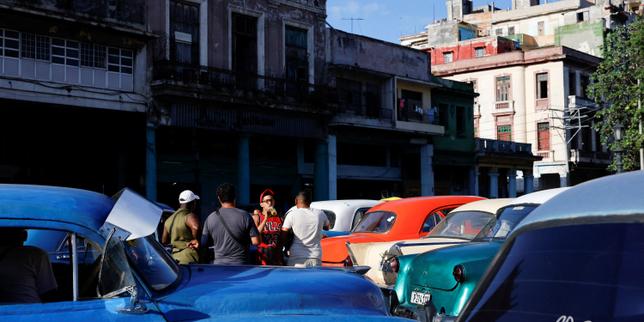
Havana is running out of fuel, time, and options. Decades of economic isolation, compounded by Washington's relentless embargo, have pushed the Cuban government into an unprecedented corner. To survive, the communist regime is doing the unthinkable. It is opening the door to private enterprise, deregulation, and foreign investment. This is not an ideological awakening. It is a desperate survival strategy forced by severe shortages and systemic collapse. While observers point to Washington as the sole catalyst, the reality is a complex collision of external US coercion and internal structural failure.
The Illusion of Continuity
For over sixty years, the Cuban state maintained absolute control over the means of production. The official narrative always championed the socialist model as unshakeable. However, the streets of Havana tell a completely different story today.
Walk into a state-run bodega and the shelves are virtually empty. Walk into a newly authorized pyme—a private small or medium-sized enterprise—and you will find imported Spanish olive oil, Mexican beer, and American poultry. The contrast is jarring. The state can no longer feed its people, so it has outsourced the logistical headache to the nascent private sector.
Washington has long used the embargo as a hammer to force democratic transition. By cutting off access to the US dollar network, restricting tourism, and penalizing foreign banks that deal with Cuba, the US government intended to starve the regime of capital. It worked, but not in the way policymakers in DC originally envisioned. Instead of sparking a popular uprising that overthrows the Communist Party, the economic asphyxiation has forced the government to decentralize its economy just enough to keep the population from rioting.
This is a controlled capitulation. The state retains ownership of heavy industry, infrastructure, and the lucrative tourism sector through military-led conglomerates like GAESA. Yet, by legalizing thousands of private businesses since 2021, the government has effectively conceded that the centralized state apparatus cannot manage daily commerce.
Washington Sanctions and the Weaponization of the Dollar
The mechanics of Cuba's current economic pivot rely directly on financial desperation. When the Trump administration placed Cuba back on the State Sponsors of Terrorism list, it effectively severed the island's remaining lifelines to the international banking system. European and Asian banks, terrified of billions in US fines, closed Cuban accounts and refused to process transactions.
Consider the basic mechanism of importing food. A state enterprise cannot simply wire funds to a supplier in Brazil. The transaction gets flagged, frozen, or rejected.
[Cuban Bank] ---> (Blocked by US Sanctions) ---> [International Supplier]
                                                        ^
[Private Pyme] -> (Through Third-Party Apps) -> [Miami Intermediary]
Private operators, however, have found cracks in the wall. They utilize informal networks, digital payment apps, and relatives in Miami to fund accounts outside the island. They purchase goods in Florida and ship them directly to Havana as commercial cargo.
Washington watches this happen with a conflicted eye. On one hand, US policy explicitly states a desire to support the independent Cuban entrepreneur as a counterweight to the state. On the other hand, the overarching sanctions regime makes operating any business on the island an administrative nightmare.
The tightening of sanctions did not stop the flow of goods. It merely shifted the profit margins from state bureaucrats to agile private traders, while driving consumer prices to astronomical heights. Inflation has gutted the purchasing power of ordinary citizens who rely on state salaries. A doctor earning the equivalent of twenty dollars a month cannot afford a single block of cheese at a private market.
The Rise of the Oligarchic Private Sector
It is a mistake to view Cuba's emerging market economy through a romantic lens of grassroots capitalism. The market is distorted, unfair, and heavily rigged in favor of those with connections.
To launch a successful private business in Havana, an individual needs capital. Since local banks do not issue loans for private commercial imports, that capital must come from abroad. This creates a stark divide between two classes of entrepreneurs.
The Miami Connection
Cubans with wealthy relatives in the United States receive remittances, which they convert into inventory. This group operates boutique cafes, Airbnb rentals, and small retail shops. They are at the mercy of shifting regulations from both Washington and Havana.
The Connected Elite
The more lucrative sector of the market—large-scale wholesale import—is dominated by individuals with close ties to the state apparatus. Former ministry officials, retired military officers, and children of the ruling elite have the bureaucratic know-how to navigate the opaque licensing process. They face fewer inspections, secure better warehouse space, and move cargo through state ports with minimal friction.
This is not a free market. It is a highly managed transition toward state-directed capitalism, mirroring paths taken by Vietnam and China, but with far fewer resources. The regime allows these businesses to exist because they generate tax revenue and absorb surplus labor from downsized state agencies, reducing the government's financial burden.
The Geopolitical Gamble
As Cuba tilts toward market mechanisms under the weight of US pressure, it is also shifting its geopolitical alliances. Havana cannot rely entirely on informal Miami trade networks to rebuild its failing power grid or secure crude oil.
Russia and China have stepped into the vacuum, though with strict conditions. Moscow has granted Cuba oil shipments and debt restructuring in exchange for long-term land leases and preferential treatment for Russian companies. Beijing provides telecommunications infrastructure and surveillance technology.
Country    | Primary Export to Cuba    | Strategic Concession Given
-----------|---------------------------|----------------------------------
Russia     | Crude Oil & Wheat         | Long-term land leases
China      | Telecom & Tech Hardware   | Deep-water port access & Data
USA        | Remittances & Food (Pymes)| Informal ideological leverage
This creates an ironic paradox for US foreign policy. The maximum pressure campaign designed to eradicate communist influence on the island has instead driven Havana deeper into the orbit of Washington's primary global rivals. The economic opening is an attempt by Cuba to balance these forces—using American goods to satisfy the immediate needs of the population, while leveraging Russian and Chinese state backing to maintain political control.
Internal Resistance and the Regulatory Whiplash
The transition to a market economy is far from smooth. Within the Cuban Communist Party, a fierce internal ideological battle rages between hardline reformers and orthodox conservatives.
The orthodox faction views the rise of the private sector as an existential threat to the revolution. They fear that an economically independent middle class will eventually demand political representation. This fear manifests as sudden, unpredictable regulatory crackdowns.
- Price Caps: The government frequently imposes arbitrary price ceilings on essential goods sold by private businesses to curb inflation. The result is predictable: private sellers pull the items from shelves, sending them into the black market where prices soar higher.
- Banking Restrictions: The state recently mandated that all private businesses handle transactions digitally to force money into the state banking system. Entrepreneurs resisted, knowing that once their money enters a Cuban bank, withdrawing hard currency is virtually impossible.
- Licensing Freezes: Certain sectors are abruptly closed to new private licenses whenever the state feels its own monopolies are threatened.
This regulatory whiplash creates a climate of extreme uncertainty. Business owners do not invest in long-term infrastructure. They focus on quick-turnaround retail operations, moving goods fast before the rules change again.
The Depopulation Exhaust Valve
The ultimate indicator of the crisis is not the emergence of private stores, but the mass exodus of the Cuban population. Since 2022, hundreds of thousands of Cubans have left the island, primarily bound for the United States.
This migration acts as an unintended safety valve for the Cuban government. The citizens most likely to protest—young, educated, and frustrated professionals—are the ones leaving. Furthermore, once they settle in the United States, they begin sending money back to their families on the island, providing the exact hard currency the regime needs to sustain its new market experiments.
The economic model emerging in Cuba is a fragmented hybrid. It features a broke state holding the levers of political power, a corporate military apparatus controlling the high-value tourism assets, and a chaotic, hyper-inflated private sector keeping the lights on. Washington's policy of economic containment accelerated this fragmentation, stripping away the state's ability to provide for its citizens while forcing a mutation of the system rather than its destruction.
Entrepreneurs in Havana operate in a grey zone where survival requires breaking or bending a dozen laws every day. They purchase black-market fuel to transport legal goods, pay bribes to state inspectors, and use unapproved foreign accounts to pay international suppliers. The market economy has arrived in Cuba, not through a triumphant legislative decree, but as a messy, desperate necessity born of isolation and decay. Those waiting for a clean break from the past underestimate the resilience of state control and the sheer adaptability of a population accustomed to surviving on the edge of ruin.


