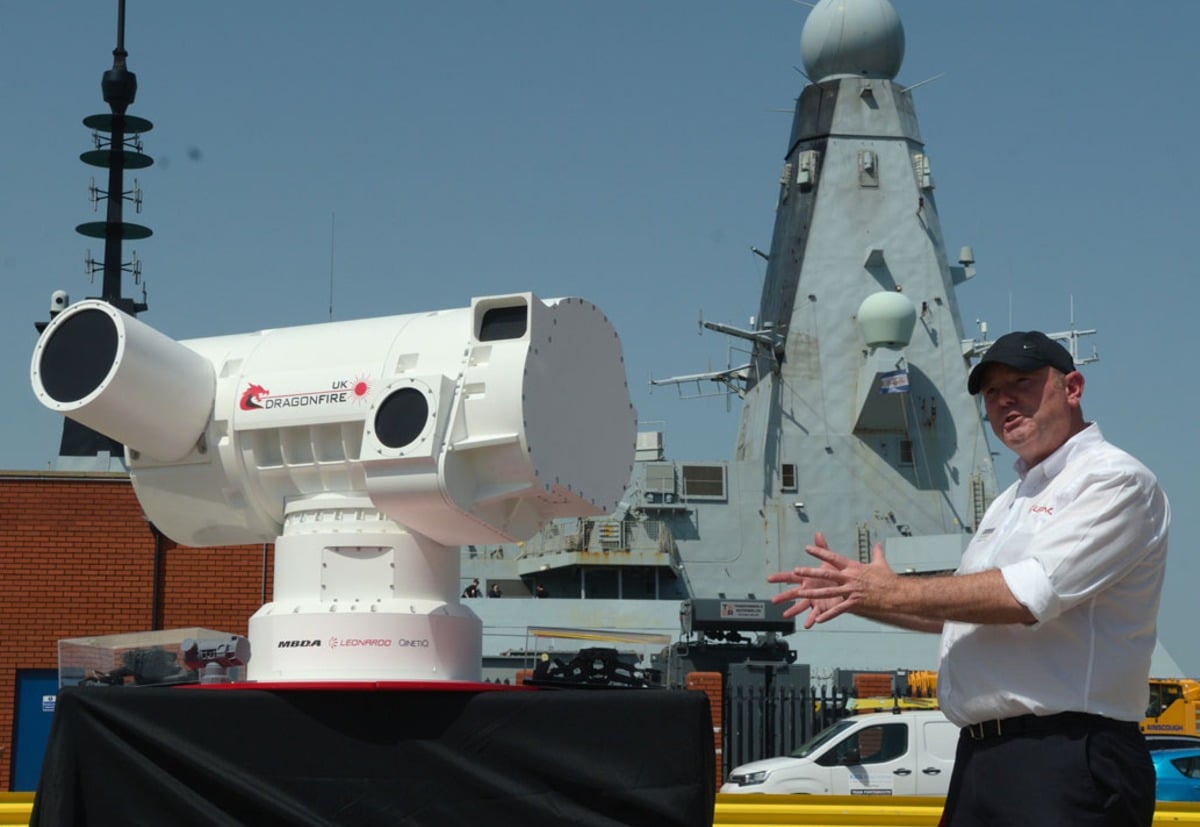
The British Ministry of Defence recently announced it will fast-track its DragonFire laser weapon onto Royal Navy warships by 2027. This timeline slashes five years off the original schedule. On paper, it looks like a triumph of bureaucratic agility. The reality is far more desperate. Faced with cheap, swarming drones and proliferating anti-ship missiles in the Red Sea, the UK military is running out of time and money. They are rushing an experimental technology to the front lines because the current economics of air defense are completely unsustainable.
The Mathematical Collapse of Modern Air Defense
The math of naval warfare has flipped. Right now, Western navies are using multi-million-dollar missiles to shoot down thousand-dollar drones.
During recent engagements in the Bab el-Mandeb strait, HMS Defender and HMS Diamond routinely fired Sea Viper missiles to intercept uncrewed aerial vehicles (UAVs) launched by Houthi rebels. A single Sea Viper costs an estimated £1 million to £2 million. The drones they are destroying often cost less than a second-hand hatchback.
This is an economic dead end. A persistent adversary does not need to pierce a warship's armor to win; they just need to empty its magazine. Once a destroyer runs out of interceptors, it becomes an incredibly expensive floating target.
DragonFire is the UK's attempt to break this cycle. The Ministry of Defence boasts that firing the laser for ten seconds costs roughly £10, which is equivalent to the price of running a domestic space heater for an hour.
But swapping a missile for a laser isn't as simple as changing a battery.
How DragonFire Actually Works (And Where It Breaks)
DragonFire is a line-of-sight directed-energy weapon (DEW). It focuses dozens of individual optical fibers into a single, devastating beam of light through a massive, ultra-precise turret.
It does not blow targets out of the sky with an explosion. It melts them.
The weapon delivers an intense concentration of light that heats the skin of a drone or missile until the structural integrity fails, the electronics fry, or the onboard fuel detonates. To do this to a target moving at hundreds of miles per hour requires an unimaginable level of tracking accuracy. The system can hit a £1 coin from a kilometer away.
That precision is remarkable in a laboratory. It is entirely different on a North Atlantic wave.
The Physics Problem
Lasers are bound by the laws of atmospheric physics. Unlike a radar-guided missile that can chase a target through thick fog, heavy rain, or sandstorms, a laser beam degrades rapidly when it encounters airborne particles.
- Atmospheric Scattering: Water droplets and dust scatter the light particles, diffusing the beam and dropping its energy delivery below the threshold required to melt metal.
- Thermal Blooming: As the laser travels through the air, it heats the atmosphere along its path. This hot air acts like a lens, defocusing the beam and spreading the energy harmlessly across a wider area.
- The Curvature Barrier: A laser cannot bend over the horizon. If a sea-skimming anti-ship missile approaches at low altitude, a ship-borne laser only has a window of a few miles to lock on, track, and burn through the target before impact.
[Target Drone] <--- (Melt Zone) --- [Degraded Beam] <--- (Fog/Rain) <--- [DragonFire Turret]
The Power Grids of 1990s Warships
Even if the weather clears, the Royal Navy faces a massive engineering hurdle: power generation.
DragonFire requires immense, instantaneous surges of electricity. The Type 45 destroyers, which are slated to receive the weapon alongside the upcoming Type 26 frigates, were designed in the late 1990s and early 2000s. Their integrated electric propulsion systems have famously struggled with reliability in warm waters, let alone handling experimental directed-energy weapons.
Fitting DragonFire onto an existing hull means adding massive energy storage banks—likely advanced flywheels or lithium-ion capacitor systems. These systems must store power from the ship's gas turbines and release it in massive bursts without blowing the ship's primary electrical grids.
If the power stabilization fails during an engagement, the ship faces a choice between keeping its propulsion online or keeping its primary defense weapon firing.
The Strategic Gamble of 2027
The decision to pull the deployment forward to 2027 bypasses the traditional procurement pipeline. Usually, a weapon like this would undergo years of monotonous sea trials, ruggedization tests, and doctrine drafting before getting near an active deployment zone.
The Ministry of Defence is skipping those steps because the geopolitical landscape demands it.
The defense industrial base in the UK and across NATO is brittle. Replacing fired missiles takes months, sometimes years, due to supply chain bottlenecks and specialized component shortages. The Royal Navy cannot afford a protracted war of attrition in the Middle East or the Indo-Pacific with its current inventory.
DragonFire is being deployed as a minimum viable product. It will likely debut with significant operational constraints, restricted to clear-weather days and specific engagement angles.
The Unanswered Questions of Laser Warfare
Defense contractors love to display videos of lasers burning neat holes through static mortar shells and stationary drones. They rarely talk about countermeasures.
What happens when adversaries begin coating their missiles in highly reflective, mirror-like materials? Or ablation shields that dissipate heat just long enough for the weapon to strike?
Ablative coatings are neither new nor overly expensive. If a hostile state can nullify a multi-million-pound laser installation with a few hundred pounds of heat-resistant ceramic paint, the economic math flips right back in their favor.
Furthermore, DragonFire is a single-target weapon. It must lock onto a target, hold the beam steady for several seconds to burn through, and then slews to the next threat. In a saturation attack involving dozens of simultaneous drones, a laser system can easily be overwhelmed by volume alone. It is an auxiliary shield, not a silver bullet.
The 2027 deployment will not mark the end of traditional naval missiles. Instead, it will mark the beginning of a messy, highly experimental hybrid era where captains must constantly calculate whether to trust the weather and use their laser, or burn through another million-pound missile from their dwindling magazines.