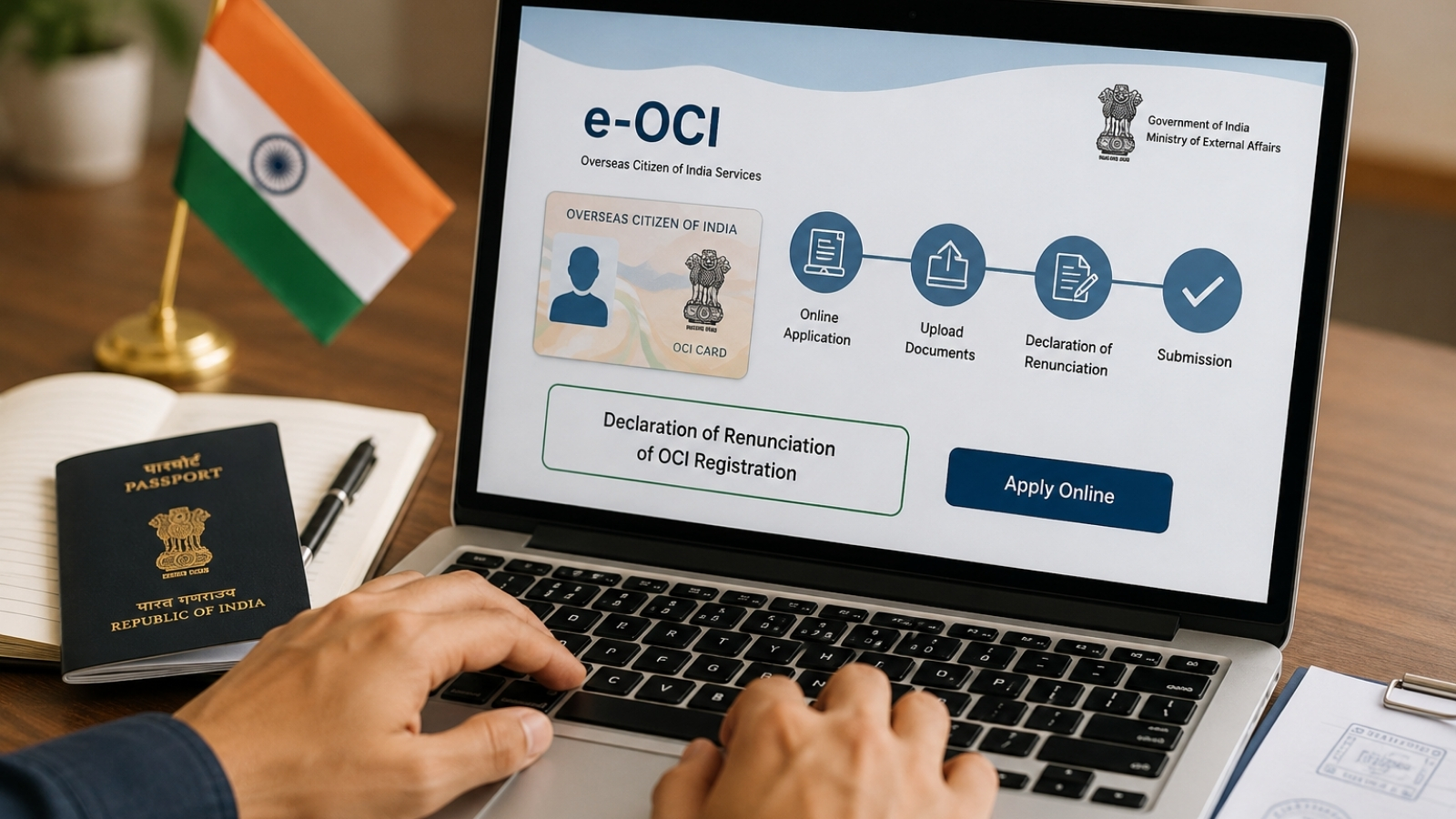
Surrendering an Overseas Citizen of India card is no longer a simple matter of returning a booklet. Under the newly implemented e-OCI system, the Ministry of Home Affairs has digitized the entire process, requiring applicants to execute a strict multi-step online declaration before submitting physical proofs to global diplomatic missions. The updated framework introduces hard timelines, a 60-day processing benchmark, and legal implications for family members. This definitive investigation details why the Indian government has tightened its grip on global status management and how applicants must navigate the new digital gauntlet to avoid permanent bureaucratic limbo.
The shift toward a digital-first surrender process reflects a broader geopolitical reality. For years, the OCI card functioned as a de facto dual citizenship document, granting millions of members of the Indian diaspora lifelong visa-free travel, property ownership rights, and economic integration. Yet, as global security clearances tighten and more individuals of Indian origin seek sensitive government, intelligence, or defense roles in Western nations, the demand to completely sever formal ties with New Delhi has surged. The Ministry of Home Affairs noticed a problem. The old, decentralized method of dropping off an OCI booklet at a local consulate lacked centralized tracking, creating data gaps between the Ministry of External Affairs and domestic immigration databases.
The e-OCI framework eliminates these discrepancies by forcing every applicant into a centralized database before a single piece of paper is touched.
The Motives Behind the Global Exit Wave
Most people spend months trying to secure an OCI card. Giving it up seems counterintuitive. However, international regulatory pressures are forcing the hands of thousands of high-earning diaspora professionals. Governments in Washington, London, and Canberra have significantly upgraded their vetting protocols for defense contractors, aerospace engineers, and high-level civil servants. For these states, an OCI card represents a substantive, ongoing tie to a foreign power. It permits foreign asset accumulation and grants unrestricted entry rights to a geopolitical actor. To secure top-secret security clearances, these professionals must present unequivocal proof that they have formal documentation confirming the termination of their semi-citizenship status.
Another factor involves taxation and asset liquidation. While India does not tax OCI cardholders on their global income, foreign tracking systems like the Foreign Account Tax Compliance Act have made holding accounts across borders increasingly complex. Some individuals choose to exit the system entirely to simplify their legal and financial footprints as they enter retirement or transition assets to children who have no connection to India.
The Digital Gauntlet of Form XXXI
The operational core of the new procedure is the OCI Miscellaneous Services portal. Applicants must navigate to the Declaration of Renunciation section to initiate what the government calls Form XXXI. This is not a casual questionnaire. Every data point must align perfectly with existing databases, leaving no room for typographical errors.
Once an applicant inputs their personal metrics, the system locks the data. If you make an error on your passport number or birth date, the system provides no edit mechanism post-submission. The application becomes void. You are forced to abandon the entry and file a completely new declaration, which creates a messy trail of duplicate files in the Ministry of Home Affairs database.
The online application demands a highly specific set of digital uploads.
- A high-resolution scan of the current valid foreign passport, showing a minimum validity of six months.
- The original OCI booklet, scanned front and back.
- The original Indian passport that was cancelled upon acquiring foreign nationality, alongside its formal surrender certificate.
- Verifiable local address proof, such as utility bills or lease agreements matching the consular jurisdiction.
The photo specifications are notoriously rigid. The system expects a JPEG file exactly 100 pixels wide by 120 pixels high, with a file size capped strictly at 50 kilobytes. Thousands of applications stall at this primary gate simply because standard digital camera photos fail the automated portal upload validation.
The Hidden Trap for Minor Children
Perhaps the most controversial element of the updated framework is the statutory impact on family members. Under Section 8 of the Citizenship Act of 1955, the legal actions of a parent bind their dependents. When an individual executes Form XXXI to renounce their OCI status, their minor children automatically lose their status as well.
This creates immense friction for families where only one parent needs to surrender their card for employment reasons while the children still require frequent, unhindered travel to India to visit extended family. The law offers a single window of rectification. Upon reaching the age of majority, a child who lost their status via parental renunciation has precisely twelve months to file a declaration to resume their Indian status. If they miss this one-year window, they are treated as standard foreign nationals, forced to navigate the standard, multi-month registration process from scratch.
The Physical Verification Window and Outsourcing Friction
Submitting the online form is merely a digital placeholder. The real administrative test begins when the physical documents must be presented to the state's authorized outsourcing provider, such as VFS Global, or directly to the local consulate.
The government mandates a strict 90-day window for this phase. If the signed physical copy of the declaration, the original OCI booklet, and the physical passports do not reach the designated consular desk within three months of the online submission, the digital file is permanently purged.
The outsourcing agencies enforce an even tighter internal timeline. If an application package arrives at an agency office with missing documents or incorrect fees, the applicant is given seven calendar days to rectify the deficiency. If that week expires without compliance, the embassy stops processing the file entirely, and all fees are forfeited. If the file is deemed fundamentally incomplete upon arrival, the agency will hold it for 20 days before sending it back unprocessed, minus shipping costs.
The physical declaration form also requires an independent witness. The second page of Form XXXI must be signed by an active Indian citizen who can vouch for the applicant's identity, providing their own address and passport details. This requirement catches many third-generation immigrants off guard, as they may live in regions without immediate access to an Indian passport holder willing to log their personal information into a government surrender file.
The 60 Day Countdown and Travel Vulnerabilities
Once the physical documents are verified and uploaded by the consulate back into the central Ministry of Home Affairs system, the official 60-day clock begins. During this two-month window, the applicant is in a precarious legal state regarding travel to India.
The original OCI card is physically retained or marked for cancellation during the initial appointment. If an emergency arises and the applicant must travel to India while the renunciation is being processed, they cannot use their OCI privileges. They cannot apply for a standard long-term visa either, because the system still lists them as active in the database until the final Form XXXI-A acknowledgment certificate is issued.
The only workaround is an emergency e-Visa. This requires a completely separate fee and application process, which is evaluated on a short-term basis by immigration authorities who may view the concurrent renunciation file with caution.
The Permanent Financial and Legal Shift
When the central government issues Form XXXI-A, the process is complete. The status is dead. The lifelong visa facility is permanently revoked.
From that exact date, the individual transitions to a pure foreign national in the eyes of the Indian state. They lose the right to acquire agricultural land, plantation properties, or farmhouses in India. Any existing properties held under OCI privileges must comply with standard foreign national ownership laws, which can complicate inheritance tracking and local property sales.
Furthermore, banking institutions in India monitor these status shifts closely. Non-Resident External and Non-Resident Ordinary accounts linked to an OCI identity must be reconfigured to match the new visa or tax status of the individual. Failure to notify your bank of an OCI surrender can result in frozen assets under the Foreign Exchange Management Act, as the legal basis for holding those specific accounts has evaporated.
The modernized online framework has successfully streamlined tracking for New Delhi, but it has shifted the logistical burden entirely to the diaspora. Navigating this system requires absolute administrative precision. A single mismatched digit or a missed seven-day correction window can derail an employment clearance or leave a family stranded between legal identities. If you are preparing to step away from your OCI status, treat the paperwork not as a routine chore, but as a high-stakes legal filing where the government holds all the leverage.