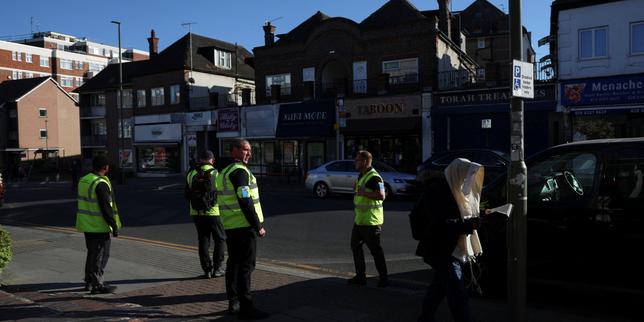
The bloody pavement outside a kosher restaurant in Golders Green was more than a localized crime scene. It was a catalyst. Following the knife attack in North London, the British government moved with uncharacteristic speed to authorize a £25 million surge in funding dedicated to protecting Jewish institutions. This isn't a simple administrative top-up. It is a desperate reactive measure to a surge in antisemitic incidents that has reached levels unseen in modern British history. The money is earmarked for the Community Security Trust (CST) and will be used to install physical barriers, advanced surveillance systems, and high-intensity security patrols at schools, synagogues, and community centers across the United Kingdom.
This emergency injection brings the total protective security grant for the Jewish community to £70 million for the 2024-2025 period. While the optics suggest a decisive government response, the reality on the ground is far more complex. Security experts and community leaders argue that while walls and cameras provide a necessary buffer, they do nothing to address the radicalization fueling the violence. The Golders Green incident serves as a grim reminder that for a specific segment of the population, the relative peace of the London suburbs has been replaced by a state of constant, low-level mobilization.
The Mechanics of Jewish Community Protection
The funding flows primarily through the Home Office but is managed on the front lines by the Community Security Trust. This organization operates with a level of sophistication that rivals some regional police forces. They don't just provide guards; they manage a vast network of intelligence gathering and incident reporting. The new £25 million will specifically fund "protective security" measures. This means physical hardware—bollards designed to stop vehicle-ramming attacks, reinforced glass that won't shatter under the impact of a brick or a blast, and infrared CCTV arrays capable of facial recognition in low-light environments.
Security isn't just about gear. It’s about manpower. A significant portion of these funds will cover the skyrocketing costs of private security personnel. In the weeks following the initial escalation of tensions in the Middle East, the demand for licensed guards at Jewish schools tripled. The government is essentially subsidizing a private army because the overstretched Metropolitan Police cannot provide a permanent static presence at every sensitive location. This reliance on private contractors creates a tiered system of safety, where the quality of protection can fluctuate based on the speed of procurement and the availability of vetted personnel.
The Geography of Fear
Golders Green is the heart of Jewish life in London. When an attack happens there, it vibrates through every Jewish household in the country. It is a neighborhood where children walk to school in blazers adorned with Hebrew lettering and where the Sabbath is physically visible in the rhythm of the streets. By targeting this specific geography, attackers aim for maximum psychological disruption.
The government’s decision to focus the funding here and in similar hubs like Manchester and Gateshead is a tactical necessity. However, the "fortress" approach has a sociological cost. When you wrap a primary school in three-meter high fencing and station armed or high-visibility guards at the gate, you change the nature of childhood. You signal to the students that they are different, and that their difference makes them targets. The state is currently betting that the cost of this psychological burden is lower than the cost of a successful mass-casualty event.
Why Policing Alone is Falling Short
There is a growing friction between the Jewish community’s need for protection and the broader policing strategy in the UK. The Metropolitan Police have been criticized for what many perceive as a "two-tier" approach to protest and public order. While the £25 million protects the buildings, it does little to protect people in transit between those buildings and their homes.
- Intelligence Gaps: Radicalization often happens in private digital spaces that are difficult for standard community policing to penetrate.
- Response Times: In high-density urban areas, even a three-minute response time is too slow to stop a knife attack.
- Legal Thresholds: Much of the vitriol directed at the community hovers just below the legal threshold for "incitement to violence," leaving police with limited powers to intervene before a physical act occurs.
The surge in funding is an admission that the standard social contract—where the state holds a monopoly on violence and guarantees the safety of all citizens—is fraying. By funding the CST to such a high degree, the government is effectively outsourcing the protection of a minority group. It is a pragmatic solution, but it highlights a systemic failure to maintain public order through traditional means.
The Escalation of Antisemitic Incident Metrics
Data provided by the CST indicates that incidents of antisemitism have spiked by over 500 percent in certain months compared to previous years. These aren't just verbal insults. We are seeing a shift toward physical confrontations, the defacing of memorials, and the targeting of Jewish-owned businesses. The Golders Green attack was not an outlier; it was a peak in a steadily rising graph of hostility.
The £25 million is a large number, but when spread across hundreds of locations, the impact is diluted. A single high-spec CCTV system for a large campus can cost upwards of £50,000. When you add the recurring costs of 24/7 monitoring and mobile patrol units, the "record-breaking" funding begins to look like a baseline requirement rather than a generous surplus.
The Counter Argument to Hyper Security
Not everyone agrees that turning synagogues into bunkers is the right path. Some civil liberties advocates and even some members within the Jewish community worry that this level of visible security further isolates the community. There is a risk of creating a self-fulfilling prophecy of exclusion. If the only way to be Jewish in London is to exist behind a wall, the proponents of hate have already achieved a form of victory. They have successfully removed a group from the common public square.
Furthermore, there is the question of the "security theater." Some measures are implemented more to reassure the public than to actually stop a determined attacker. A guard standing at a gate is a deterrent, but they are also the first person targeted in a coordinated assault. The government’s funding focuses heavily on the "hard" side of security, often neglecting the "soft" side—community outreach, deradicalization programs, and inter-faith dialogue that might prevent the person from picking up the knife in the first place.
Budgetary Realities in an Age of Austerity
The timing of this £25 million allocation is also significant. It comes at a time when other public services—libraries, youth centers, and general policing—are facing severe budget cuts. This creates a potential for resentment among other minority groups or struggling communities who feel their security concerns are not receiving the same level of financial commitment.
The Home Office defends the move by pointing to the specific, measurable rise in threats against the Jewish community that is not currently mirrored in other demographics with the same intensity or frequency. They argue that the state must direct resources where the fire is hottest. Nevertheless, the political optics of such a targeted spend require careful management to avoid fueling the very divisions the money is meant to mitigate.
The International Context of the UK Strategy
The UK is not acting in a vacuum. Similar surges in security spending are occurring across France, Germany, and the United States. However, the British model is unique because of the deep integration between the government and a private charity (the CST). In many European countries, the military or national police provide direct protection to sensitive sites. The UK’s "grant-and-outsource" model allows for more flexibility and community-led decision-making, but it also creates a layer of separation that can complicate accountability.
Critics of the French model, which saw soldiers patrolling streets under "Operation Sentinelle," argue it creates a "state of exception" that feels like martial law. The British approach is more discreet, focusing on technology and plainclothes or private security. The goal is to make the community feel safe without making the neighborhood look like a war zone. Whether £25 million is enough to maintain that delicate balance remains to be seen.
Tactical Shifts in Urban Terrorism
The threat profile has shifted away from organized, large-scale bombings toward "low-tech, high-impact" attacks. A single individual with a kitchen knife or a rented van is significantly harder to track than a cell of individuals trying to acquire explosive precursors. This shift makes traditional counter-terrorism surveillance less effective and places a higher premium on physical barriers and immediate on-site response.
The new funding recognizes this reality. It prioritizes the "last mile" of security—the actual point of contact between a perpetrator and a potential victim. By hardening these targets, the government hopes to force would-be attackers to reconsider, or at least to delay them long enough for armed police response units to arrive.
The Long-Term Viability of Fortress Thinking
We have reached a point where the cost of being a Jewish citizen in the UK includes a multi-million pound security bill paid by the taxpayer. This is a staggering realization. If the current trend of antisemitism continues, there is no reason to believe that £70 million or £100 million will be the ceiling. We are witnessing the beginning of a permanent security infrastructure that will be woven into the fabric of British urban planning.
The success of this investment won't be measured by how many attackers are caught, but by how many attacks never happen. Deterrence is notoriously difficult to quantify. If Golders Green remains quiet for the next year, the government will claim the funding worked. If another attack occurs, the call will be for even more money, more cameras, and higher walls.
The real challenge for the Home Office isn't just signing the checks. It is figuring out how to de-escalate the social tensions that make these checks necessary. Until the underlying drivers of this specific brand of hatred are addressed with the same financial and tactical intensity as the physical security measures, the UK will continue to find itself in a reactive loop, building higher fences while the ground underneath them continues to shift.
The £25 million is a vital bandage, but the wound is deep and shows no signs of healing on its own. Focus must shift toward the digital and social corridors where this violence is conceived long before it reaches a street corner in North London. Use the cameras and the guards to buy time, but use that time to dismantle the ideologies that make them necessary. Stay alert to the fact that a community that only feels safe behind a wall is a community that is still, in many ways, under siege.



