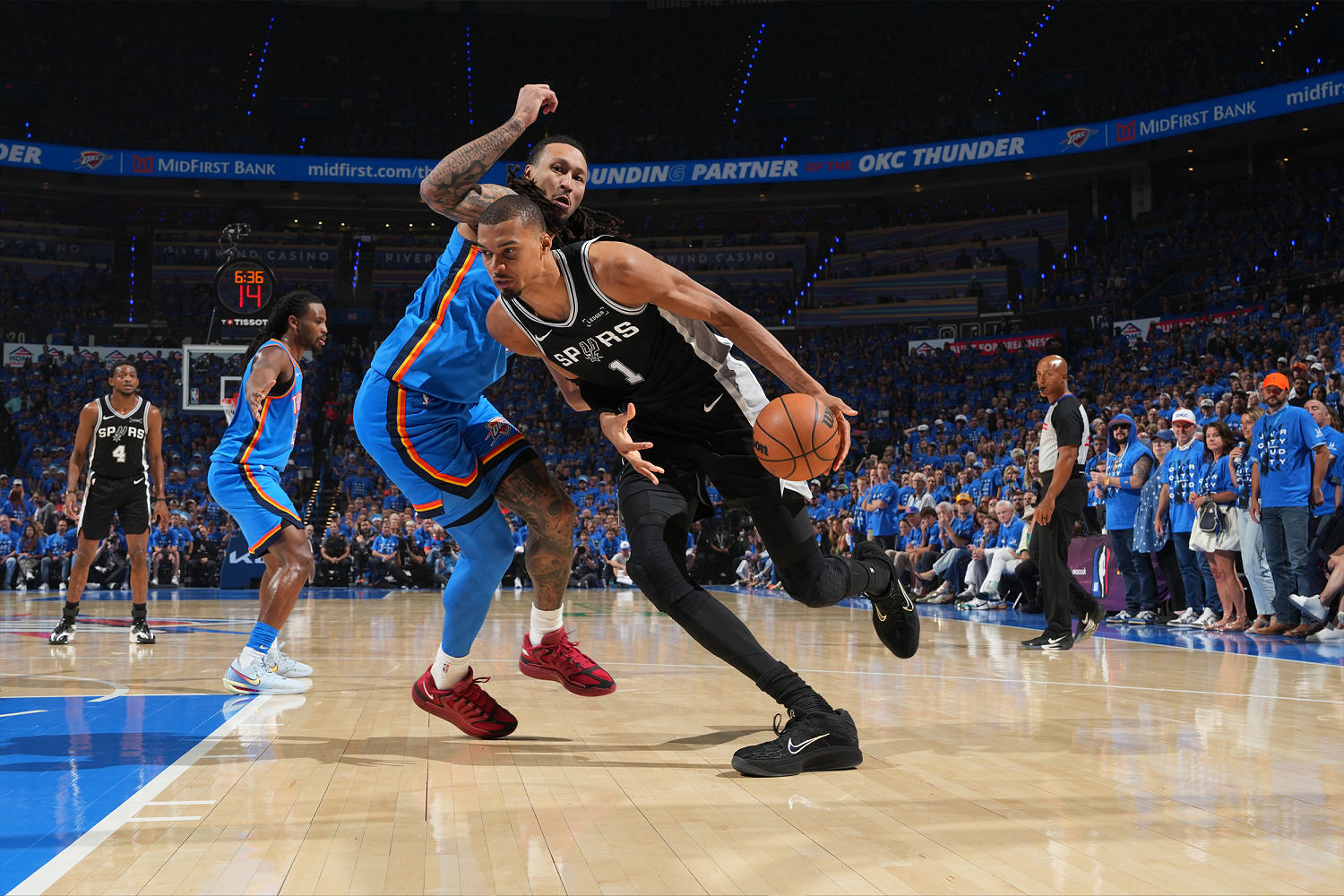
The San Antonio Spurs are going back to the NBA Finals for the first time since 2014 after capturing a grueling 111-103 Game 7 victory over the top-seeded, defending champion Oklahoma City Thunder. While superficial post-game analysis will fixate heavily on the final box score, the true architecture of this Western Conference Finals upset was drawn over seven intense, tactical iterations. San Antonio did not just outplay the defending champions; they completely dismantled the systematic advantages that made Oklahoma City an elite basketball machine. By deploying an evolving defensive scheme that suppressed Chet Holmgren and forcing Shai Gilgeous-Alexander into inefficient isolation volumes, the Spurs exposed the structural fragility hidden beneath the Thunder's regular-season dominance.
The Decoy and the Cage
To understand how the Thunder lost their grip on the Western Conference, one must examine the specific engineering behind the Spurs' defensive coverage. Throughout their championship run, Oklahoma City thrived on space. They operated a continuous drive-and-kick system that utilized Holmgren as a high-post hub or a trailing five-out shooter, pulling opposing rim protectors out of the paint.
San Antonio head coach Mitch Johnson refused to accept that compromise. Instead of letting Victor Wembanyama chase Holmgren to the perimeter, the Spurs shifted their defensive geometry. They utilized Julian Champagnie and Harrison Barnes as primary cross-match defenders on Holmgren, allowing Wembanyama to operate as a free-roaming safety in the baseline lanes.
This schematic adjustment completely broke the Thunder's interior offensive engine. Holmgren was effectively erased from the offensive script, finishing Game 7 with just 4 points on a mere two field goal attempts in 33 minutes of action. When Holmgren did attempt to roll or slip into space, he found his driving angles blocked by a recovery system engineered specifically to minimize his length.
With the roll-man option eliminated, Oklahoma City's offense devolved into heavy isolation. Shai Gilgeous-Alexander scored a magnificent, exhausted 35 points on 12-of-21 shooting, but he was forced to convert highly contested mid-range pull-ups without the benefit of his usual secondary playmaking outlets. He dished out 9 assists, but his teammates shot poorly from deep as the Spurs prioritized staying attached to perimeter shooters like Luguentz Dort, who was held to just 3 points. The continuous drive-and-kick sequences that defined the Thunder's identity were replaced by stagnant, individual possessions.
The Multi-Generational Counter-Attack
The roster construction of the Spurs provided a stark contrast to Oklahoma City’s pure youth movement. San Antonio balanced their generational superstar with calculated backcourt depth and fearless rookie production that wore down the Thunder’s perimeter defenders.
De'Aaron Fox provided the steady, veteran point guard play necessary to navigate the high-pressure environment of a road Game 7. He managed the game’s tempo, adding 15 points and 5 assists while routinely breaking the Thunder's initial line of pressure. This composure allowed the team's younger rotation pieces to excel within their specific roles.
Rookie guard Stephon Castle played with a physical defiance that belied his lack of postseason experience. Starting alongside Fox, Castle contributed 16 points and 6 rebounds, repeatedly attacking the paint and creating secondary transition opportunities. Fellow rookie Dylan Harper provided a massive spark off the bench, scoring 12 points and grabbing 7 rebounds in 27 critical minutes.
The most devastating offensive variance came from Julian Champagnie. With the Thunder defense naturally collapsing toward Wembanyama in the post, Champagnie found clean looks from the perimeter and capitalised brutally, hitting 6-of-10 from beyond the arc to finish with 20 points. This outside shooting prevented Oklahoma City from deploying the aggressive double-teams they used effectively in their three victories earlier in the series.
The Most Valuable Modern Weapon
At the center of everything was Victor Wembanyama. Named the unanimous Western Conference Finals Most Valuable Player, the second-year center averaged 27.3 points, 10.9 rebounds, and 2.7 blocks over the seven-game stretch. His Game 7 performance—22 points, 7 rebounds, and 3 high-leverage triples—served as the definitive statement of his ascension.
Wembanyama Western Conference Finals Statistical Impact
+-----------------------------------+-----------------------+
| Category                          | Series Average / Stat |
+-----------------------------------+-----------------------+
| Points Per Game                   | 27.3                  |
| Rebounds Per Game                 | 10.9                  |
| Blocks Per Game                   | 2.7                   |
| Game 1 Performance (Double OT)     | 41 PTS, 24 REB        |
| Game 7 Closing Performance        | 22 PTS, 3-5 3PT       |
| MVP Voting Result                 | Unanimous (9/9 Votes) |
+-----------------------------------+-----------------------+
Wembanyama’s evolution across these seven games was primarily mental. In the three games San Antonio lost, the Thunder managed to push him out of his preferred spots, holding him to 22.3 points per game on 43 percent shooting. In the four victories, he adapted, altering his rim-run timing and using his perimeter gravity to open up the floor.
His impact extended beyond schematic execution into locker room leadership. Following a tense moment earlier in the series where coach Mitch Johnson vocally challenged rookie Carter Bryant on the sideline, Wembanyama was the one who pulled the young roster together, stabilizing the bench's confidence. By the time the ball was tipped in Oklahoma City for Game 7, the emotional variance that usually plagues young teams in elimination environments had vanished.
The Reality Facing the Champions
For Oklahoma City, this exit reveals a hard truth about their roster composition. The acquisition of Isaiah Hartenstein was supposed to provide the physical interior presence needed to complement Holmgren. In Game 7, however, Hartenstein was a minus-14 in 21 minutes, routinely targeted by San Antonio's high pick-and-roll configurations.
The Thunder ran out of answers because their secondary creation options failed to materialize when Gilgeous-Alexander lacked space. Cason Wallace provided a valiant effort with 17 points, hitting five three-pointers, but Jalen Williams was completely unavailable to contribute his usual wing scoring. Without that versatile second option on the floor to punish the Spurs' cross-matches, the Thunder could not generate enough offensive variance to survive a disciplined defensive opponent.
San Antonio won the battle on the glass, matching the Thunder's total rebound count while generating 15 offensive rebounds that led to crucial second-chance points. They turned 13 Thunder turnovers into 19 direct points, flipping the script on an Oklahoma City team that usually prides itself on transition efficiency.
The Western Conference crown now belongs to an organization that orchestrated a classic, calculated rebuild around an incomparable talent. San Antonio's focus shifts immediately to the New York Knicks in the NBA Finals, a matchup that promises to test their defensive discipline in entirely different ways. The defending champions have been dethroned, not by a fluke of shooting percentages, but by a superior tactical blueprint executed without error.