The dashboard clock reads 4:15 AM. Outside the windscreen, Kent is a smudge of damp, bruised purple, the kind of heavy pre-dawn mist that makes the motorway cats-eyes look like dropped coins. In the backseat, eight-year-old Leo is fast asleep, his face pressed against a plush blue dinosaur. Next to him, his sister Maya, fourteen, is scrolling through her phone in the dark, the blue light reflecting in her eyes like a tiny, distant television screen.
Her father, David, grips the steering wheel. His knuckles are white. He is tracking the brake lights ahead.
They are forty miles from the Port of Dover, heading toward what used to be a routine family getaway to the Dordogne. A week of stale baguettes, warm brie, and sunburn. But this year, the air in the estate car is thick with an unspoken, collective anxiety. It is the Friday before the school half-term holidays, and every parent in the South East seems to have had the exact same idea: beat the rush.
Except you cannot beat the rush anymore. The rush is systemic. It is built into the concrete.
For decades, the journey from the rolling hills of England to the motorways of France was a thoughtless transition. You bought a ticket, drove down the M20, flashed a book of dark red paper at a smiling official, and rolled onto a vessel that smelled of diesel and cheap fry-ups. It was less a border crossing and more a motorway toll with a sea view.
That version of Europe is gone. In its place sits a new mathematical reality, a quiet bureaucratic friction that turns minutes into hours and family holidays into endurance tests.
The Anatomy of the Sixty Second Friction
To understand why David is staring nervously at his sat-nav, we have to look at the numbers that the Port of Dover authorities are desperately trying to balance.
Consider a hypothetical standard lane at the Dover terminal. In the old days, checking a British vehicle took roughly 25 to 30 seconds. A glance at the photo, a wave of the hand, and the car moved on. It was a fluid system designed for volume.
Under the post-Brexit reality, French border police (Police Aux Frontières) operating on British soil must manually stamp every single passport entering the Schengen zone. They must check for previous entry and exit stamps to ensure compliance with the 90-day rule. They must ask about the purpose of the trip.
This changes the average processing time from 30 seconds to roughly 90 seconds per vehicle.
On paper, a minute and a half sounds trivial. It is the time it takes to boil a kettle or listen to a radio jingle. But when you apply that 60-second increase to thousands of vehicles arriving simultaneously for a bank holiday weekend, the math becomes brutal.
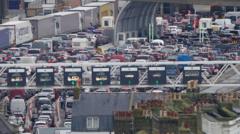
Imagine a pipe that can naturally vent 1,200 cars an hour. Suddenly, without changing the width of the pipe, you slow the flow down so only 400 cars can pass through in the same timeframe. The liquid backlogs. It spills over into the surrounding towns. It turns the A20 and the M20 into temporary, multi-lane car parks.
The Port of Dover itself has explicitly warned families to prepare for significant delays this half-term. They aren't saying this to be alarmist; they are saying it because the physical space of the port cannot stretch. It is hemmed in by the famous white chalk cliffs on one side and the cold grey English Channel on the other. It is a choke point by geographic design.
When the Car Becomes a Pressure Cooker
By 5:30 AM, David’s car has ground to a halt just outside the town limits. The sat-nav map has turned a deep, angry crimson.
This is where the abstract world of international border policy hits the messy, vulnerable reality of human psychology. A car is not just a mode of transport; during a delay, it becomes a high-stakes pressure cooker.
"How much longer?" Leo asks from the back. He is awake now, his dinosaur discarded. He wants a toilet. He wants breakfast.
Maya groans, her phone battery now at 14 percent. "We’ve been in the same spot for forty minutes, Dad. We're going to miss the ferry."
David doesn't answer. He is calculating. If they miss the 7:45 AM sailing, will P&O or DFDS put them on the next one? Probably. But the next one will be delayed too. Every delayed car rolls its lateness into the next departure slot, creating a compounding interest of human frustration.
The sensory details of a Dover queue are distinct and miserable. The smell of burning clutches as hundreds of cars creep forward six inches at a time. The low, discordant chorus of diesel engines idling in the cold air. The sight of parents standing on the grass verges of the dual carriageway, holding plastic cups of lukewarm coffee, staring blankly toward the coast as if hoping for a miracle.
We used to view borders as lines on a map. Today, they are experienced as physical weight. It is the weight of a heavy foot on a brake pedal, the weight of a child’s disappointment, the weight of realizing that your hard-earned week of rest is being consumed by asphalt and bureaucracy before it has even begun.
The Ghost in the Machine: What Happens Next?
The current queues, bad as they are, are merely a dress rehearsal for a much larger disruption looming on the horizon. For months, there has been talk of the European Union’s upcoming Entry/Exit System (EES).
The EES will replace the manual stamping of passports with an automated biometric check. On paper, it sounds like a technological leap forward. Travelers will have their fingerprints taken and their faces scanned the first time they cross the border.
But the physical reality of Dover makes this digital solution a terrifying prospect.
How do you take the fingerprints of four people sitting inside a Nissan Qashqai while keeping the traffic moving? Do they get out of the vehicle in the middle of a roaring ferry port? Do border officials pass biometric tablets through car windows in the driving rain?
During initial testing of similar systems, processing times per person skyrocketed. Not per car—per person. If a family of four takes three to four minutes to process, the system collapses under its own weight within an hour.
The port authorities know this. They are spending millions constructing new tourist holding areas and expanding baggage checkpoint configurations to create more physical buffering space. They are trying to build a dam to hold back a flood of data and flesh. But you cannot code your way out of a lack of physical tarmac.
The Fragility of the Modern Escape
There is a profound irony in the modern British holiday. We live in an era of unprecedented connectivity. We can book a villa in southern France with three taps on a glass screen while sitting on a commuter train. We can preview the local restaurants on street-view maps. We can translate menus instantly using our phone cameras.
Yet, the actual physical act of moving our bodies across the channel has become more precarious than it was in the mid-1990s.
We forgot that friction is the default state of the world. For a few decades, a brief historical anomaly allowed us to treat international travel like a domestic commute. We became spoiled by the illusion of seamlessness.
Now, the borders have reawakened. They have grown teeth.
David looks at his wife, Sarah, who has been quietly monitoring the local traffic radio station. The announcer’s voice is cheerful, a stark contrast to the grim data he is delivering. “Heavy congestion building around the Jubilee Way flyover... travelers are advised to bring plenty of water and snacks...”
"We should have taken the train," Sarah says softly.
"The Eurotunnel is just as blocked," David replies, his voice flat. "Everyone had the same idea."
They are trapped in a collective action problem. Every individual family made the rational choice to maximize their holiday time by leaving early. But when thousands of people make the same rational choice simultaneously, the result is collective madness.
A Passing Glance through the Glass
At 8:10 AM—twenty-five minutes after their scheduled departure time—David’s car finally reaches the French checkpoint booths. The white cliffs rise up behind them, immense and indifferent, scarred by old fortifications and modern radar towers.
A young French officer steps out of the booth. He looks exhausted. His uniform is crisp, but his eyes are heavy with the knowledge that he has thousands more cars to process before his shift ends. He takes the four blue passports through the window.
He opens David’s passport. Thump. The heavy rubber stamp hits the crisp paper.
He turns to Sarah’s. Thump.
He glances into the back seat. Leo is staring at him, wide-eyed. The officer doesn't smile, but his expression softens slightly for a fraction of a second. Thump. Thump.
The passports are handed back through the window. The gate rises.
"Merci," David says, his French rusty and awkward. The officer nods curtly, already looking past David’s shoulder to the silver estate car waiting next in line. The next minute-and-a-half has begun.
David hits the accelerator, and the car rolls forward onto the concrete ramp toward the towering hull of the ferry. The relief in the vehicle is palpable, a sudden lowering of shoulders, a collective exhalation. They made it. They are on the board.
But as the car climbs the steel ramp into the dark belly of the ship, David looks in his rearview mirror. Behind him, stretching back up the hill, winding through the grey concrete lanes and spilling out onto the Kent highways, is a glittering, motionless snake of red taillights that stretches as far as the eye can see, thousands of families still waiting for their ninety seconds of permission to begin their lives again.