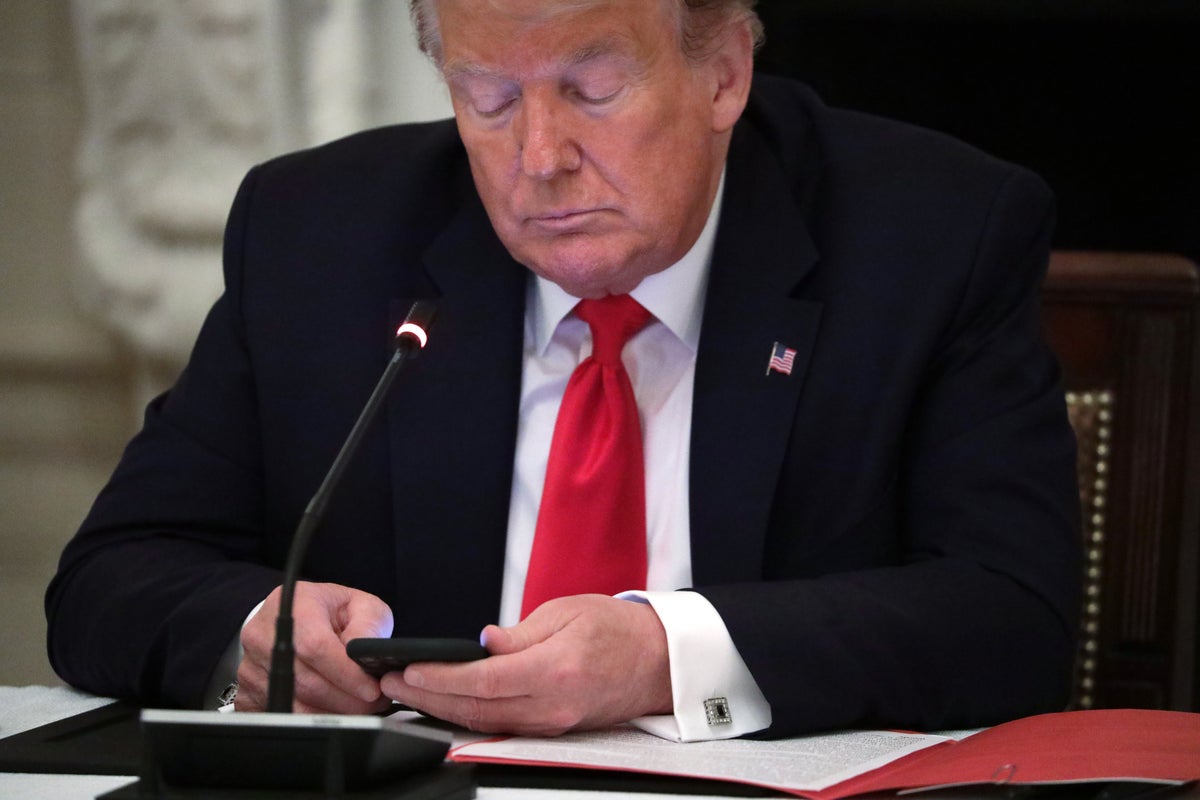
The house is silent, but the air is electric with a specific, modern kind of haunting. It is three in the morning. Outside the fortified windows of Mar-a-Lago, the Atlantic tide pulls at the shore with a rhythmic, indifferent thud. Inside, the world is reduced to the size of a handheld glowing rectangle.
Most people use their phones at this hour to scroll through photos of pets or to find a cure for their sudden insomnia. Donald Trump uses his to settle scores.
There is a unique psychology to the late-night post. In the daylight, a politician is surrounded by handlers, lawyers, and the stifling weight of teleprompters. But in the small hours, the filters dissolve. The "Truth Social spree" isn't just a collection of digital data points or a list of grievances. It is a window into a singular, unyielding architecture of the mind—a place where the past never stays buried and no slight is ever too old to be polished back to a sharp, stinging edge.
The Ghost of 2016 and the Persistence of Memory
Imagine a man who has reached the highest peak of global power, yet still feels the cold draft of an open door behind him. For Trump, that door is the legitimacy of his reign and the perceived betrayals of those who came before. When the blue light hits his face at 2:00 AM, the first person he sees isn’t the voter of 2024. It is Barack Obama.
The critique isn't nuanced. It isn't a policy paper on the Affordable Care Act or a disagreement over foreign intervention in the Middle East. It is visceral. By reaching back years to poke at the "spying" allegations or the "hoaxes" of a previous administration, Trump isn't just campaigning. He is performing a ritual of self-defense.
To understand the late-night spree, you have to understand the stakes of the ego. For a figure like Trump, history isn't a straight line moving toward progress; it is a circle. Every old enemy is a current enemy. Every past "steal" is a present threat. When he types out a capital-letter screed against the "Deep State," he is inviting his millions of followers into a foxhole that he has lived in for nearly a decade.
The Digital Echo Chamber as a War Room
The standard news cycle would tell you that these posts are "unhinged" or "erratic." That misses the point of the human connection at play.
Consider the worker in a shuttered factory town in Ohio, waking up at 4:30 AM for a shift that barely pays the bills. They open their phone and see that the former President has been awake, too. He’s been up all night fighting the same people they feel have ignored them for forty years. There is a strange, distorted intimacy in that.
The grievances—the "stolen" election, the "corrupt" judges, the "radical left" prosecutors—act as a shared language. It’s a campfire story told in the dark, where the monsters are real and only one man is staying awake to keep watch.
The facts of the legal cases against him are heavy. They involve complex filings, depositions, and the dry, dusty gears of the American judiciary. But on Truth Social, those facts are transformed into a narrative of martyrdom. A gag order isn't just a legal restriction; it is a muzzle on the "voice of the people." A courtroom isn't a place of law; it is a "gladiator pit" where the hero is being unfairly jumped by a mob.
The Anatomy of the Midnight Grievance
There is a rhythm to the spree. It usually begins with a defensive crouch—a repost of a poll or a flattering clip from a late-night cable news host. Then, as the hour grows later, the tone shifts.
The sentences get shorter. The exclamation points multiply.
DISGRACED.
WITCH HUNT.
ELECTION INTERFERENCE.
These aren't just words. They are hammers. Trump is building a reality where the nuance of law cannot survive. If you repeat a grievance enough times, it stops being a claim and starts being an environment. You don't breathe the air; you breathe the grievance.
Compare this to the way a standard politician operates. They release "statements." They have "press secretaries" who issue "clarifications." Trump has removed the middleman. He has realized that in the attention economy, anger is the most valuable currency. By spending that currency at 3:00 AM, he ensures that by 7:00 AM, he is the only thing the world is talking about.
He isn't just reacting to the news. He is the weather.
The Cost of Never Forgetting
There is a heavy emotional price to this kind of existence. To live in a state of constant "tearing into enemies" is to deny oneself the quiet of peace.
Metaphorically, it is like a general who refuses to leave the tent even after the battle has shifted to a different continent. The maps on the table are yellowed and torn, but he is still stabbing his finger at the positions of the 2020 election results, insisting that the reinforcements are just over the hill.
The human element here is the exhaustion. Not just his, but the nation's. We are strapped into the passenger seat of a car driven by a man who is looking entirely in the rearview mirror, shouting about the people who cut him off five miles back. It’s a gripping ride, terrifying and exhilarating, but it leaves everyone involved wondering if we’ll ever actually look at the road ahead.
The invisible stakes are the institutions themselves. When the midnight posts target specific clerks, judges' daughters, or individual witnesses, the "human-centric" narrative shifts from the man in the mansion to the private citizens caught in his digital crosshairs. For them, a Truth Social spree isn't a political headline. It is a security concern. It is a flood of redirected rage that lands on their doorstep because a man with a phone felt a midnight pang of resentment.
The Final Glow
The sun eventually rises over Palm Beach. The gold leaf in the ballroom catches the light, and the staff begins the business of the day. The phone is finally set aside, its battery drained, its screen smudged with the fingerprints of a long night’s work.
Behind the headlines about "meltdowns" and "sprees" lies a man who cannot stop fighting because he believes that if he stops, he will disappear. The posts are more than political strategy; they are a heartbeat. They are the proof of life for a movement that feeds on the idea that the world is broken and only the loudest voice can fix it.
The screen goes black. The Atlantic continues its indifferent thud against the sand. But the words are already out there, vibrating in the pockets of millions, a digital ghost that ensures no one—not the enemies, not the allies, and certainly not the man himself—will get any rest today.