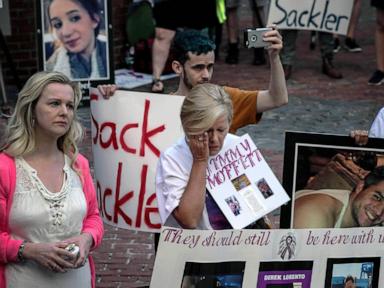
The ink on a court order is black, but the money it releases is stained a deep, indelible crimson.
In a federal courtroom, a judge’s gavel strikes a final, wooden note. It is a sound that signifies the end of Purdue Pharma as a corporate entity and the beginning of a massive, multi-billion-dollar distribution project. To the lawyers in tailored suits, this is a "sentencing." To the Sackler family, it is a managed exit. But to the woman sitting in a kitchen in rural West Virginia, staring at a framed photograph of a son who didn't live to see twenty-five, it is something else entirely. You might also find this connected article useful: The Harsh Reality of Life After Chernobyl That History Books Ignore.
It is too little. It is too late. And yet, it is all there is.
The legal machinery has finally ground to a halt. Purdue Pharma, the architect of OxyContin, has been formally sentenced for its role in a conspiracy to defraud the United States and violate anti-kickback laws. This isn't just a corporate slap on the wrist; it is a death sentence for a company that once stood as a titan of the pharmaceutical industry. The company is being dissolved. Its assets are being scraped together. Billions of dollars are being funneled into a trust intended to mend the very communities the company helped break. As extensively documented in recent articles by Reuters, the results are significant.
The Anatomy of a Crisis
We often talk about the opioid crisis in abstract numbers. We speak of 500,000 deaths. We track the rise of synthetic fentanyl. We map the "hot zones" across the Rust Belt and Appalachia. These figures are cold. They are distant. They mask the reality of what happened in the mid-nineties when a sales force descended upon small-town doctors like a secular crusade.
Imagine a salesman walking into a clinic. He isn't selling a drug; he’s selling a promise. He carries charts that "prove" OxyContin is less addictive than other painkillers because of its patented time-release formula. He has lunch for the staff. He has coupons for the patients. He tells the doctor that pain is the "fifth vital sign," something that must be crushed at all costs.
The doctor, overworked and seeing fifty patients a day, wants to believe him. He wants his patients to stop hurting. So, he writes the script.
The patient takes the pill. The time-release coating dissolves in the stomach, but the brain doesn't care about the engineering. It only cares about the flood of dopamine. When the pill wears off, the pain returns, sharper and meaner than before. The patient needs more. The dose goes up. The cycle begins.
This wasn't an accident. It was a business model.
The Price of Admission
The sentencing of Purdue Pharma serves as the structural support for a wider settlement worth approximately $10 billion. That sounds like a staggering sum until you divide it by the number of lives lost, the number of children in foster care because their parents are gone, and the cost of rebuilding the public health infrastructure of entire states.
The Sacklers, the family that owned and controlled Purdue, have agreed to contribute $6 billion of their personal fortune to this settlement. In exchange, they receive a controversial prize: a shield. This legal immunity protects them from future civil lawsuits related to the opioid crisis.
Critics call it a ransom. They argue that the family is buying their way out of accountability. The Supreme Court even hit the brakes on this plan for a time, questioning whether a bankruptcy court had the power to grant such immunity to people who hadn't actually declared bankruptcy themselves.
But the states and the victims' families faced a brutal choice. They could fight the Sacklers in court for decades, watching the legal fees eat away at the remaining assets until there was nothing left but dust. Or, they could take the deal. They could take the $6 billion now and start opening treatment centers, hiring addiction counselors, and distributing Narcan.
They chose the money. It wasn't because they forgave the architects of the crisis. It was because the bodies were still piling up, and a check today is worth more than a moral victory twenty years from now.
The Ghost in the Machine
Purdue Pharma will no longer exist in its current form. It is being resurrected as a "public-benefit company." This is a strange, modern alchemy where a criminal enterprise is transformed into a government-monitored entity dedicated to addressing the very plague it helped create.
The profits from the "new" Purdue—which will still manufacture OxyContin and other medicines—will go directly to the settlement fund. It is a grim irony. The medicine that fueled the fire will now be sold to pay for the fire extinguishers.
Consider the logistical nightmare of this redistribution. How do you decide if a suburb in Ohio deserves more money than a fishing village in Maine? The formula is based on "harm." It looks at overdose rates, the number of pills shipped to specific zip codes, and the local cost of healthcare.
But how do you quantify the loss of a generation?
In many of these communities, the damage is structural. It’s the loss of the local mechanic who was the only person who knew how to fix the town’s tractors. It’s the grandmother raising three toddlers on a fixed income because her daughter is in jail or in the ground. The settlement money will buy beds in rehab facilities, but it won't bring back the mechanic. It won't give those toddlers their mother back.
The Ledger of Human Suffering
The legal documents for this case are thousands of pages long. They are filled with jargon like "non-consensual third-party releases" and "abatement accounts."
Step back from the legalese.
The real story is told in the quiet moments. It’s in the bathroom stalls of gas stations where the lights have been changed to blue so users can’t find their veins. It’s in the elementary school classrooms where teachers have to keep "calm-down kits" for children born with Neonatal Abstinence Syndrome. It’s in the morgues that had to rent refrigerated trailers because they ran out of room.
The sentencing of Purdue is a milestone, but it isn't a finish line. The money flowing from this settlement is a drop of water in a very large, very dry bucket.
The money is designated for "abatement." This means it can only be used for things like expanding access to Medication-Assisted Treatment (MAT), such as methadone or buprenorphine. It can fund programs that train first responders on how to handle an overdose without losing their own lives to the secondary trauma of the job. It can pay for the data systems needed to track the spread of the next wave of the epidemic.
The tension lies in the implementation. Money alone doesn't fix a cultural wound. In many parts of the country, there is still a deep stigma attached to addiction. If a town receives $5 million from the Purdue settlement but the local council refuses to allow a needle exchange or a methadone clinic to open on Main Street, the money is useless. It sits in a bank account while the ghost of the empire continues to haunt the streets.
The Long Shadow
The Sackler name was once synonymous with philanthropy. It was etched into the walls of the Louvre, the Met, and Oxford. One by one, those names are being chiseled away. The family’s reputation is in tatters, their "legacy" now inextricably linked to the rows of white crosses in churchyards from Massachusetts to California.
But they remain billionaires.
They will live out their lives in comfort, far removed from the consequences of the aggressive marketing campaigns they oversaw. They will never have to worry about the cost of a funeral or the price of a rehab stay.
The settlement is a compromise in the truest sense of the word. Nobody is happy. The victims feel the price of their loved ones' lives was set too low. The Sacklers feel they have been unfairly maligned for a crisis that had many causes. The lawyers feel they have navigated an impossible thicket of bankruptcy law.
The reality is that we are witnessing the liquidation of a tragedy.
As the money begins to flow, it will be monitored by court-appointed overseers. Every dollar will be tracked to ensure it goes toward healing. This is the "win." The "loss" is the fact that such a system had to be built in the first place.
The opioid crisis has shifted. It is no longer just about a single pill or a single company. It has morphed into a monster of illicit fentanyl and xylazine, a street-level horror that is even more lethal than the prescription drugs that started it. Purdue Pharma was the spark, but the forest is now fully ablaze.
The $10 billion settlement is a fire break. It is a desperate attempt to stop the spread, to save what can still be saved.
We watch as the checks are signed and the wires are transferred. We watch as the corporate logo of Purdue Pharma is lowered for the last time. We watch, and we wait to see if this infusion of capital can actually turn the tide.
But for the families who have already lost everything, the sentencing isn't a moment of joy. It’s just a moment of silence. The courtroom clears out. The lawyers pack their briefcases. The judge retires to his chambers.
Outside, the world remains broken, and the money—no matter how much of it there is—cannot buy back a single soul.