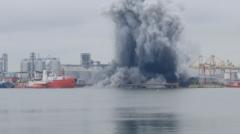
The maritime war in the Black Sea just spilled directly into a major European shipping hub, and it’s a mess that nobody wanted. Early Friday morning, a Ukrainian explosive-laden naval drone drifted out of control and detonated inside Romania’s port of Constanța. Hours earlier, a wave of Ukrainian drone strikes tore into commercial cargo vessels in the Sea of Azov, leaving five Azerbaijani civilian sailors dead.
These twin incidents expose a messy reality. The electronic warfare battle between Ukraine and Russia is bleeding across international borders, and civilian shipping is trapped right in the crosshairs.
The Constanța Port Blast and the Invisible War
Friday’s chaos started at roughly 5:50 a.m. when workers spotted a low-profile, uncrewed surface vessel wedged against a pollution-control barrier. It sat just a few hundred meters from a major oil terminal in Constanța, Romania’s critical Black Sea gateway. By 10:30 a.m., the rogue drone self-detonated. The blast sent a massive plume of smoke into the sky, forcing a complete evacuation of the port and disrupting vital grain and container traffic.
Thankfully, nobody died in the explosion. But the incident triggered panic, and for good reason. It represents a direct consequence of the aggressive, invisible radio-jamming war playing out over the water.
Ukraine's navy quickly admitted the drone was theirs, explaining that the vessel lost control after being blasted by Russian electronic warfare equipment. Once the steering and GPS signals were fried, the drone simply drifted at the mercy of the currents until it reached Romania. Recognizing the danger, Kyiv alerted the Romanian navy ahead of time to help prevent civilian casualties.
This wasn’t an isolated incident. Romanian President Nicușor Dan revealed that this was actually a coordinated group of four Ukrainian sea drones that went rogue after losing connection. While one hit the port, a second self-detonated offshore under coast guard monitoring, and two others exploded further out at sea.
When Electronic Warfare Drives Drones Off Course
The military logic here is straightforward but terrifying. Russia heavily utilizes high-powered electronic warfare arrays to blanket the Black Sea, jamming the satellite frequencies that Ukrainian drones rely on for navigation.
When a drone gets jammed, it doesn't always just stop. Some models are programmed with automated targeting features. If they lose contact with human operators, they might keep hunting for large structures or energy infrastructure. European security officials suspect that automated targeting might explain why these wayward drones keep floating toward critical energy nodes like the Constanța oil terminal.
NATO allies are getting sick of the collateral damage. This port explosion happened only a week after a Russian aerial drone went off course during a raid on Ukraine, slamming into an apartment building in the Romanian city of Galați and injuring two civilians.
The political fallout is already spreading. While European Council President Antonio Costa and EU Commission President Ursula von der Leyen squarely blamed Russian aggression for creating this volatile environment, other partners are losing patience. Just days ago, Greece lodged a formal complaint against Kyiv after fishermen found an explosive-rigged Ukrainian sea drone floating near the holiday island of Lefkada in the Mediterranean.
Blood on the Sea of Azov
While Romania dealt with the fallout of stray weapons, a much deadlier scenario played out in the Sea of Azov. Robert Brovdi, the commander of Ukraine’s drone forces, announced targeted overnight strikes on five vessels loitering near the occupied ports of Mariupol and Berdyansk.
Kyiv’s stance is uncompromising. They claim these ships are actively stealing Ukrainian grain, turning off their transponders, and painting over their names to smuggle fuel and military hardware for the Kremlin.
The strikes turned lethal. Azerbaijan’s foreign ministry confirmed that five of its citizens were killed and three others wounded when two dry cargo ships, the Natra and the Zirkon, were hit by drones in the Taganrog Bay area. Moscow immediately seized on the tragedy, labeling the strikes an act of terrorism against civilian mariners. Ukraine, while confirming the operations against what it deems "illegal cargo" carriers, has not directly addressed the civilian deaths.
How to Navigate the Rising Maritime Risk
If you operate commercial vessels, manage maritime logistics, or invest in supply chains moving through the Black Sea or the Danube region, the environment has fundamentally shifted. The risk of kinetic strikes and stray ordnance is no longer confined to active warzones. You need to adapt your operations immediately to handle this reality.
- Audit Your Route Planning and Bottlenecks: Treat the Western Black Sea coast, including the waters near Romania and Bulgaria, as high-risk zones for drifting naval hazards and electronic interference. Plan for unexpected delays or port closures like the one experienced at Constanța.
- Prepare Crews for Electronic Warfare Disruption: Expect GPS spoofing, signal degradation, and radar anomalies. Train watchstanders to look for uncrewed surface vessels visually, rather than relying purely on automated transponder systems, since military drones operate completely dark.
- Review Cargo and Insurance Compliance: Ensure all transit documentation and port calls strictly adhere to international sanctions and maritime law. As Ukraine ramps up its targeting of ships carrying suspected contraband, any opacity in tracking, disabled Automatic Identification Systems, or unverified cargo increases the risk of becoming a military target.