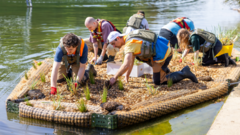
Coastal cities are drowning in their own runoff, and the current plan to save them involves tethering plastic-and-coconut-fiber rafts to the seabed. While press releases paint a picture of lush, green havens for fish and birds, the mechanical reality of floating treatment wetlands (FTWs) is far more complex and significantly more expensive than most municipal budgets can stomach. These engineered ecosystems are being deployed from Baltimore to Singapore as a desperate fix for dead zones, yet they face a brutal set of engineering hurdles that could turn these green dreams into maritime debris.
The fundamental problem is nitrogen. In any given harbor, agricultural runoff and urban waste create a chemical soup that starves the water of oxygen. Traditional land-based wetlands act as nature's kidneys, filtering this sludge before it hits the open sea. But we paved over those kidneys decades ago. Now, with no land left to restore, engineers are trying to build artificial kidneys that float.
The Engineering Behind the Greenery
A floating wetland is not just a bunch of plants on a raft. It is a high-performance biological filter designed to maximize the surface area for specific bacteria. These microbes live on the underwater roots of the plants and in the buoyant matrix of the raft itself. They are the heavy lifters, breaking down nitrates and phosphates that would otherwise trigger toxic algae blooms.
The science is sound, but the physics of the ocean are unforgiving. To be effective, an FTW must survive the constant stress of tidal surges, salt spray, and the corrosive nature of seawater. Most designs utilize a base of recycled plastics or high-density polyethylene (HDPE) foam injected with coconut coir. The plants—typically salt-tolerant species like Spartina alterniflora—are tucked into these mats. Their roots grow straight through the bottom, dangling into the water column like a mop.
This creates a concentrated zone of biological activity. Unlike a static pond, the moving water in a harbor constantly brings new "food" to the bacteria on the roots. When it works, the results are measurable. Water clarity improves, and dissolved oxygen levels rise. But when the structural integrity of the raft fails, you aren't just losing a garden; you are dumping several tons of plastic and decaying biomass into a navigation channel.
The Hidden Costs of Maintenance
Municipalities often fall in love with the initial photo op. A floating island looks great on a brochure. However, the operational reality is a logistical headache. These structures are massive biological sponges, and sponges get heavy.
As the plants mature and the root systems expand, the weight of the island increases. This requires an active management of buoyancy. If the raft sinks too deep, the "crowns" of the plants become submerged, the vegetation dies, and the entire system begins to rot. Maintenance crews must regularly prune the greenery and, in some cases, manually harvest the biomass. If you don't remove the dead plants, the nitrogen they sucked out of the water simply leaches back in as they decompose.
Then there is the issue of biofouling. It isn't just the plants that grow on these rafts. Barnacles, mussels, and heavy algae hitch a ride on the underside. Within two years, a floating wetland can double in weight. This creates a massive amount of drag. In a heavy storm, a floating wetland becomes a giant sail. If the anchoring system—usually a series of heavy-duty marine chains and concrete blocks—isn't over-engineered, the entire project can break loose. A runaway island drifting into a shipping lane is an expensive liability that few city councils have factored into their long-term projections.
The Biodiversity Mirage
Proponents claim these islands are a boon for local wildlife. This is true, but it comes with a caveat. While they do provide a refuge for small fish and crabs, they also attract unintended guests.
In urban environments, floating wetlands often become high-density housing for Canada geese. These birds are not exactly helpful for water quality. A large flock of geese can contribute enough fecal coliform to the water to effectively cancel out the nitrogen-scrubbing benefits of the plants. Furthermore, their grazing can strip an island of its vegetation in a matter of days.
To combat this, many projects now require unsightly wire cages or netting to protect the young plants. The result is a "nature-based solution" that looks more like a floating construction site than a pristine habitat. For the veteran analyst, this points to a larger truth: you cannot simply drop a piece of nature into a broken system and expect it to behave perfectly. It requires constant, human intervention to mimic a natural cycle.
Scaling Up or Sinking Fast
The real test for FTWs is scale. A few hundred square feet of floating mats in a calm marina is a localized success. To actually move the needle on a harbor’s overall health, you need acres of them.
The cost-per-acre for floating wetlands is astronomical compared to traditional land restoration. You are paying for marine-grade materials, specialized labor, and constant monitoring. In many cases, the price tag per pound of nitrogen removed is three to five times higher than what it would cost to upgrade a wastewater treatment plant upstream.
This leads to a hard question for urban planners: Is this about water quality, or is it about optics?
If the goal is truly to save the ecosystem, the money might be better spent on the boring, invisible infrastructure that prevents the pollution from reaching the water in the first place. Permeable pavement, improved sewer systems, and stricter industrial regulations don't look as good in a drone shot as a floating green island, but they solve the problem at the source.
The Bio-Industrial Complex
We are seeing the rise of a new sector in the environmental industry. Specialized firms are now competing for multi-million dollar contracts to "re-wild" urban waterfronts. These companies are innovating rapidly, experimenting with 3D-printed concrete bases that mimic coral reefs and automated sensors that monitor water chemistry in real-time.
This technological push is necessary. If we are going to use floating wetlands, they need to be more than just glorified rafts. They need to be integrated into the city’s smart infrastructure. We are seeing prototypes that use solar-powered aerators to pump oxygen directly into the root zones, supercharging the bacterial breakdown of pollutants.
These advancements bridge the gap between "nature" and "machine." However, they also move us further away from the simplicity of a self-sustaining ecosystem. We are effectively building a life-support system for our harbors.
The Resilience Trap
There is a danger in the "resilience" narrative. By touting floating wetlands as a way to adapt to rising sea levels and worsening pollution, we risk accepting those conditions as inevitable. It is a form of technological retreat.
Instead of fixing the chemistry of the ocean, we are trying to build a surface layer that can survive it. This works for the birds and the upper-level aquatic life, but it does nothing for the benthic zones—the bottom of the harbor—where the real toxic legacy of industrialization sits in the silt. Floating wetlands are a top-down solution for a bottom-up problem.
The most successful projects are those that acknowledge these limitations. In places like the Inner Harbor of Baltimore, the "Healthy Harbor" initiative uses floating wetlands as part of a much larger strategy that includes massive "water wheels" to scoop up trash and aggressive upstream advocacy. The wetlands are the public face of a gritty, multi-pronged war on pollution.
The Reality of Implementation
To make these systems viable, the industry must move away from the "set it and forget it" mentality.
Structural longevity must be the first priority. Using biodegradable materials sounds eco-friendly, but if the raft falls apart in three years, you have failed. The focus is shifting toward "permanent" floating structures that can support several generations of plant life.
Harvesting protocols must be baked into the budget. A floating wetland without a harvest plan is just a temporary nitrogen storage unit. Cities need to treat these rafts like any other utility, with a dedicated crew and a maintenance schedule.
Site selection is often driven by politics rather than limnology. Putting a floating wetland where people can see it is good for PR, but putting it where the water flow is slowest is better for the environment. These rafts need "residence time"—the water has to stay in contact with the roots long enough for the bacteria to do their job.
The Final Calculation
We are currently in a trial phase for this technology. The next decade will determine if floating wetlands are a legitimate tool for coastal defense or a high-priced fad.
The success of these projects will not be measured by how green they look from a pier. It will be measured by the parts-per-million of dissolved oxygen at the harbor floor and the survival rate of the rafts during a Category 3 hurricane.
If we want to fix our coastlines, we have to stop treating them like a scenery project. We have to treat them like the complex, struggling biological engines they are. This requires an honest look at the costs, the engineering failures, and the uncomfortable reality that a floating mat is no substitute for a healthy, natural shore.
Stop looking at the greenery and start looking at the anchors. The survival of the project depends entirely on what is happening beneath the surface, where the heavy lifting—and the potential for failure—resides.