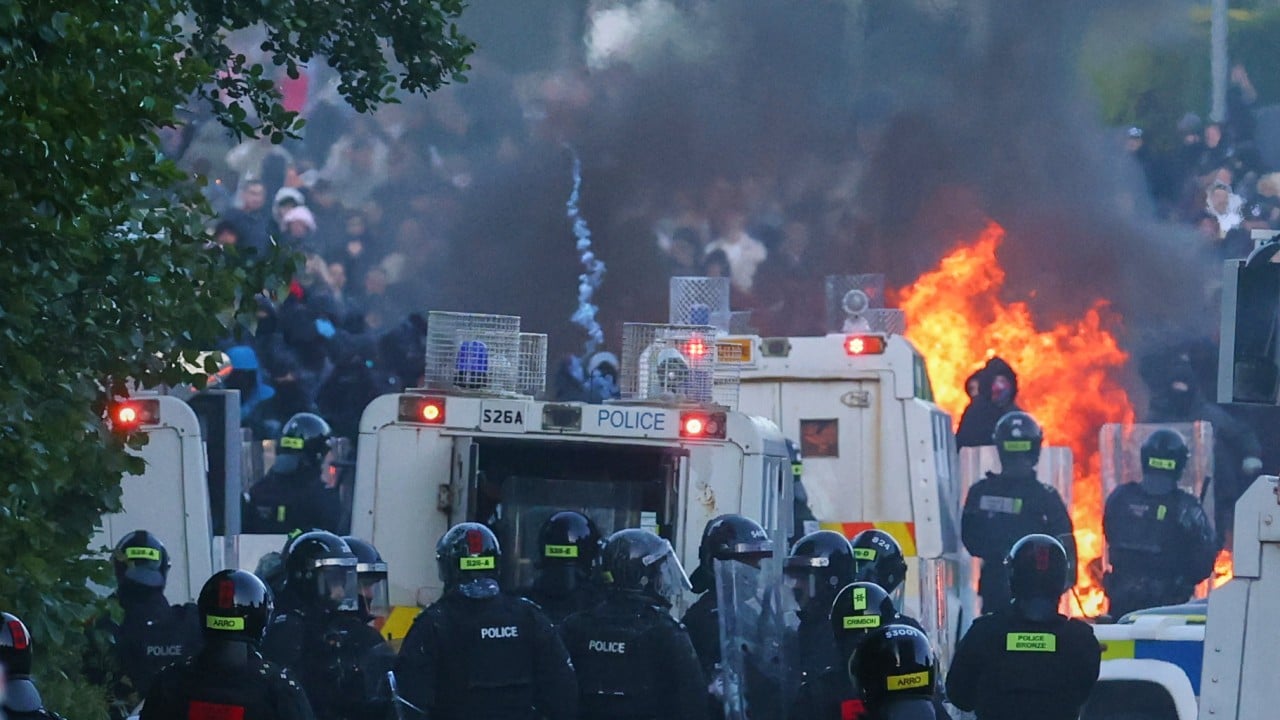
The media needs a script, and when Belfast burns, it reaches for the oldest one in the drawer.
Mainstream news outlets looked at the recent violence following a stabbing in Northern Ireland, saw a water cannon being rolled out, and immediately hit copy-paste on their favorite narrative. They told you this was a predictable resurgence of ancient sectarian hatred, a direct continuation of historical tribalism triggered by a single spark.
They are wrong. They are lazy. And their diagnosis of the situation actively prevents anyone from understanding why these streets actually erupt.
The media’s favorite consensus is that Belfast is a tinderbox of frozen historical grievances waiting for an excuse to explode. This view treats working-class communities like automated drones wired to riot whenever a specific cultural button is pushed. It is a comforting lie for outsiders because it means they do not have to look at the economic rot, the catastrophic failure of post-conflict governance, and the deliberate manipulation of social media algorithms that actually drive twenty-first-century unrest.
This is not the 1970s. The water cannons are real, but the mechanics behind the madness have completely changed.
The Myth of the Purely Sectarian Riot
To understand why the mainstream narrative collapses under scrutiny, look at who was actually on the streets and what they were shouting.
The traditional script dictates a rigid binary: Green versus Orange. Catholic versus Protestant. Yet, the recent unrest following the Belfast stabbing featured a bizarre, deeply confusing convergence of symbols that completely scrambled the old sectarian lines. Anti-immigration rhetoric mixed with loyalist flags, while simultaneously mirroring talking points found in far-right circles across Western Europe and the Republic of Ireland.
If this were purely about historical Northern Irish tribalism, the geography and the targets would look entirely different. Instead, we saw a chaotic, hyper-modern grievance machine in action.
I have spent years analyzing urban conflict and policy failures. The biggest mistake external observers make is confusing the aesthetic of a riot with its cause.
- The Aesthetic: Balaclavas, petrol bombs, police Land Rovers, and water cannons. This looks like classic Belfast unrest, so reporters treat it as such.
- The Cause: Decades of economic abandonment, a vacuum of local political leadership, and an algorithmic ecosystem that weaponizes local anxieties.
When you treat a modern, internet-fueled anti-immigration riot as if it is just another chapter of the Troubles, you misdiagnose the disease. You cannot fix a modern infection with an outdated antidote.
How the Media Misinterprets the Water Cannon
When the Police Service of Northern Ireland (PSNI) deploys a water cannon, it acts as a visual magnet for international journalists. The images are cinematic. They convey a sense of maximum state force holding back an unstoppable tide of ideological zealots.
But let us talk about the tactical reality of public order policing.
A water cannon is not a sign of state strength. It is an admission of operational desperation.
It is a blunt, indiscriminate tool used when intelligence has failed and tactical containment has broken down. Rolling it out means the police failed to read the digital room days in advance.
The mainstream press framed the deployment as a necessary escalation to suppress a traditional sectarian uprising. In reality, the police were playing catch-up against a decentralized, fluid crowd that was organized not in local community halls, but in encrypted chat groups and public comment sections.
The Real Drivers: Cash, Chaos, and Clickbait
Let us dismantle the premise that this unrest is purely about ideology. If you want to know why a neighborhood explodes, stop reading political manifestos and start looking at the balance sheets of the people living there.
The Peace Dividend That Never Arrived
The 1998 Good Friday Agreement promised a peace dividend. It promised investment, jobs, and a future for the youth in working-class enclaves. For the corporate centers of Belfast, that promise was kept. Tourism boomed, tech hubs opened, and film studios moved in.
But for the areas where the riots actually occur, the economic reality remained stagnant. Educational underachievement in these neighborhoods is rampant. Youth unemployment is stubbornly high. When you leave a generation of young men with zero economic mobility, immense boredom, and a sense of systemic neglect, they become highly combustible material.
Algorithmic Radicalization
The competitor article treats the stabbing as a local trigger. This completely ignores the digital supply chain of outrage.
The misinformation surrounding the incident did not originate organically on the street corner. It was amplified by coordinated networks, many operating outside of Northern Ireland entirely, utilizing algorithms designed to maximize engagement through rage. Local anxieties regarding housing, public services, and demographic shifts were hijacked by digital actors who do not care about Belfast's future. They care about traffic, chaos, and polarization.
The rioters on the street were operating on a distorted reality manufactured by global tech platforms, executed via local proxies. Calling this a "traditional Belfast riot" is like calling a modern drone strike a cavalry charge.
Dismantling the "People Also Ask" Assumptions
When violence breaks out in Belfast, the public looks for quick answers. The standard questions asked online reveal just how deeply the flawed media narrative has penetrated the public consciousness.
"Is Northern Ireland sliding back into the Troubles?"
This is the ultimate clickbait question, and the answer is a definitive no. The Troubles were defined by highly organized, heavily armed paramilitary structures with clear, albeit conflicting, political objectives. What we are seeing now is decentralized, erratic, and largely opportunistic. It is characterized by low-level street disruption rather than sustained guerrilla warfare. Framing it as a return to the past completely misjudges the scale, the capability, and the intent of the actors involved.
"Why do these communities resort to violence so quickly?"
The premise of this question assumes a cultural pathology unique to Northern Ireland. The reality is far less exceptional. Strip away the local flags, and the dynamics of these riots look identical to the unrest seen in Paris, Southport, or Dublin. They are driven by the exact same volatile cocktail: social exclusion, distrust of authority, perceived threat to identity, and digital manipulation. Belfast isn't a historical anomaly; it is a mirror reflecting a broader Western crisis of social cohesion.
The Hard Truth Nobody Wants to Admit
There is a major downside to acknowledging this nuance. If the violence is not just a rerun of old sectarianism, then the solution isn't as simple as telling politicians to "get along" or holding cross-community workshops.
If the root causes are economic neglect, systemic educational failure, and unregulated digital manipulation, then fixing it requires massive, long-term structural overhaul. It requires holding social media companies accountable for facilitating civil unrest. It requires massive state investment in forgotten neighborhoods.
It is far easier for the political elite, both locally and internationally, to blame the ghosts of history. If the riots are just the fault of ancient hatreds, then nobody alive today has to take responsibility for the policy failures that created the tinderbox.
Stop buying into the lazy narrative of the timeless Belfast conflict. The water cannons are spraying water, but the fire this time is fueled by entirely modern grievances. Treat it as the twenty-first-century crisis it is, or get used to watching the streets burn.


