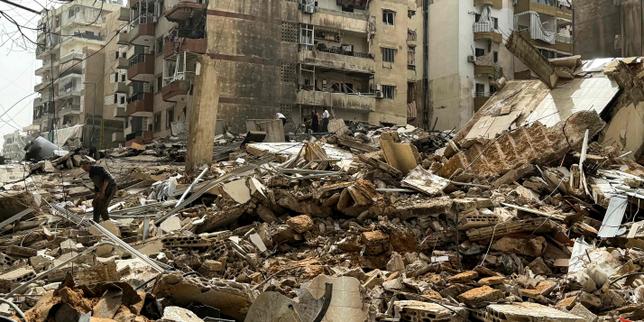
Walking through the streets of Dahiyeh right now doesn't feel like a victory. It feels like a breath held too long. For the people living in the southern suburbs of Beirut, the current truce isn't a solid floor they can stand on. It’s a thin sheet of ice. You see the white flags and the trucks loaded with mattresses, but you also see the jagged remains of apartment blocks that look like they were hit by a giant’s fist. This isn't just about rebuilding walls. It’s about the gnawing uncertainty that the sky might open up again tomorrow.
The ceasefire reached between Israel and Hezbollah in late 2024 brought a technical end to the heaviest bombardment this area has seen in decades. But "technical" is the keyword here. If you talk to the families returning to Haret Hreik or Burj al-Barajneh, the conversation isn't about interior design. It’s about the mechanics of the deal. They know the terms involve a phased withdrawal and the deployment of the Lebanese Army. They also know that one stray spark can burn the whole thing down.
Life among the ruins of Dahiyeh
Dahiyeh has always been more than just a suburb. It’s a dense, vibrating hub of commerce, family, and political identity. Now, large swaths of it are unrecognizable. When people return, they aren't just coming back to homes; they're coming back to craters. The smell of pulverized concrete and stale smoke still hangs in the air. You’ll see a man sitting on a plastic chair in the middle of a street where three buildings used to be. He’s not there because it’s comfortable. He’s there to reclaim his space before the dust even settles.
The skepticism isn't coming from a vacuum. History in Lebanon doesn't repeat; it rhymes with a very violent beat. Residents remember 2006. They remember the promises made then. When they look at the current truce, they see a document signed in foreign capitals that doesn't account for the reality of a drone hovering overhead. The Lebanese Army’s presence is supposed to be the stabilizer, but locals are realistic about the military's actual capacity to stop a full-scale regional escalation.
The math of destruction and the cost of staying
Let’s look at the numbers. Thousands of units are completely gone. We aren't talking about cracked windows. We’re talking about "pancaked" structures where the roof meets the basement. The financial cost is staggering, and Lebanon’s economy is already a disaster movie. Most people don't have insurance that covers "act of war" by a neighboring state. They’re relying on political parties, NGOs, and their own dwindling savings to put a roof back over their heads.
The skepticism grows when you consider the oversight. The truce includes a monitoring committee led by the United States and France. For a resident of Dahiyeh, the idea of a committee in a boardroom protecting their kids from a missile strike feels thin. It’s hard to trust a ceasefire when the underlying political grievances haven't moved an inch. Hezbollah remains a potent force, and Israel’s security demands haven't changed. The suburb is essentially the front row of a theater where the play hasn't actually ended.
Why the Lebanese Army deployment is complicated
The plan hinges on the Lebanese Armed Forces (LAF) taking control of areas south of the Litani and maintaining order in strongholds like Dahiyeh. On paper, it sounds great. In practice, the LAF is underfunded and caught in a political vice. They have to play the role of the neutral arbiter in a landscape that’s anything but neutral. Residents are watching how the army interacts with local structures. If the army looks too aggressive, they lose the people. If they look too passive, the ceasefire loses its international backing.
The psychological toll of the "Double Tap"
You can’t talk about the southern suburbs without talking about the trauma of the strikes. The "double tap" tactic—hitting a site and then hitting it again minutes later—has left a permanent mark on the collective psyche. People don't just run toward a collapsed building to help anymore. They hesitate. That hesitation is a poison. Even now, with the guns mostly silent, a loud car exhaust or a low-flying plane sends a ripple of visible panic through a crowd. The truce hasn't fixed the nerves.
The gray zone of reconstruction
Who’s going to pay for this? That’s the question everyone’s dodging. In the past, Gulf money flooded in to rebuild. This time, the geopolitical winds have shifted. Donors are tired. They want to see structural changes in Lebanon before they write checks for billions. This leaves the average resident in a gray zone. Do you spend your last $5,000 fixing your kitchen if the building next door is an unstable pile of rubble? Probably not.
The uncertainty also stalls the local economy. Dahiyeh was a place where you could buy anything from a knock-off designer bag to industrial kitchen equipment. Now, the shop owners are standing in front of shuttered gates. They’re waiting for a sign that this peace isn't just a sixty-day window for both sides to reload. Without small business owners taking the risk to reopen, the suburb stays a graveyard of concrete.
Redefining security in a broken city
Security doesn't come from a signed piece of paper. It comes from the absence of fear. Right now, fear is the primary resident of the southern suburbs. The truce is a start, but it’s an fragile one. People are moving back because they have nowhere else to go, not because they feel safe. It’s a forced bravado. They’re cleaning up glass while looking at the horizon.
If you’re watching this from the outside, don't mistake the movement of cars for a return to normalcy. Normalcy is a long way off. The people here are experts in survival, but they’re tired of being experts. They want a life where the "solidite de la treve" isn't a daily debate but a boring reality. Until the political foundations are as reinforced as the new concrete pillars they’re pouring, the suburbs will remain a place of restless sleep and wary eyes.
If you want to help or understand the situation better, focus on local grassroots organizations that are actually on the ground. Don't just read the headlines from official government portals. Look for the groups doing structural engineering assessments and providing immediate food security. They’re the ones doing the heavy lifting while the politicians argue over the fine print of the withdrawal. Check the status of the Lebanese Red Cross or local neighborhood committees before assuming the crisis is over just because the bombs stopped falling. It's just getting started.