The crunch of volcanic ash under a boot sounds exactly like broken glass.
For the people who live on the eastern slopes of Sicily, in towns like Milo or Sant’Alfio, this sound is the background music of their lives. It is the texture of their mornings, swept from balconies into small black piles.
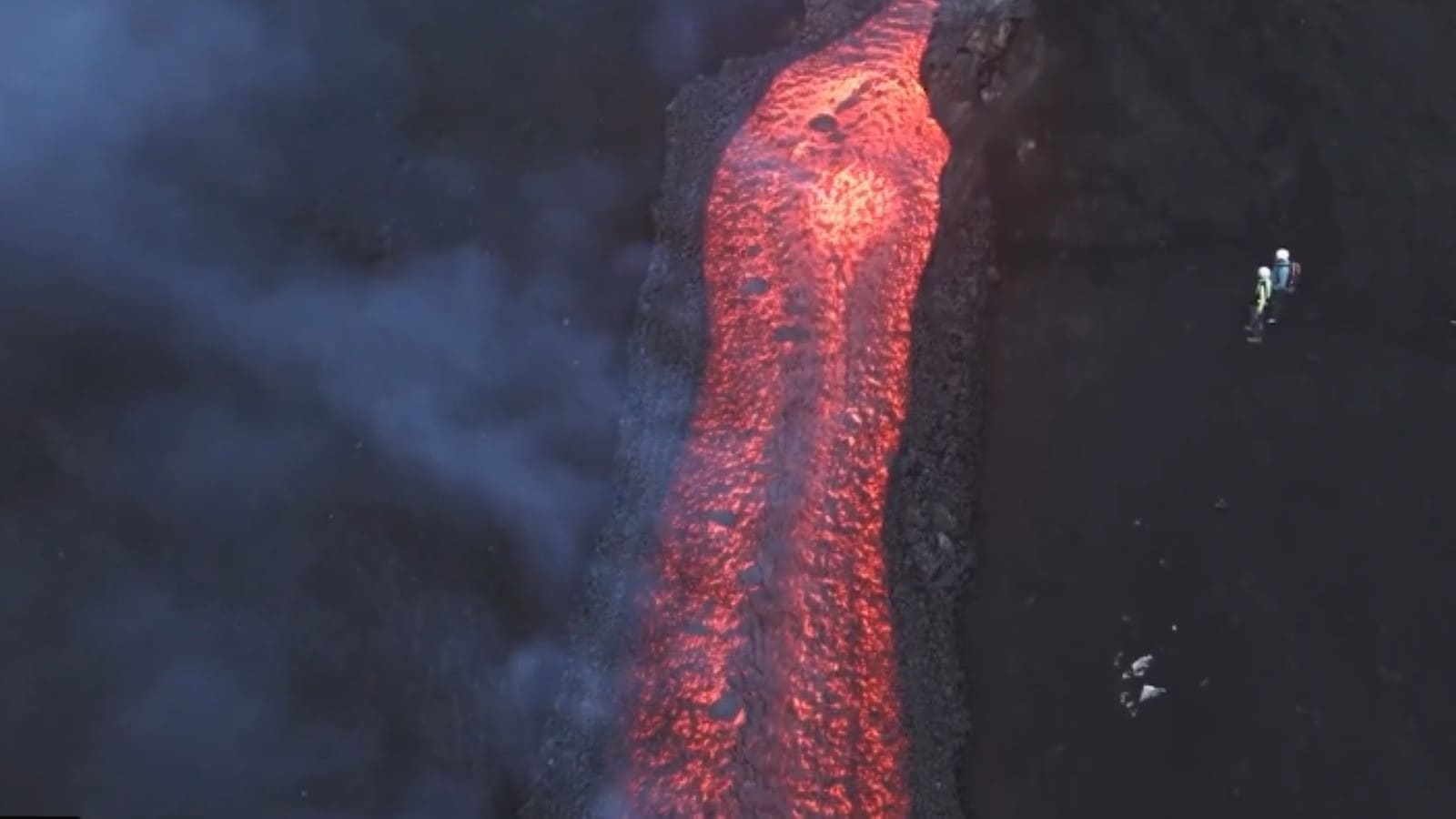
When a major news network runs a headline reading "Watch: Mount Etna eruption creates trail of bright orange lava," the world looks at a screen. They see a spectacular, detached geometric line of neon orange cutting through blue-gray volcanic rock. They see a postcard. A digital spectacle.
But if you stand on the Mareneve road as a fresh fracture opens inside the Valle del Bove, you do not see a postcard. You feel it. A low, sub-audible vibration that settles directly into the center of your chest. It is a frequency that does not travel through the air, but through the soles of your feet, vibrating the ancient limestone foundations of houses that have stood for three centuries.
Consider a man like Marco. He is a hypothetical composite of the third-generation winemakers who cultivate the dark, mineral-heavy soil of Carricante grapes just a few miles below the active craters. To the global public, an eruption is a breaking news alert. To Marco, it is an erratic business partner waking up from a nap.
When the National Institute of Geophysics and Volcanology raises the aviation color code to orange or red, the economic reality hits the ground before the ash does. Flights into Catania’s international airport are diverted. Tourists who booked rooms to taste the crisp, smoky wines of the region find themselves stranded in Palermo or Rome. The bright orange trail is not just molten rock; it is a ribbon of pure uncertainty cutting through a delicate local economy.
The volcano is the tallest active peak in Europe, scraping the sky at over 3,400 meters. But its height is a lie. It changes constantly. A massive eruption in one crater builds a new peak, while a collapse in another drops the summit by dozens of meters in a single afternoon. It is a shape-shifter.
The relationship between the mountain and the people who live beneath it is deeply misunderstood by outsiders. There is a common assumption that those living in the shadow of Etna are trapped in a state of perpetual terror, waiting for the day their lives are erased.
The reality is far more complicated. It is an intimate, daily negotiation.
The volcanic soil is incredibly fertile, packed with potassium, iron, and phosphorus. The mountain gives the locals some of the best agricultural conditions on Earth, producing blood oranges and grapes that cannot be replicated anywhere else. But the tax for that fertility is paid in anxiety.
When a new fissure tears open, the lava moves with a deceptive, heavy slowness. It looks viscous, almost lazy, as it channels into natural depressions. It creeps. It swallows a stone wall here, an old dirt road there. It is easy to watch it from a distance and feel a sense of calm.
But the real problem lies elsewhere. The danger isn't always the slow-moving river of fire that stays contained within the uninhabited valleys. The true threat is the invisible pressure building inside the magmatic plumbing system deep beneath the crust.
Volcanologists track what they call the "b-value"—the ratio of small earthquakes to larger ones happening miles below the surface. When that ratio shifts, it means magma is forcing its way upward, tearing new paths through the solid rock. The bright orange trail on the evening news is just the overflow valve. The real story is the immense, claustrophobic stress happening under the feet of the Sicilians.
Then there is the ash. A cloud of black, glassy dust can rise five miles into the sky, drifting on changing winds. When it falls, it is not soft like wood ash. It is heavy. It is abrasive. It coats the leaves of the citrus groves, blocking the sunlight. It clogs the gutters of medieval churches.
If you walk outside during a heavy ash fall, you hear a faint, distinct sound. Tink. Tink. Tink. Millions of microscopic fragments of volcanic glass hitting the roofs, the cars, and the jackets of people running for cover. It feels warm against the skin, a brief, surreal reminder of the furnace raging miles above.
Living here requires a specific kind of psychological resilience. It forces you to accept that the land beneath you is not permanent. It is a fluid, breathing entity that can alter the landscape over the course of a single weekend.
Visitors often ask the locals why they don't simply move away to a place where the ground stays still. The answer is usually a quiet shrug. To leave the mountain would be to leave the very thing that gives the region its identity, its flavor, and its soul. They do not view the volcano as an enemy. They call it Idda—"She." A maternal, temperamental matriarch who demands respect but provides life.
As night falls over the eastern coast, the true nature of the eruption reveals itself. The smoke disappears into the black sky, leaving only the incandescent glow of the fissure. From the piazza in Milo, the lava flow looks like a jagged neon vein pulsing against the dark silhouette of the mountain.
It is undeniably beautiful. But for those watching from their terraces, sipping wine grown from the very dust falling around them, the beauty is inseparable from the risk. They watch the slow, glowing advance, knowing that the mountain will eventually quiet down, the tourists will return, and the glass on the ground will be swept away once again.