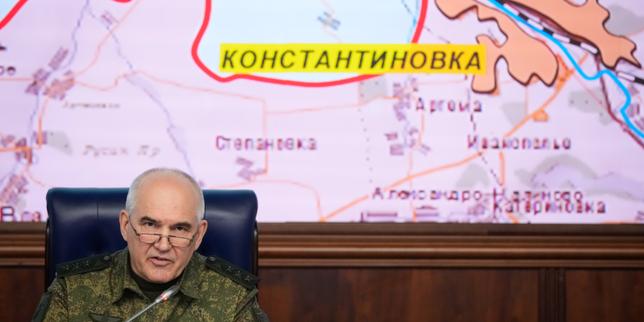
The air in the Donbas does not just carry the scent of sulfur. It carries the weight of waiting. In the eastern Ukrainian town of Kostyantynivka, that waiting has become a physical presence, pressing down on the remaining residents like a low-hanging storm cloud. For months, this railway hub has sat in the crosshairs of geopolitical strategy, a dot on a map that generals covet and empires clash over.
Moscow claimed the town had fallen. Kyiv flatly denied it.
To the global media, it was a fast-breaking headline, a ping on a smartphone screen, a tactical update in an endless war of attrition. But to understand what is actually happening on the ground, you have to look past the military communiqués. You have to look at the dust.
Imagine standing at a deserted intersection where the only sound is the rhythmic creak of a torn metal billboard swinging in the wind. A sudden explosion rattles the windows of a nearby apartment block. It is not close enough to kill, but it is near enough to remind everyone that life here hangs by a thread. This is the reality behind the competing press releases. The Kremlin’s state media spoke of a decisive breakthrough, painting a picture of Russian flags raised over smoking ruins. Almost immediately, the Ukrainian General Staff issued a sharp correction, stating firmly that their soldiers still held the line. The town had not fallen. The battle was very much alive.
War is fought with artillery, but it is sustained by geography. Kostyantynivka is not just another name on a casualty list. It is a vital artery. For years, its rail lines and roads served as the industrial backbone of the region, moving coal, steel, and people across the plains of eastern Ukraine. In military terms, it is a gateway. If the town falls, the defensive network protecting the larger cities of Kramatorsk and Sloviansk begins to fray. It is the domino that both sides know could tip the scales of the entire regional campaign.
That strategic reality translates into a brutal daily calculus for the people who still call it home.
Consider Olena. She is sixty-two, a former schoolteacher who refuses to leave her ground-floor apartment. She represents the invisible stakes of this conflict. While spokesmen in pristine briefing rooms debate territorial control, Olena spends her afternoons organizing jars of preserved beets in her cellar. She knows the sound of every incoming shell. She can tell the difference between a Grad rocket and a mortar blast just by the vibration in her teeth.
When the news broke that Russia claimed total control of her town, Olena was sweeping glass from her kitchen floor. A neighbor ran in, breathless, holding a phone displaying the foreign reports. Olena looked out the window. Down the street, a Ukrainian armored vehicle rumbled past, its crew covered in soot but very much active.
The report was a ghost. The reality was still a fight.
This discrepancy highlights the secondary front of modern warfare: the information space. The declaration of victory is often used as a weapon itself, designed to demoralize defenders and convince international observers that resistance is futile. By claiming Kostyantynivka had been captured, the advancing forces attempted to create a psychological fait accompli. If the world believes a position is lost, the political will to support its defense begins to erode.
But lines on a map are stubborn things. The Ukrainian military's denial was not just a public relations exercise; it reflected a fierce, block-by-block resistance. Military analysts who track the conflict through satellite imagery and open-source intelligence confirmed that while Russian forces had pushed into the eastern outskirts, the core of the town remained a contested labyrinth.
The tragedy of Kostyantynivka lies in this very limbo. To be "contested" means to endure a slow, grinding pulverization. Every street becomes a trench. Every basement becomes a bunker. The industrial infrastructure that once gave the town life is systematically dismantled by heavy explosives. The local glassworks, once a pride of the community, is now a skeleton of twisted girders.
The human cost of this stalemate is measured in small, heartbreaking details. It is found in the lack of running water, forcing volunteers to haul plastic jugs through artillery fire to reach elderly residents. It is found in the makeshift graves dug in front yards because the local cemetery is under constant bombardment.
The international community watches these developments through a lens of abstract strategy. Analysts discuss logistics, supply lines, and ammunition burn rates. They calculate whether Ukraine can hold the industrial heartland or if Russia's mass-heavy tactics will inevitably flatten everything in their path. These calculations are necessary, but they frequently obscure the sheer exhaustion of the individuals keeping the machinery of defense moving.
The soldiers holding the western sectors of the town are not mythic heroes; they are tired men and women operating on three hours of sleep, fueled by cheap coffee and adrenaline. They know that a denial from the General Staff in Kyiv means they must continue to hold the line, no matter how heavy the iron raining down upon them becomes.
As the sun sets over the Donbas, the artillery fire usually intensifies. The flashes light up the horizon, casting long, dancing shadows across the empty parks where children used to play. The competing narratives from Moscow and Kyiv will continue to flood the digital airwaves, each side insisting on its own version of reality.
But the truth remains grounded in the dirt and concrete of the town itself. Kostyantynivka has not surrendered its identity to a headline. It exists in the stubborn determination of the soldiers ducking into the ruins, and in the quiet resolve of civilians like Olena, who blew out her single candle as the shelling started again, waiting out the night in a town that refuses to become a memory.