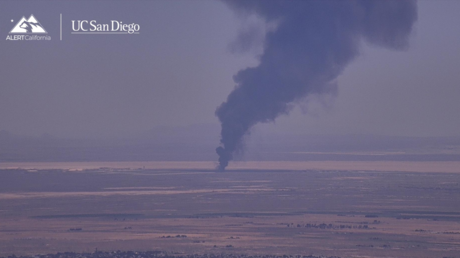
A massive column of thick, black smoke rising above the Mojave Desert just rewrote the script for the future of American airpower. On Monday morning, a U.S. Air Force B-52 Stratofortress heavy bomber crashed shortly after takeoff at Edwards Air Force Base in Southern California. Eight people were on board. Military officials confirmed that the crash was not survivable.
It's a devastating loss. The dead include a mix of uniformed military personnel and defense contractors. Aerial footage of the scene, located about 100 miles north of Los Angeles, shows a harrowing sight: a blackened, smoldering patch of desert roughly the size of a football field. The airframe itself was basically vaporized. There are no large pieces of debris visible.
People are looking at this tragedy and asking the obvious question: why are we still flying eight-engine behemoths that first entered service during the Eisenhower administration?
The answer is complicated, tied up in military hardware updates and global standoffs. But this accident exposes the thin line the military walks when forcing 70-year-old airframes to carry 21st-century technology.
Inside the Flight Track of the Edwards Air Force Base Disaster
The flight lasted only moments. At 11:20 a.m. local time, the B-52 took off from the runway at Edwards Air Force Base on what officials called a routine test mission.
Radar tracking data reveals a terrifying final sequence. The bomber initially headed northeast, gradually turning north. Then, it abruptly hooked northwest and plunged toward the desert floor at a rate exceeding 5,000 feet per minute.
The speed and violence of the descent left no time for emergency maneuvers or ejection. A standard B-52 crew consists of five people: an aircraft commander, pilot, radar navigator, navigator, and electronic warfare officer. Monday's flight carried eight, a common setup for test missions where engineers and contractors tag along to monitor experimental systems in real time.
Col. James Hayes, deputy commander for the 412th Test Wing, noted that a full investigation could take up to six months. However, aviation safety experts are already pointing to specific vulnerabilities. Jeff Guzzetti, a former accident investigator for the FAA and NTSB, stated that the quick plunge points toward a severe controllability issue. This could mean flight controls were rigged incorrectly during recent maintenance, or a massive mechanical failure occurred.
The Upgrades That Pushed a Cold War Icon Too Far
This wasn't just an old plane out for a spin. This specific aircraft was part of a high-stakes military modernization push. Col. Hayes confirmed the flight was supporting the Air Force’s Radar Modernization Program.
In 2025, Boeing delivered a specialized B-52 variant to Edwards equipped with a new Active Electronically Scanned Array (AESA) radar system. The Air Force scheduled aggressive ground and flight testing for this system throughout 2026. The goal was to replace the obsolete radar tech currently keeping the fleet lagging behind modern adversaries.
Testing new tech on a vintage airframe introduces immense risk. You're combining modern digital systems with mechanical flight controls engineered in the 1950s. When you modify an aircraft’s nose to fit a massive new radar array, you alter its aerodynamics, its weight distribution, and its electrical load.
Historically, the B-52 is a resilient platform. Before Monday, the last major Stratofortress crash happened a decade ago in May 2016 on the island of Guam, where all seven crew members survived. But testing experimental hardware elevates the danger. As Guzzetti noted, flight tests are inherently risky, which is exactly why they rely on highly specialized test pilots and strict safety protocols. This time, something failed catastrophically.
The Problem with Keeping a 70 Year Old Fleet Flying
The Air Force operates under brutal operational strain. The military has surged fighter jets, refueling tankers, and heavy bombers into the Middle East to project dominance. The remaining fleet of roughly 70 B-52 bombers carries a massive share of that burden.
Military planners intend to keep the B-52 flying past 2040. By then, the airframe will be nearly a century old. The plan is to fly these Cold War relics alongside the upcoming B-21 Raider stealth bomber. Retired Lt. Gen. David Deptula recently warned that today’s Air Force is the oldest and smallest it has ever been, arguing that the nation cannot keep asking an aging fleet to meet global security demands without experiencing these exact kinds of breaking points.
Maintaining these planes is a logistical nightmare. Parts aren't manufactured anymore; technicians frequently have to custom-fabricate components or salvage them from retired aircraft sitting in the Arizona boneyard. When you pack these older airframes with modern electronics and push them through high-stress test flights, the margin for error drops to zero.
The immediate next step for the pentagon is a complete safety stand-down of the testing program at Edwards Air Force Base. Investigators will spend the coming weeks analyzing the flight data recorder, checking maintenance logs, and studying the telemetry from the radar test equipment to find out exactly what locked up those flight controls. For now, the crash serves as a grim reminder of the real human cost of keeping an aging military tech stack on life support.