The cancellation of flights between Hong Kong and the Middle East following US-Israeli kinetic operations against Iranian targets is not merely a localized logistical failure but a systemic breakdown of the global "mid-continent" transit model. For airlines like Cathay Pacific and regional competitors, the closure of sovereign airspace creates a multi-dimensional cost spike that transcends fuel surcharges. When the Persian Gulf and the Levant become active combat theaters, the primary casualty is the efficiency of the Great Circle route—the shortest distance between East Asia and Europe. This analysis deconstructs the structural impact on aviation networks, the economics of rerouting, and the permanent shift in risk assessment for long-haul carriers.
The Triad of Operational Displacement
Aviation disruptions of this magnitude are governed by three primary pressures: legal mandates, physical safety, and the "yield-to-cost" inversion.
NOTAM and Regulatory Compliance: Civil aviation authorities (CAAs) issue Notices to Air Missions (NOTAMs) that effectively act as digital fences. Once the FAA or the Hong Kong Civil Defense Department flags a region as a high-risk combat zone, insurance premiums for airframes (Hull War Risk) skyrocket. Carriers do not cancel flights because they fear a single missile; they cancel because the cost of insuring a $400 million Airbus A350 for a single transit over a conflict zone becomes actuarially impossible.
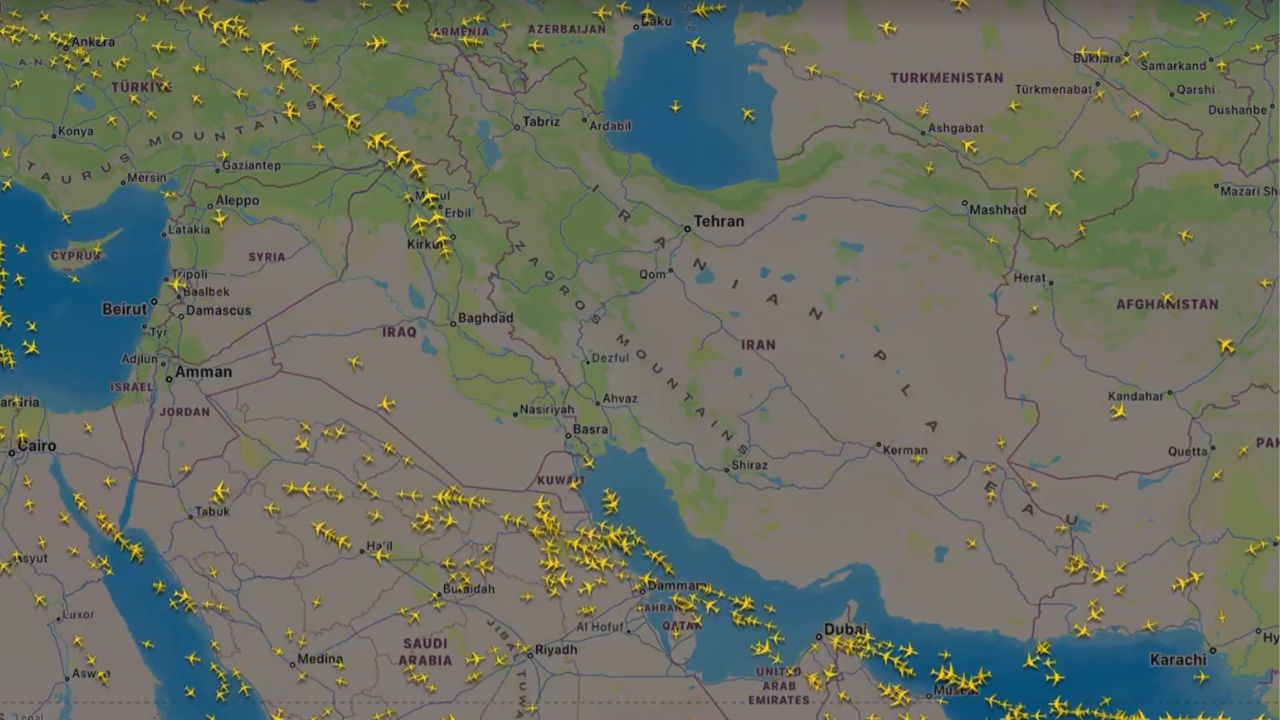
Airspace Chokepoints: The Middle East serves as the world’s most critical "overflight" corridor. When Iranian, Iraqi, or Syrian airspace is restricted, the traffic is funneled into the "Baku Corridor" (Azerbaijan/Caspian Sea) or pushed south over the Arabian Peninsula and Egypt. This creates a capacity bottleneck where Air Traffic Control (ATC) must increase the longitudinal separation between aircraft, causing systemic delays that ripple back to Hong Kong International Airport (HKIA).
Crew Duty Limitations: Long-haul flights are precision-tuned to stay within "Flight Duty Period" (FDP) limits. A 90-minute detour to avoid Iranian ballistic trajectories can push a crew over their legal 14-hour limit. If an aircraft cannot reach its destination within the FDP, it must divert to a secondary hub to swap crews—a maneuver that costs upwards of $150,000 per occurrence in landing fees, hoteling, and passenger compensation.
The Physics of Fuel and Payload Degradation
The most significant miscalculation in general reporting is the assumption that a detour is a simple matter of "flying longer." In the physics of ultra-long-haul (ULH) travel, weight and fuel are in a non-linear relationship.
The Tankering Penalty To fly around a closed Iranian airspace, an aircraft must carry "contingency fuel." However, carrying more fuel increases the aircraft's gross weight, which in turn requires burning more fuel just to carry the extra fuel. This is known as the "fuel-to-burn" ratio. On a flight from Hong Kong to London, adding two hours of flight time might require an additional 15 tons of fuel. To accommodate this weight, the airline must often "bump" revenue-generating cargo or passengers. This creates a "double-loss" scenario: increased operating expenses (OPEX) combined with decreased revenue-per-available-seat-mile (RASM).
Extended-range Twin-engine Operational Performance Standards (ETOPS) Modern aircraft like the Boeing 787 or Airbus A350 are rated for ETOPS, which dictates how far they can be from an emergency diversion airport. As conflict zones expand, the number of "safe" diversion airports (like Tehran or Baghdad) drops to zero. This forces flight planners to hug coastlines or alternative borders, further lengthening the flight path to ensure they remain within a 180-minute or 240-minute radius of a functional, friendly runway.
Mapping the Geopolitical Risk Function
The current Hong Kong-Iran friction reveals a deeper shift in how "hub and spoke" networks function. Hong Kong’s status as a premier transit hub depends on its ability to offer predictable, time-efficient connections to the West.
- The Northern Route Constraints: The ongoing closure of Russian airspace to Western-aligned carriers (including those based in Hong Kong) had already pushed traffic southward. The US-Israeli-Iranian escalation effectively closes the "Southern Escape Route."
- Carrier Asymmetry: State-owned Middle Eastern carriers (the "ME3" — Emirates, Qatar, Etihad) often maintain different risk thresholds than Asian or Western carriers. If HK-based carriers cancel flights while Gulf carriers continue to fly via specialized corridors, a massive market share migration occurs. This is not a temporary dip; it is a permanent realignment of passenger loyalty toward whichever carrier demonstrates the highest "operational uptime" during regional instability.
Structural Vulnerability in the "Just-in-Time" Cargo Model
Hong Kong is the world’s busiest air cargo hub. The belly-hold capacity of passenger flights represents nearly 40% of the total freight capacity out of HKIA. When passenger flights are cancelled due to the Iranian conflict, the global supply chain for high-value electronics and perishables undergoes an immediate cardiac arrest.
The "Cargo-to-Fuel" bottleneck:
- Priority 1: Minimum fuel for the flight (Non-negotiable).
- Priority 2: Contingency fuel for weather/rerouting (Safety requirement).
- Priority 3: Passenger baggage.
- Priority 4: Revenue cargo.
In a conflict-rerouting scenario, Priority 4 is always the first to be sacrificed. Consequently, even if a flight is not cancelled, the "economic throughput" of that flight drops significantly. For the Hong Kong economy, which leverages its geography as a competitive advantage, the Middle Eastern "shuttering" of airspace is a direct tax on its GDP.
The Strategy of Strategic Diversification
Airlines must now move away from "Reactionary Planning" toward "Predictive Airspace Hedging." This involves several tactical shifts:
- Synthetic Flight Planning: Utilizing AI-driven weather and conflict modeling to simulate 500+ permutations of a flight path 24 hours before takeoff. This allows the airline to pre-purchase fuel at alternative hubs (like Mumbai or Istanbul) if a diversion is statistically likely.
- Intermodal Redundancy: Strengthening sea-air links via Dubai or Singapore. If the air corridor over Iran is severed, cargo must be able to transition seamlessly to maritime or rail-bridge solutions without renegotiating contracts.
- Dynamic Fleet Reassignment: Moving smaller, long-range aircraft (like the A321XLR) onto routes that were previously served by wide-bodies. Smaller aircraft have lower "trip costs," making a detour less financially catastrophic than flying a half-empty, fuel-heavy Boeing 777.
The escalation between the US, Israel, and Iran is no longer a localized geopolitical event; it is a permanent variable in the global aviation cost-basis. Carriers that continue to view these disruptions as "black swan" events will be outcompeted by those that treat airspace volatility as a standard operational cost.
Immediate action requires the transition of the "Operations Control Center" (OCC) from a scheduling department to a real-time risk-arbitrage unit. This unit must be empowered to cancel flights 48 hours in advance based on SIGINT (Signals Intelligence) and NOTAM trends, rather than waiting for an active kinetic strike. Early cancellation allows for the re-routing of passengers via the Trans-Pacific corridor, which—while longer—offers a 100% stability rating compared to the 60% stability of the Euro-Asian Southern corridor during active hostilities.
The objective is to minimize "AOG" (Aircraft on Ground) time. Every hour a Cathay Pacific or Qatar Airways jet sits at HKIA due to Iranian airspace volatility, the carrier loses approximately $25,000 in opportunity cost and fixed depreciation. The strategy is clear: bypass the "Conflict Tax" by pivoting to trans-polar or trans-pacific vectors, even if it means abandoning the legacy efficiency of the Middle Eastern hub model for the duration of the current 24-month geopolitical cycle.