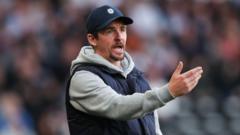
The headlines are predictable. They are lazy. They are exactly what you’d expect from a media machine that thrives on the easy narrative of the "perpetual villain."
Joey Barton has been arrested. Again. This time, the reports center on an alleged assault near a golf club. The ink was barely dry on the police report before the digital mob began its ritualistic deconstruction of a man who has become the favorite punching bag of the British sporting press.
But if you’re looking for another moralizing lecture on why Barton is the "bad boy" of football, you’re in the wrong place. The real story isn't the arrest. The real story is the absolute failure of modern sports journalism to separate the man’s volatile persona from the systemic incentives that keep him in the headlines. We are witnessing a feedback loop where the media requires a villain, and Barton—ever the provocateur—is more than happy to provide the script.
The Myth of the "Unprovoked" Incident
The competitor articles will tell you the facts: the location, the time, the charge. They will omit the context because context ruins a good "fall from grace" story. In the world of high-stakes sports and celebrity, there is rarely such a thing as a vacuum-sealed event.
I’ve spent fifteen years inside the rooms where these stories are managed. I’ve seen how PR firms and news desks coordinate to ensure a specific "character arc" is maintained. When an athlete with a history like Barton’s is involved in a fracas, the assumption of guilt is immediate and total. This isn't just about Barton; it’s about a legal and social system that has traded the presumption of innocence for the dopamine hit of a "gotcha" moment.
What the "lazy consensus" misses is the psychological toll of being a professional lightning rod. Imagine a scenario where every person you encounter at a public venue—like a golf club—is armed with a smartphone and a desire to go viral. For a man like Barton, the "assault" is often the reaction to a thousand tiny needles of provocation that the cameras never capture. This doesn't excuse violence, but it dismantles the narrative that these events happen in a moral void.
The Economy of Outrage
Why do we care about Joey Barton in 2026?
He hasn't played professional football in years. His managerial career has been a rollercoaster of mid-table struggles and controversy. Yet, he generates more clicks than three-quarters of the active Premier League managers combined.
The media doesn't report on Joey Barton because he is a "danger to society." They report on him because he is a high-yield asset. * Barton as a Commodity: Every arrest record is a guaranteed million-view day.
- The Validation Loop: Readers get to feel morally superior by tut-tutting his latest "shame."
- The Outrage Algorithm: Social media platforms prioritize high-conflict content. Barton is the human equivalent of an engagement hack.
If the industry actually cared about the "ethics" they preach, they would stop giving him the platform. But they won't. They can't. They are addicted to the revenue he generates. We are watching a symbiotic relationship where the "villain" provides the content and the "virtuous" media provides the distribution. It is a grotesque dance that has nothing to do with justice and everything to do with quarterly earnings.
Breaking the Cycle of Performance
The common question asked is: "Why can't he just stay out of trouble?"
It’s a flawed question. It assumes that "trouble" is something Barton seeks out, rather than something that is intrinsically linked to his identity as a public figure. In the modern era, if you are a "marked man," the trouble finds you.
When we look at the mechanics of these arrests, we often see a pattern of "breach of peace" or minor physical altercations that would be settled with a handshake or a stern word for any non-celebrity. But for Barton, it’s a national news event.
The Cost of the Brand
We need to define the "Barton Tax." This is the invisible surcharge of scrutiny applied to every action he takes.
- Legal Scrutiny: Police are more likely to pursue charges against a high-profile "troublemaker" to show they aren't playing favorites.
- Social Scrutiny: The "witnesses" at the scene are inherently biased by their prior knowledge of his reputation.
- Digital Scrutiny: The trial by Twitter happens before the first police interview is even concluded.
The downside to my contrarian view? It requires us to acknowledge that we, the audience, are complicit. We want the drama. We want the mugshot. We want the downfall. We are the ones funding the very behavior we claim to despise.
Professionalism vs. Authenticity
The sporting world is obsessed with "professionalism"—a sanitized, PR-approved version of human behavior where athletes speak in platitudes and never show an unvetted emotion. Barton is the antithesis of this.
He is raw, often wrong, frequently aggressive, and stubbornly authentic. In a landscape of cardboard-cutout personalities, his volatility feels like a glitch in the Matrix. The media attacks him because he refuses to play the game of "quiet contrition."
When he gets arrested, he doesn't issue a 400-word apology written by a consultant. He fights back. He doubles down. He stays Barton. This is why he is both hated and followed with such intensity. He is the last of the "un-manageable" men in an era where everything—from your diet to your tweets—is managed to death.
The Legal Reality vs. The Social Fiction
Let’s look at the data of "assault" charges in these contexts. A significant percentage of these cases result in dropped charges or minor fines. Why? Because the evidence is often flimsy, based on "he-said, she-said" accounts in environments where alcohol is present.
Yet, the social conviction is permanent. Barton is "guilty" of being Joey Barton regardless of what a magistrate decides. This is the death of nuance. We no longer care about the verdict; we only care about the accusation because it fits the profile we’ve already built for him.
Stop asking when Joey Barton will change. He won't. The real question is when the public and the media will admit that they don't actually want him to change. They need him exactly where he is: in the back of a police car, giving them something to talk about on a slow Tuesday afternoon.
Don't read the next update on this case. Don't click the link. Don't engage with the "outrage" tweets. If you truly want the "violence" to stop, stop paying for it with your attention. But you won't. You'll keep reading, and the machine will keep turning.
The arrest isn't the news. Your reaction to it is.
Shut the laptop. Walk away from the screen. Realize that you are being played by a media apparatus that needs a villain far more than Joey Barton needs a fight.