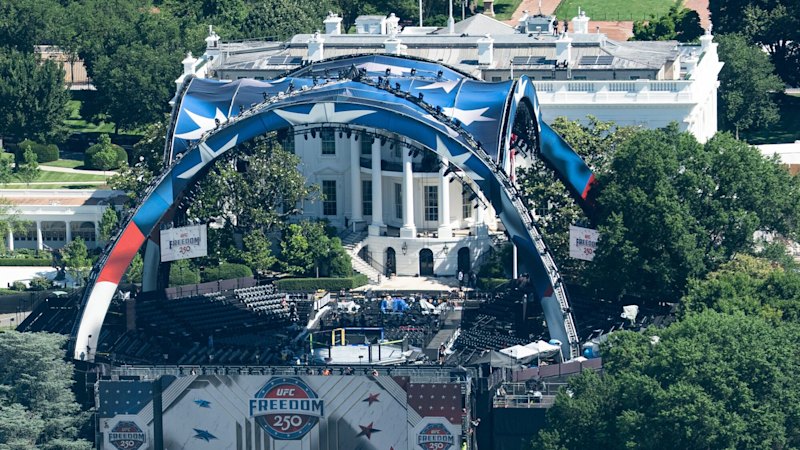
The air inside the arena tastes of stale beer, expensive cologne, and the distinct, metallic tang of anticipatory sweat. Twenty thousand people are screaming, their voices fusing into a low, vibrating roar that rattles the concrete beneath your boots. Lights—blinding, theatrical, blood-red—slice through the rising haze of vape smoke. In the center of it all sits the Octagon, a chain-link cage where two men are currently preparing to break each other’s bones.
Then, the music changes. The crowd shifts. The focus pivots away from the warriors in four-ounce gloves to a man walking down the arena steps.
Donald Trump moves through the sensory assault of a Ultimate Fighting Championship event with the practiced ease of a Roman emperor entering the Colosseum. He wears the familiar uniform: the boxy dark suit, the crimson tie hanging just a bit too low, the unmistakable crest of spun-gold hair. Beside him walks Dana White, the UFC’s bald, hyper-masculine frontman, acting as both hype man and bodyguard. The ovation is deafening. It is a visceral, throat-shirking wall of sound that has nothing to do with policy papers or legislative victories.
It is about raw power.
To understand why a former president and current political candidate spends his critical weekend hours cageside, you have to understand the mathematics of human optics. Outside these walls, the headlines are brutal. Legal battles loom like thunderstorms. Polling data fluctuates with every news cycle, and the traditional machinery of politics feels increasingly fractured, sterile, and hostile.
But inside the cage, the rules are simple. One man stands. One man falls. By immersing himself in this theater of unapologetic dominance, Trump isn’t just watching a sport. He is borrowing its skin.
Imagine a man standing before a mirror before a massive job interview. He doesn't look at his resume; he adjusts his posture. He puffs his chest. He practices a lower, more authoritative vocal register. This is the primal instinct of the political animal. When the world accuses you of vulnerability, you do not retreat to a library to write a defense. You go to the loudest, most aggressive room on the planet and let the noise wash over you.
The relationship between the political right and the cage-fighting world isn't an accident. It is a perfectly engineered cultural marriage. For decades, traditional American sports like football and baseball have become battlegrounds for cultural wars. They grew corporate, carefully curated, and deeply concerned with public relations.
The UFC went the other way.
It remained unapologetically raw. It embraces conflict, blood, and trash-talk that borders on the malicious. For a specific, massive demographic of young men who feel alienated by modern corporate culture, the Octagon represents the last bastion of unfiltered reality. When Trump steps into that space, he isn’t just a politician looking for votes. He is a tribal leader claiming his territory.
Consider the contrast of a typical campaign stop versus a cageside appearance. A standard rally is a controlled environment. The podium is vetted; the crowd is pre-screened; the applause is expected. It can feel like theater. But the UFC is chaotic. It is live. It is dangerous. By placing himself in the front row, inches away from flying sweat and canvas stained with real blood, Trump projects an aura of fearlessness. The unspoken message to the viewer at home is clear: If I can handle this room, I can handle anything.
The strategy works because humans are hardwired to respond to physical cues of strength. Long before we invented constitutions, political parties, or economic theories, our ancestors gathered around fires to choose leaders based on who could hunt the longest and fight the fiercest. We like to think we have evolved past these caveman metrics. We haven't. The modern political arena is just a slightly more polite version of the savannah, and a UFC broadcast is the closest thing we have left to a gladiator tournament.
Every fighter who wins a bout and grabs the microphone to shout out the former president adds another brick to this fortress of projection. These athletes are peak physical specimens, men and women who face the terrifying reality of combat for a living. When they bow, shake his hand, or dedicate their victories to him, that warrior credibility transfers through the television screen directly to Trump.
It is a masterful illusion of invincibility. It creates a narrative where he is not a man beset by courtroom dramas and political opposition, but a gladiator who has simply stepped out of the cage for a moment to wave at his fans.
But shadows always linger at the edge of the bright stadium lights. The real world doesn’t disappear just because a referee raises a fighter's hand. The strategy of projecting absolute strength is a high-stakes gamble. It requires a flawless performance, every single time. The moment the posture slips, the moment the roar of the crowd turns to a whisper, the illusion shatters.
The fighters in the cage know this truth intimately. You can look invincible for four rounds, dominating every exchange, slipping every punch, appearing like a god made of muscle and resolve. But the fight isn't over until the final bell rings. A single, unseen left hook can find your chin in the dying seconds of the match. The canvas is always waiting, indifferent to who you used to be, ready to catch you when you fall.
The music swells again as the night winds down. The arena begins to empty, leaving behind a graveyard of crushed plastic cups and discarded fight programs. The champion has been crowned, the blood has been wiped from the mat, and the blinding lights finally begin to dim. Outside, the night air is cold, waiting with the quiet, stubborn reality of tomorrow's headlines.