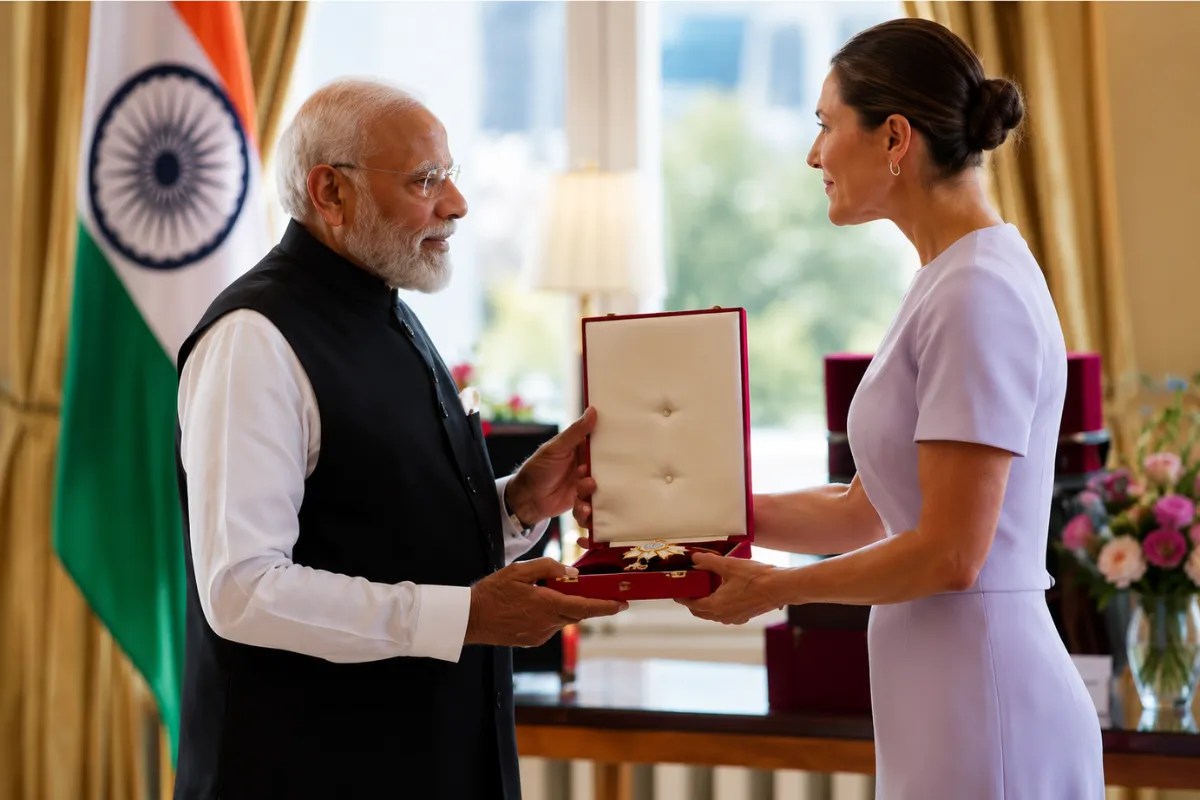
The conferral of Sweden’s highest civilian honor, the Royal Order of the Polar Star, upon Prime Minister Narendra Modi marks the 31st international award received during his tenure. Standard media narratives treat these events as isolated diplomatic photo-opportunities or mere symbolic gestures. This view miscalculates how modern nation-states convert sovereign prestige into tangible geopolitical equity. State honors operate as a highly calibrated signaling mechanism within international relations, functioning as a non-monetary currency that quantifies bilateral alignment, strategic dependence, and shared long-term objectives.
To understand the systemic impact of this 31st award, one must move past the superficial tally and analyze the underlying mechanics of honor diplomacy. This requires breaking down the strategic utility of state honors into structured operational pillars, examining the cause-and-effect relationship between institutional recognition and economic alignment, and evaluating the limitations inherent in this form of soft-power maximization.
The Tri-Border Framework of Sovereign Recognition
International state honors are not distributed arbitrarily; they follow a strict logic dictated by three distinct structural pillars. Each pillar serves a specific function in a nation's foreign policy architecture.
1. The Geostrategic Alignment Pivot
Honors from Western and European nations, such as Sweden's Royal Order of the Polar Star, serve as formal validations of institutional convergence. When a nation bestowes its highest order upon a foreign leader, it signals to its domestic electorate and global allies that the recipient nation is a critical node in its security or economic network. In this instance, the award functions as a structural anchor, binding India's massive market scale with Sweden's advanced industrial and defense capabilities.
2. The Civilizational and Regional Bridge
Awards from the Middle East (such as the highest civilian honors from Saudi Arabia, the UAE, and Bahrain) and the Pacific Island nations represent a different strategic vector. Here, the honors operate as tools of diplomatic de-risking. For India, these awards neutralize historical friction points, secure energy supply chains, and establish maritime security partnerships. The mechanism at play is reciprocity: the honoring nation secures a stable, high-growth economic partner, while the recipient nation solidifies its position as a multi-aligned global power.
3. The Global South Consensus Node
Honors from African and Latin American nations build institutional capital within multilateral forums like the United Nations. By accumulating these awards, a state establishes a visible ledger of goodwill, which translates into voting blocs and collective bargaining power on issues ranging from climate finance to counter-terrorism architecture.
The Transmission Mechanism: From Prestige to Capital
The core error of conventional analysis is the failure to map how a symbolic medal translates into measurable economic and security outcomes. The transmission mechanism operates through a predictable chain of institutional steps.
State Honor Conferral ➔ Sovereign Risk Reduction ➔ Institutional Investor Confidence ➔ Foreign Direct Investment (FDI) Inflow
When Sweden awards the Royal Order of the Polar Star, it reduces the perceived political risk for Swedish multinational corporations operating or planning to invest in India. Companies like Ericsson, Volvo, and SAAB do not make capital allocation decisions based on sentiment; however, they utilize state-level honors as a green light from their home government indicating long-term bilateral stability.
This creates a dual-benefit loop:
- Defense Technology Transfer: European nations possess sophisticated military-industrial frameworks but lack the scale of domestic markets to sustain long-term research and development. India provides the consumption scale. The honor signals a willingness to engage in co-development and deep technology sharing, moving beyond a simple buyer-seller dynamic.
- Green Transition Capital: Sweden leads in sustainability infrastructure, carbon-neutral manufacturing, and smart-city frameworks. The diplomatic proximity signaled by the award accelerates institutional capital flows into India’s clean energy sector, helping bridge the capital expenditure gap required for industrial decarbonization.
The Quantification of 31 Awards: Portfolio Analysis
Accumulating 31 international awards across a twelve-year trajectory changes the nature of a nation's diplomatic leverage from a series of bilateral agreements into an integrated portfolio of global influence.
| Dimension | Early-Phase Honors (1-10) | Mid-Phase Honors (11-20) | Advanced Portfolio Phase (21-31) |
|---|---|---|---|
| Primary Objective | Establishing basic bilateral credibility and overcoming legacy diplomatic inertia. | Expanding regional footprints, particularly in the Middle East and Southeast Asia. | Consolidating major power status and securing critical technology and supply chain nodes. |
| Strategic Focus | Energy security and diaspora engagement. | Infrastructure investment and maritime security collaboration. | High-tech co-development, defense integration, and multilateral reform leadership. |
| Leverage Type | Reactive (responding to immediate regional shifts). | Active (shaping regional partnerships). | Structural (influencing global policy architectures). |
The transition to the advanced portfolio phase alters how India negotiates on the global stage. It establishes a baseline of diplomatic immunity against unilateral economic coercion. When a state possesses deep, honored relationships across competing geopolitical blocs—such as receiving top honors from both Western democracies and Middle Eastern absolute monarchies—it minimizes its vulnerability to the polarization of global supply chains.
Strategic Bottlenecks and Structural Limitations
An objective analysis must outline the limitations of honor diplomacy. These awards are leading indicators of diplomatic intent, not lagging indicators of structural economic integration.
The first limitation is the implementation gap. A state honor can clear bureaucratic friction at the highest political levels, but it cannot fix localized structural bottlenecks such as land acquisition delays, complex regulatory frameworks, or contract enforcement deficits within the recipient nation. If the domestic economic apparatus fails to capitalize on the political goodwill generated by the Royal Order of the Polar Star, the honor remains an underutilized asset on the diplomatic balance sheet.
The second limitation involves the risk of diminishing returns. As the volume of international honors approaches a critical mass, the marginal utility of each subsequent award decreases in terms of domestic public relations and global media impact. The focus inevitably shifts from the quantity of accolades to the execution metrics of the bilateral joint statements signed in tandem with those awards.
The Defense-Industrial Playbook
The immediate operational priority following the Swedish conferral lies within the defense and advanced engineering sectors. Sweden's defense architecture relies heavily on niche technological dominance, particularly in submarine stealth capabilities, radar systems, and fighter jet aviation. India’s strategic mandate requires the indigenization of these exact technologies to counter regional security imbalances.
The strategic play is to leverage this high-point in bilateral relations to bypass standard bureaucratic defense procurement cycles. This involves establishing joint ventures structured around intellectual property co-ownership rather than simple licensed manufacturing. By tying the prestige of the Royal Order of the Polar Star to concrete targets in defense-industrial corridors, the symbolic capital is converted directly into national security capabilities.
The trajectory from the first international honor to the 31st demonstrates a deliberate shift from seeking global acceptance to exercising global choices. The metrics that matter moving forward are not the weight of the medals received, but the volume of high-tech manufacturing plants broken ground, the dollar value of sovereign wealth funds deployed, and the cross-border institutional frameworks established under the canopy of this sovereign prestige.