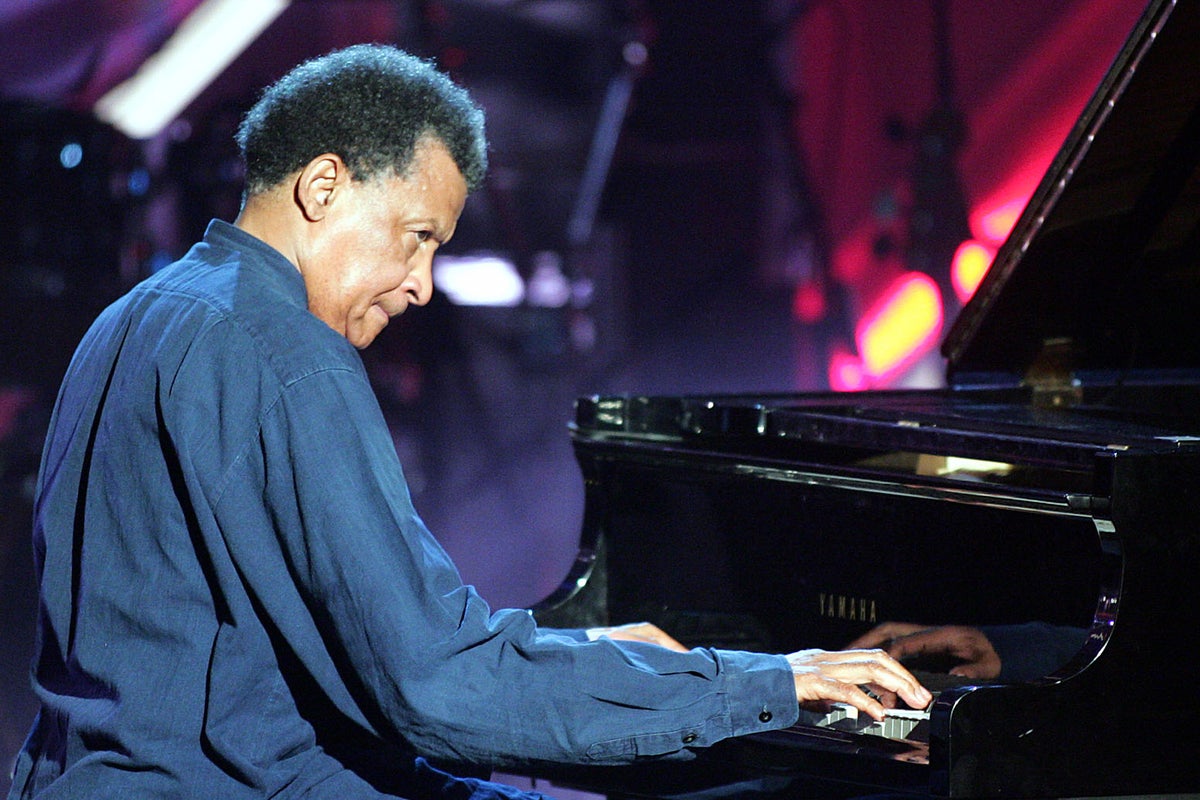
The death of Abdullah Ibrahim in Germany at age 91 marks the conclusion of a seven-decade operational case study in cultural autonomy and geopolitical resistance. Standard musicology frequently treats jazz as a purely aesthetic phenomenon, relying on subjective descriptors like "unique blend" or "cultural ambassador." This approach obscures the precise structural mechanisms through which Ibrahim—initially performing as Dollar Brand—engineered a distinct sonic architecture capable of surviving state-enforced censorship and driving political mobilization.
Ibrahim did not merely mix genres; he constructed a highly organized, dual-axis musical framework. By identifying and isolating the technical vectors of his work, we can analyze how music functions as a tool of political economy and collective resilience during structural oppression. If you enjoyed this piece, you might want to read: this related article.
The Dual-Axis Compositional Framework
The foundational engine of Ibrahim's work relies on a systematic synthesis of two distinct musical traditions. This synthesis operates on a deliberate structural strategy rather than casual improvisation.
       [Global Jazz Improvisation] (Ellington/Monk)
                   ▲
                   │   Vector: Dissonance & Form
                   │
                   ┼──────────────────► [Local Sonic Traditions]
                   │   Vector: Harmonic Stasis  (Marabi/Mbaqanga/Hymns)
                   │
                   ▼
     [Synthetic Hybrid: "Mannenberg" / The Cape Jazz Model]
1. The Local Axis: Harmonic Stasis and Communitarian Rhythm
The base infrastructure of Ibrahim’s style is anchored in the traditional forms of the Western Cape, specifically marabi and mbaqanga, alongside African Methodist Episcopal church hymns and Cape Malay choral music. Marabi utilizes cyclical, short harmonic progressions—frequently a predictable, repeating $I - IV - I^6_4 - V$ pattern. For another angle on this development, check out the latest update from Deadline.
This structural choice prioritizes harmonic stability over rapid chord changes. The rhythmic foundation functions as a collective locomotive drive, maximizing sonic accessibility and facilitating group participation. It mimics structural repetition to create a shared, communal space.
2. The Global Axis: Discursive Modernism
Superimposed upon this local foundation were the harmonic and structural principles of mid-century American avant-garde jazz, learned directly through mentorship from Duke Ellington and immersion in New York’s creative ecosystem alongside figures like Max Roach, Ornette Coleman, and Thelonious Monk. From Ellington, Ibrahim adopted programmatic orchestrations and highly voiced chords. From Monk, he extracted the deliberate use of space, asymmetric phrasing, and stark, percussive dissonance.
The collision of these two axes created an operational friction. The local axis provided a steady, predictable rhythmic and harmonic safety net, while the global axis introduced complex, modernist disruption. This deliberate tension prevented the music from dissolving into commercial pop or alienating avant-garde abstraction.
The Economics and Architecture of "Mannenberg"
The structural utility of this framework is best demonstrated by Ibrahim's 1974 composition, "Mannenberg." Recorded during a period of intense state crackdowns following the 1960 Sharpeville massacre and subsequent banning of political organizations, the track serves as a model of tactical cultural distribution.
+-------------------------------------------------------------------+
|               "MANNENBERG" SYSTEMIC PROPAGATION                   |
+-------------------------------------------------------------------+
|                                                                   |
|  [Production Phase]                                               |
|  - Cape Jazz Hybridization (Marabi Cycle + Avant-Garde Voicings)  |
|  - High Sonic Accessibility = Accelerated Public Adoption         |
|                                                                   |
|  [Distribution Phase]                                             |
|  - Decentralized Audio Smuggling (Cassette Tapes)                |
|  - Penetration of High-Security Sectors (e.g., Robben Island)      |
|                                                                   |
|  [Systemic Impact Phase]                                          |
|  - Preservation of Black Political Discourse under Censorship     |
|  - Unofficial National Anthem Status (Mobilization Catalyst)     |
|                                                                   |
+-------------------------------------------------------------------+
The piece functions on a strict, repeating three-chord marabi structure. This simplicity was a deliberate tactical choice. By utilizing a highly accessible melodic line over a familiar rhythmic groove, the track optimized its distribution potential. It lowered the barrier to auditory entry, allowing for immediate memorization and reproduction across a fractured, oppressed population.
The track became a decentralized mechanism for political discourse. When the South African state banned explicit political speech, the distribution of "Mannenberg"—smuggled into communities on cassette tapes and allegedly even played inside the Robben Island prison complex—maintained public morale and unified resistance networks. The music acted as a proxy infrastructure for communication, carrying ideological alignment without requiring written text that state censors could intercept.
The Logistics of Exile and the "Tactical Retreat"
Ibrahim’s relocation to Europe and the United States in the 1960s is frequently categorized as a passive flight from danger. This narrative misinterprets the strategic reality of creative resistance under authoritarian regimes. Ibrahim himself defined this migration as a "tactical retreat."
Under apartheid, the Group Areas Act and systemic segregation restricted the mobility of Black artists, choked their economic self-sufficiency, and banned desegregated audiences. Remaining entirely within the domestic borders created a bottleneck that guaranteed creative and financial asphyxiation.
Exile served as an operational pivot that unlocked several critical resources:
- Capital Preservation and Extraction: Access to international recording contracts (such as Enja, Reprise, and Chiaroscuro) and performance fees allowed Ibrahim to sustain his family and fund continuous creative output independent of state-controlled financial pipelines.
- Ideological Immunity: Operating outside the jurisdiction of the South African Directorate of Publications enabled Ibrahim to explicitly align with the African National Congress (ANC) post-1976, transforming global concert stages into international advocacy platforms.
- Network Building: Collaborations with international institutions and figures—reinforced by financial vehicles like a 1967 Rockefeller Foundation grant to study at Juilliard—integrated South African political narratives into the broader global anti-colonial movement.
The primary limitation of this strategy was the risk of cultural decoupling—the danger that prolonged physical separation from Cape Town would dilute the local axis of his compositional framework. Ibrahim mitigated this by converting to Islam in 1968, a shift that provided a disciplined spiritual and philosophical anchor (reinforced later by Zen philosophy and traditional Japanese martial arts), which insulated his work from Western commercial assimilation.
Structural Evolution and Pedagogical Institutionalization
The final phase of Ibrahim’s operational model focused on long-term sustainability and systemic legacy. After returning to South Africa following Nelson Mandela’s release and performing at his 1994 presidential inauguration, Ibrahim shifted his focus from political mobilization to institutional preservation.
The creation of the M7 Academy in Cape Town in 1999 represents a formal effort to institutionalize a holistic curriculum. Rather than isolating music as a standalone technical skill, Ibrahim’s framework integrated:
- Sonic Craft: Rigorous study of both traditional African idioms and Western classical/jazz composition.
- Somatic Discipline: The integration of martial arts and physical therapy to optimize performance stamina and longevity.
- Intellectual Autonomy: Business and production education to prevent the exploitation of young African artists by global distribution monopolies.
This holistic pedagogical design addresses the core vulnerability of oral and localized musical traditions: their susceptibility to erasure or corporate distortion once the pioneering generation passes.
Ibrahim's final public performance in South Africa, delivered in March at the Cape Town International Jazz Festival, served as an empirical validation of his system's durability. At age 91, his physical execution relied less on rapid virtuosity and more on structural minimalism—using precise, resonant chord voicings and calculated silence to sustain maximum emotional and harmonic tension.
The blueprint for evaluating an artist of Ibrahim's scale requires looking past standard obituaries. His real legacy is a rigorous, reproducible model demonstrating how cultural production can be designed, distributed, and institutionalized to withstand state oppression and preserve national identity.
:max_bytes(150000):strip_icc()/high-angle-view-of-black-widow-spider-on-plant-681958901-5b4607d346e0fb0037bf3962.jpg)