The ink on a diplomatic communique is always cold, but the air in Seoul when the sirens test-wail is something else entirely. It is a physical weight. On a Tuesday afternoon, the sound cuts through the hum of neon-lit convenience stores and the quiet rush of electric buses. People do not panic. They look down at their phones, check the notification, and keep walking.
This is the geometry of a normalized threat. We live alongside the absolute zero of international relations, a frozen state where words are weaponized and weapons are the only words that seem to matter.
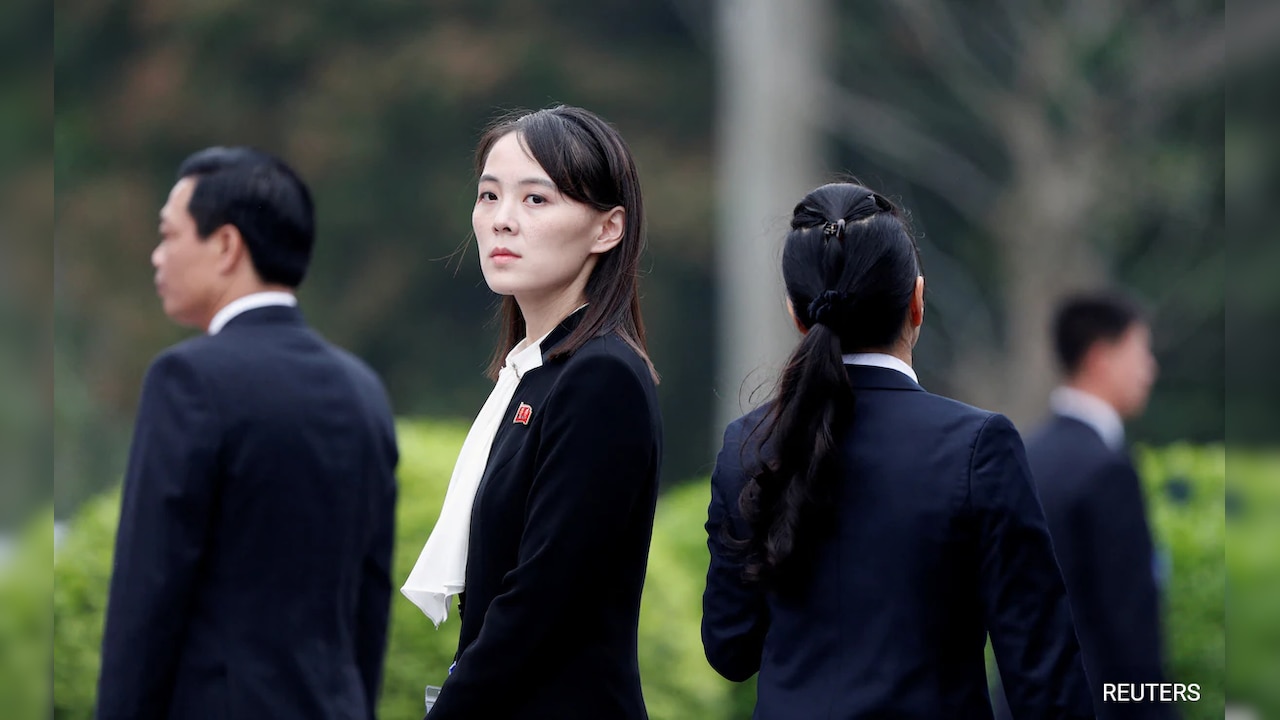
When Kim Yo Jong, the influential sister of North Korean leader Kim Jong Un, released her latest statement, the international press treated it like another data point in an endless spreadsheet of geopolitical friction. She declared that Pyongyang’s nuclear program is "absolutely non-negotiable." She warned that any attempt to infringe upon their sovereignty would face an immediate, catastrophic response.
To the analyst behind a desk in Washington, this is predictable rhetoric. To the people who live within the arc of those potential trajectories, it is the sound of a heavy door slamming shut in a dark room.
The debate is no longer about percentages, enrichment levels, or economic carrots. The regime has moved the goalposts entirely out of the stadium.
The Illusion of the Ledger
For three decades, Western foreign policy operated under a comforting assumption. The theory was simple: everything has a price. We treated the Korean Peninsula like a vast, high-stakes negotiation table where one side happened to hold a terrible hand but possessed a very sharp knife. The strategy was always to offer enough food, enough fuel, or enough diplomatic legitimacy to convince them to lay the knife down.
It failed because we misread the currency.
Imagine a homeowner who inherits a house with a crumbling foundation in a hostile neighborhood. Analysts kept offering him cash to fix the roof, assuming he wanted a comfortable home. But the homeowner did not care about the roof. He spent every penny buying a security system that could blow up the entire street. To him, the house was not an asset to be improved; it was a fortress to be defended at the cost of total starvation inside.
North Korea’s nuclear capability is not a bargaining chip. It is the state's central nervous system.
The rhetoric coming out of Pyongyang reveals a fundamental truth that many in the West are still reluctant to accept. The regime views denuclearization not as a path toward economic modernization, but as a suicide pact. When Kim Yo Jong speaks of an "absolutely non-negotiable" status, she is not setting an opening bid for the next round of six-party talks. She is stating a theological fact of the Kim dynasty.
Consider the sheer scale of what has been sacrificed to build this arsenal. This is a country with a gross domestic product smaller than that of many mid-sized American cities, yet it has mastered the most complex engineering feat in human history. They did it through decades of famine, systemic isolation, and a total detachment from the global economy.
When a society invests its very survival into a single technology, you cannot buy that technology back with a shipment of grain or a lifting of sanctions. The investment is too deep. The ghost of Libya’s Muammar Gaddafi—who gave up his nuclear ambitions only to be overthrown and killed years later—hangs over every decision made in Pyongyang. They looked at the ledger of history and decided that a weapon is the only contract the West cannot tear up.
The Human Cost of a Standoff
Behind the terrifying geometry of ICBM trajectories lies a quieter, more devastating reality. The true weight of this non-negotiable stance is borne by the millions of ordinary citizens whose lives are shaped by an enforced isolation.
To understand the tragedy of the peninsula, you have to look away from the missile launchers and toward the borderlands. In the Chinese border towns along the Yalu River, the contrast is stark. On one side, bright lights, bustling night markets, and the noise of capitalism. On the other, a dark shore. A silhouette of mountains against a starless sky, broken only by the occasional sweep of a military searchlight.
We often talk about North Korea as a monolith, a grey mass of goose-stepping soldiers and synchronized mass games. But the monolith is made of individuals.
There are families who have not heard from their relatives across the Demilitarized Zone in seventy years. There are children who grow up learning how to calculate the blast radius of an American bomb before they learn how to cultivate a field properly. The state’s insistence on nuclear absolutism requires a permanent wartime footing. It demands that every resource, every calorie, and every human dream be funneled into the maintenance of the deterrent.
The psychological toll extends southward too. In South Korea, a generation has grown up under the shadow of an existential threat so constant it has become invisible. It is a strange sort of cognitive dissonance. You sit in a chic café in Gangnam, sipping an iced Americano, fully aware that hundreds of artillery pieces are aimed directly at your coordinate from just thirty miles north.
You learn to live with it. You have to. If you spent every day contemplating the sheer destructive power sitting across the border, society would grind to a halt. The human mind adapts to the unthinkable by treating it as mundane.
The Failure of the Old Vocabulary
The real danger of the current moment is that our diplomatic language is obsolete. We are still using the vocabulary of the 1990s to describe a reality that changed permanently in the 2020s.
We still use terms like "provocation" whenever a missile is tested. But a provocation implies that someone is trying to get your attention, that they want a reaction. Pyongyang is no longer trying to provoke the West into a conversation. They are testing their hardware because they intend to keep it, refine it, and mass-produce it. They are moving from a phase of development to a phase of deployment.
The sister’s statement was a direct response to the tightening alliance between Washington, Seoul, and Tokyo. As the US flies strategic bombers over the peninsula and South Korea refines its conventional strike capabilities, the North responds by hardening its position. It is a classic security dilemma, scaled up to the level of thermonuclear annihilation. Each side convinces itself that its actions are purely defensive, while the other side views those same actions as a preparation for war.
But the real problem lies elsewhere. It lies in the fact that the international community has run out of levers. Sanctions have reached the point of diminishing returns. There is very little left to cut off in a country that has already severed itself from the global grid. The assumption that China would eventually step in to force denuclearization has proven to be a fantasy; Beijing prefers a nuclear North Korea to a collapsed state on its border that brings a unified, US-allied Korea right to its frontier.
We are left with a reality that is deeply uncomfortable to acknowledge. The goal of complete, verifiable, and irreversible denuclearization is dead. It has been dead for years, but policymakers keep its ghost alive because admitting the truth feels like a surrender.
The Cold Dawn
Accepting this reality does not mean condoning it. It means shifting the objective from an impossible peace to a manageable stability. It means recognizing that we are no longer in a pre-nuclear crisis, but a post-nuclear coexistence.
The shift from non-proliferation to deterrence is subtle, but it changes everything. It means the focus must move away from grand summits and historic handshakes toward the boring, meticulous work of risk reduction. It means establishing hotlines that stay open during a crisis, creating clear communication channels to prevent an accidental launch triggered by a technical glitch or a misunderstood radar blip.
It is a terrifyingly fragile way to live. It requires trusting that rational actors on both sides will always choose survival over pride, even when the rhetoric reaches a fever pitch.
The sirens in Seoul eventually stop. The traffic resumes its normal, frantic rhythm. The smartphone screens flicker back to text messages, stock prices, and videos of pop stars. The threat does not disappear; it just sinks back beneath the surface of daily life, waiting for the next statement, the next test, the next shift in the geopolitical wind.
We are trapped in an architecture of absolute zero, where the only thing keeping the peace is the mutual understanding of total destruction. The sister of the regime has made it clear that the foundation of their state is forged in plutonium, and no amount of diplomatic alchemy is going to change it back into gold. The world has to learn to live with the bomb, or figure out how to survive the day the architecture finally collapses.