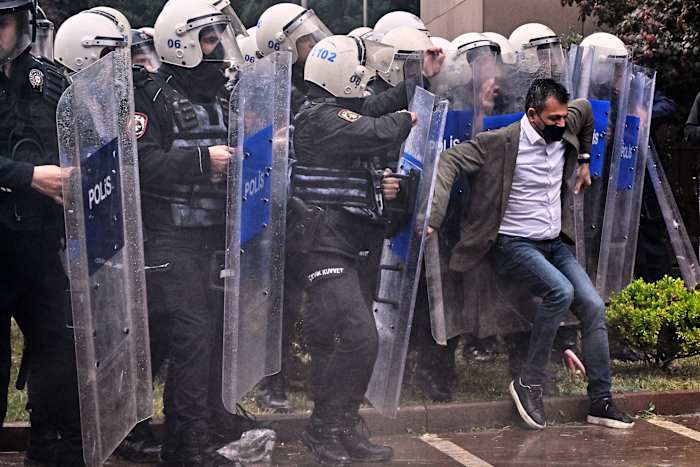
Turkish riot police launched a coordinated raid on the Ankara headquarters of the Republican People’s Party (CHP), deploying tear gas and rubber bullets to forcefully evict party officials and loyalists. The violent confrontation marks the culmination of a tense three-day standoff inside the main opposition party's central building. This intervention followed an appeals court decision that nullified the November 2023 internal elections, effectively ousting the popular party chairman, Ozgur Ozel, and reinstating his defeated predecessor, Kemal Kilicdaroglu. What appears on the surface to be a bureaucratic dispute over internal party rules is, in reality, a highly strategic judicial maneuver engineered to neutralize the greatest political threat to President Recep Tayyip Erdogan's twenty-three-year rule.
The timing of the raid reveals a calculated effort to minimize public backlash and immediate resistance. Security forces moved on the building on a Sunday morning at the absolute onset of a nine-day national holiday for Eid al-Adha. During this period, major urban centers like Ankara and Istanbul empty out as millions of citizens travel to rural provinces or coastal resorts. By striking when the public was distracted and physically displaced, authorities ensured that spontaneous, massive street mobilizations would be significantly harder to organize.
The Anatomy of a Judicial Coup
The crisis began when an appeals court suddenly invalidated the results of the 2023 CHP party congress. That congress had seen Ozgur Ozel achieve what many thought impossible, unseating the 77-year-old Kemal Kilicdaroglu, who had steered the party through thirteen years of consecutive election defeats against Erdogan. Under Ozel’s fresh leadership, the CHP achieved a historic breakthrough in the 2024 municipal elections, emerging as Turkey’s top vote-earning political party for the first time in forty-seven years and breaking the ruling Justice and Development Party’s (AKP) electoral dominance.
By reversing that congress, the court did not just alter party paperwork. It effectively decapitated the operational leadership of the country's most formidable opposition entity.
The mechanics of the intervention rely on a complex web of legal maneuvers designed to force an internal civil war. The court order suspended Ozel and his entire executive board, replacing them with a court-appointed management team comprised of Kilicdaroglu-era loyalists. When Ozel and the vast majority of CHP lawmakers refused to recognize the decree, barricading themselves inside the Ankara headquarters with furniture and buses, the new court-appointed administrators took a step that shocked the secular base of the party. Kemal Kilicdaroglu’s personal attorney formalised a request to the Ankara police department to forcibly vacate the premises, providing the provincial governor with the legal cover required to authorize a militarized assault on the building.
Smoke Fire Extinguishers and Ripped Decrees
The physical takeover of the building resembled a military operation rather than a civil eviction. Riot police breached the exterior gates, moving through the courtyard while firing canisters of tear gas directly into enclosed spaces. Inside, CHP staffers and supporters attempted a desperate defense, utilizing fire extinguishers to push back heavily armed police, but the resistance was short-lived. Ground-floor windows were shattered, doors smashed, and journalists were aggressively cleared from the area to halt live broadcasts of the unfolding chaos.
As police officers breached the executive suite, Ozel was captured on video being served the formal eviction papers. He ripped the documents to shreds in front of the officers.
Driven into the street amid choking gas, Ozel remained defiant. He addressed a crowd of cheering supporters, stating that his faction was vacating the physical building only to reclaim it in a manner that would permanently prevent state interference. Rather than dispersing, Ozel immediately initiated an eight-kilometer march through torrential rain and hail toward the Turkish Parliament, picking up hundreds of citizens along the route. Standing outside the legislature, he declared the historical party—founded in 1923 by Mustafa Kemal Ataturk—as "de facto shuttered" by authoritarian overreach, pledging to rebuild the movement from the streets upward.
Clear Space for 2028
To understand why the state apparatus has taken such extreme measures against the CHP, one must look at the upcoming electoral timeline. The next presidential election is scheduled for 2028, but Erdogan possesses the constitutional authority to call for an early vote at any moment. At 72 years old, Erdogan faces strict constitutional term limits that prevent him from running again under normal circumstances. However, a major loophole exists. If the Turkish Parliament votes to call an early election, Erdogan is legally permitted to run for another term.
Securing that early election requires a fractured, weak opposition incapable of mounting a unified challenge. The state has systematically systematically systematically targeted every viable challenger within the CHP stable.
- Ekrem Imamoglu: The highly popular and charismatic Mayor of Istanbul, widely viewed as the most formidable potential presidential candidate, has been imprisoned since March of last year and faces ongoing corruption trials aimed at permanently banning him from politics.
- Ozgur Ozel: By stripping him of his chairmanship, the state removes an effective organizer who proved he could win conservative and nationalist swing voters.
- The Party Apparatus: Forcing the reinstatement of Kilicdaroglu, an unpopular figure associated with over a decade of political failure, alienates younger voters and demoralizes the opposition base.
The state's narrative remains rigid. Government spokespersons maintain that the judiciary operates with absolute independence and that the police action was merely the lawful execution of a court order requested by a faction within the CHP itself. Yet the synchronization between judicial rulings, police mobilization, and strategic holiday timing paints a radically different picture. The utilization of anti-corruption probes and asset-laundering investigations, which saw thirteen party officials detained just twenty-four hours prior to the raid, serves as the standard playbook for neutralizing political opposition under the guise of accountability.
The CHP now faces an existential fork in the road. Legally, the party's parliamentary group has bypassed the court ruling by electing Ozel as their official head inside the legislature, ensuring he retains a platform as an elected lawmaker from Manisa. But the physical loss of their central headquarters and the looming threat of further criminal prosecutions against senior leadership means the traditional arenas of Turkish politics are closing down. The opposition's battleground has officially shifted from the halls of bureaucracy to the public square, setting up a volatile period of civil friction as Turkey edges closer to a definitive constitutional showdown.


