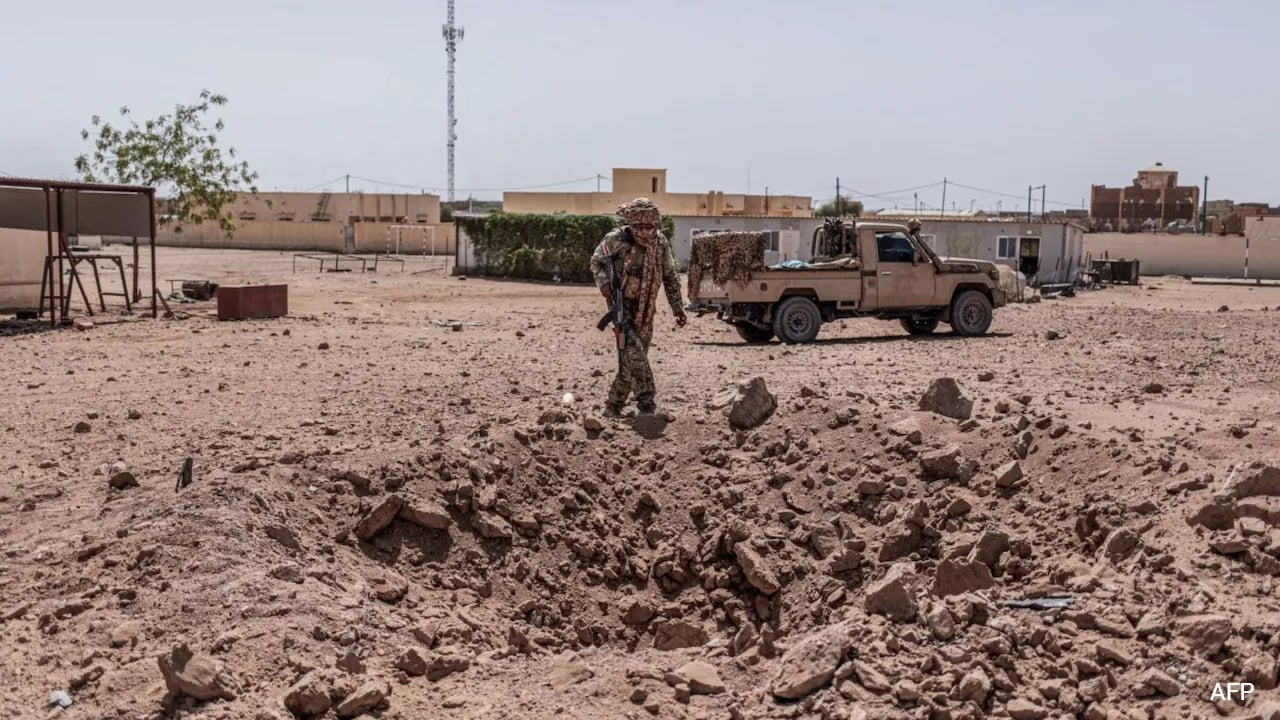
The ambush of a joint Malian Armed Forces (FAMa) and Wagner Group convoy near the Algerian border town of Tinzaouaten exposed fundamental flaws in the operational doctrine of Russian irregular forces in hyper-arid environments. Rather than a localized tactical setback, the engagement serves as a case study in the structural failure of motorized reconnaissance columns when stripped of electronic warfare superiority, localized air supremacy, and logistical depth.
Understanding this engagement requires analyzing three critical failure vectors: the overextension of the motorized column without intermediate logistical nodes, the weaponization of geography by the Strategic Framework for the Defense of the People of Azawad (CSP-DPA) and allied elements, and the severe degradation of Russian tactical intelligence.
The Operational Context: The Overextension Vector
The joint FAMa-Wagner operation, spearheaded by elements of the 13th Storm Brigade, aimed to project power into Mali's far northern Kidal Region to sever rebel supply lines and secure territory up to the Algerian border.
This operational design contained a structural vulnerability: an overreliance on a single, un-reinforced motorized column to clear deep territorial pockets without establishing intermediate fire-support bases or secure lines of communication.
[Logistical Base: Gao/Kidal] ───(Overextended GLOC)───> [Motorized Column] ───> [Ambush Zone: Tinzaouaten]
                                                               │
                                                 (No Intermediate Fire Support)
The column, consisting of approximately 20 vehicles—including armored personnel carriers, main battle tanks, and logistics trucks—marched north from Boghassa through the Tamassahart valley. By advancing deeper into the desert corridor, the force function of the column decreased relative to the expansion of its vulnerable flanks.
The physical geography of northern Mali penalizes heavy wheeled and tracked configurations that are restricted to predictable wadi networks and valley floors, while granting high mobility to light, decentralized insurgent forces utilizing modified all-terrain transports.
The Anatomy of the Ambush: Topographical and Tactical Traps
On July 25, 2024, CSP-DPA separatist fighters, alongside opportunistic interventions from the jihadist group Jama'at Nasr al-Islam wal-Muslimin (JNIM), exploited a classic bottleneck geometry roughly 12 miles west of Tinzaouaten. The tactical engagement unfolded through three distinct phases that stripped the convoy of its material advantages.
Phase One: Mobility Mission Kill
The insurgent force initiated the engagement using heavy improvised explosive devices (IEDs) and anti-tank guided missiles (ATGMs) to target the lead and rear vehicles of the column. This technique effectively box-cared the convoy within a low-lying riverbed, neutralizing its speed and forcing the remaining vehicles into a static defensive posture.
Phase Two: Topographical Asymmetry
The ambush geometry forced the FAMa-Wagner personnel into low ground with negligible natural cover. Insurgent forces occupied the surrounding high ground, establishing clear fields of fire.
From these elevated positions, Tuareg snipers and light machine-gun teams suppressed the convoy's occupants, preventing them from dismounting effectively or establishing a cohesive perimeter. The structural prose of the terrain eliminated the tactical utility of the column’s armor, transforming the vehicles into large, easily targeted cross-sections.
Phase Three: Air Support Neutralization
While a FAMa Mi-24 Hind helicopter was deployed to provide close air support and casualty evacuation, the asset was structurally constrained by extreme thermal conditions and ground-based anti-aircraft fire. The helicopter suffered damage during the engagement and subsequently crashed near Kidal, removing the column's only mechanism for tactical retreat or fire equalization.
Stripped of air cover and facing an insurgent force estimated at several hundred fighters, the remaining Wagner elements were systematically isolated into fragmented defensive pockets.
The Attrition Balance Sheet
Casualty figures from the three-day engagement indicate a near-total operational defeat for the 13th Storm Brigade detachment.
| Force Element | Estimated Personnel Killed | Personnel Captured | Materiel Losses |
|---|---|---|---|
| Wagner Group | 50 – 84 | 7 – 15 | Multiple APCs, Logistics Trucks, Tankers |
| Malian Armed Forces (FAMa) | 10 – 47 | Highly Variable | Small Arms, Command Vehicles |
| Insurgent Coalitions | 7 – 20 | Minimal | Negligible |
Among the Russian fatalities were senior tactical commanders, including Sergei Shevchenko (call sign "Pond"), and key informational assets, such as the administrator of the influential "Grey Zone" Telegram channel. The high ratio of fatalities to survivors underscores the absolute lack of an extraction capability or a secondary reserve force.
Strategic Implications for the Sahelian Security Architecture
The defeat at Tinzaouaten exposes the core structural limitation of substituting institutional state partnerships—such as the departed French-led Operation Barkhane or UN peacekeeping missions (MINUSMA)—with commercial, state-backed irregular forces.
The security architecture implemented by the Malian military junta relies on a high-attrition, low-sustainability model. Wagner operates primarily as a regime-protection force and a localized shock-infantry unit; it lacks the institutional capability to project durable administrative or military control over vast, non-permissive geographic expanses.
The strategic bottleneck for Russia’s Africa Corps model is economic and logistical. The business model relies on securing extractive assets, such as gold mines, to fund local security operations. However, when the security footprint must expand into non-extractive, highly hostile terrain to maintain the host state's territorial integrity, the cost function shifts rapidly.
The loss of highly experienced personnel in single engagements like Tinzaouaten degrades the organizational memory and capability of the force, making recruitment and sustainability increasingly expensive for the Kremlin.
The security equilibrium in the Sahel will likely shift toward more frequent, coordinated insurgent offensives. By demonstrating that a heavily armed Russian motorized column can be decisively neutralized through conventional ambush tactics, the Tinzaouaten engagement has altered the psychological dynamics of the conflict.
To maintain operational viability, future FAMa-Wagner deployments must abandon deep-penetration missions in favor of static point-defense or localized counter-insurgency operations, leaving the vast northern border regions exposed to autonomous insurgent control.



