Sweden's 5-1 victory over Tunisia at the Monterrey Stadium establishes a clear tactical blueprint for exploiting low-block systems using asymmetric structural overloads. While standard commentary attributes the scoreline to individual class or generic momentum, a data-driven breakdown reveals that Sweden's success was the direct result of systematic space creation designed by Graham Potter. By isolating Tunisia's defensive lines and maximizing the physical and technical output of their front-line assets, Sweden did not merely win; they executed an optimized offensive strategy that leaves Tunisia's tournament prospects in critical condition.
The match unfolded across clear tactical phases defined by how Sweden structured their attacking phases against Tunisia's passive 4-2-3-1 mid-block. The structural breakdown of this Group F fixture demonstrates exactly how high-level tactical frameworks override basic defensive positioning.
The Asymmetric Front Two As An Isolation Mechanism
The primary engine of the Swedish attack was the strike partnership of Alexander Isak and Viktor Gyökeres. Rather than operating as a traditional linear front two, Potter deployed them in an asymmetric dual-threat matrix within a 3-4-1-2 base formation. This mechanism functioned on two specific operational principles:
- Vertical Decoupling: One forward consistently dropped into the half-spaces to drag a central defender out of line, while the other pinned the remaining center-back horizontally.
- Symmetric Facilitation: The partnership became just the second Swedish duo to assist one another in a World Cup match, proving that their positioning was linked by design rather than coincidence.
This spatial manipulation created critical defensive breakdowns for Tunisia. For Isak's goal in the 30th minute, Gyökeres operated as the structural anchor, receiving a pass in the middle third and drawing the focus of Tunisia's center-backs, Montassar Talbi and Omar Rekik. This movement cleared a linear vertical corridor. Isak exploited this space, accelerating past the defensive line into a high-value shooting zone.
The roles reversed in the 58th minute. Following a turnover generated by Sweden’s mid-pitch press, Isak immediately assumed the role of facilitator, identifying the optimal passing lane to feed Gyökeres. The Sporting CP striker used his physical frame to shield the ball before delivering a clinical finish, restoring Sweden’s two-goal cushion and illustrating the repeatable nature of this spatial exploit.
Midfield Overloads and the Out-of-Possion Transition Bottleneck
Tunisia's defensive failure stemmed from an structural flaw in their out-of-possession transition phase. Sabri Lamouchi's setup sought to use Ellyes Skhiri and Rani Khedira as a protective double-pivot ahead of the back four. Sweden nullified this defensive structure by creating numerical superiority in central areas through advanced central midfielder Yasin Ayari and playmaker Benjamin Nygren.
The opening goal in the 7th minute exposed this structural mismatch. As Sweden pushed their wing-backs high to pin Tunisia's full-backs, Yan Valery and Mohamed Amine Ben Hamida, wide, Tunisia's central midfield was forced to shift horizontally to cover the half-spaces. This lateral stretching left a massive structural pocket open at the edge of the penalty area. Ayari stepped into this space completely unmarked, capitalizing on a cleared Gyökeres effort to hit a long-range strike into the back of the net.
The second half highlighted the physical deterioration of Tunisia's defensive block under continuous pressure. As Khedira received a yellow card in the 53rd minute, his capacity to break up play was severely diminished. This change allowed Sweden's substitute, Lucas Bergvall, to command the tempo after his introduction in the 64th minute. At 20 years old, Bergvall's insertion changed the technical profile of the midfield, using short, progressive passes that forced Tunisia deep into their own box.
The physical strain on Tunisia's defensive structure led directly to a lack of security on the ball. When deep transitions failed, Hannibal Mejbri was forced to drop almost into a left-back position to demand the ball. This structural desperation removed Tunisia's primary creative outlet from the final third, turning their possession phases into low-risk, horizontal sequences that Sweden handled comfortably.
Structural Efficiency and Benchmark Capitalization
Sweden's performance shows the value of tactical depth and execution speed over raw volume of possession. The final ten minutes of the match showed the contrasting physical conditions of the two squads:
[Sweden Deep Possession] -> [Vertical Long Ball to Gyökeres] -> [Second-Phase Drop] -> [Svanberg Late Box Entry]
This sequence was perfectly illustrated by Mattias Svanberg's goal in the 83rd minute. Just 18 seconds after coming onto the pitch to replace Jesper Karlström, Svanberg scored on his very first touch. The goal required a lengthy VAR review to check an offside call on the initial phase. The technical analysis showed that Isak made minimal contact with the ball, triggering a new attacking phase that kept Svanberg legally onside. This instant impact highlights the tactical clarity within Potter's squad; substitutes enter the system with exact knowledge of their spatial responsibilities.
The match concluded with a mirror image of how it began. In the 96th minute, another Tunisian turnover caused by tired defensive tracking allowed Ayari to collect the ball on the edge of the area. With Tunisia's defensive lines completely disconnected, Ayari had the time to execute a precise, right-footed drive into the side-netting, securing his brace and emphasizing the total breakdown of Tunisia's defensive block.
Defensive Set-Piece Fragility as a Systemic Risk
The single blemish on Sweden's data profile occurred in the 42nd minute, exposing a minor vulnerability in their defensive set-piece structure. Hannibal Mejbri delivered an inswinging cross from a secondary phase that allowed Omar Rekik to score with a glancing header, briefly cutting the deficit to 2-1.
The breakdown happened because Sweden shifted from a zonal setup to loose man-marking during the second phase of the set-piece. Isak Hien and Victor Lindelöf failed to communicate effectively, allowing Rekik to exploit the blind-side gap between Sweden's central defenders. While this goal gave Tunisia temporary hope, it was a rare breakdown in a match otherwise controlled by Sweden's structural dominance.
Group F Tactical Projections
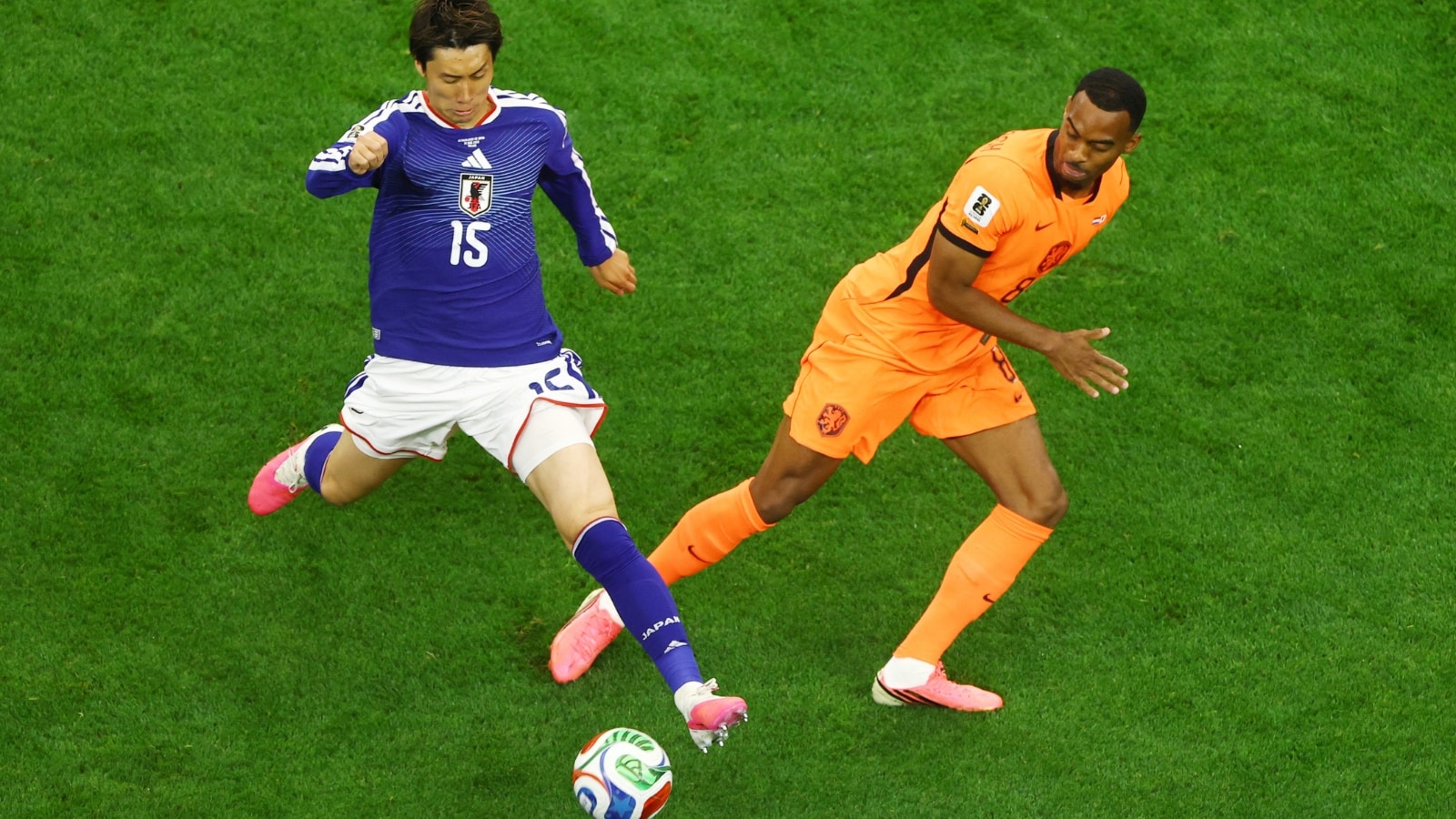
Following Matchday 1, Group F's standing shows a significant shift in qualifying probabilities. With Japan and the Netherlands drawing 2-2, Sweden holds a clear advantage at the top of the group with three points and a +4 goal difference.
Group F Standings - Matchday 1
1. Sweden      | 3 Pts | +4 GD
2. Japan       | 1 Pt  |  0 GD
3. Netherlands | 1 Pt  |  0 GD
4. Tunisia     | 0 Pts | -4 GD
This goal difference cushion acts as an important structural asset ahead of Sweden's next fixtures against the Netherlands and Japan. For Tunisia, the path to qualification requires a complete overhaul of their mid-block mechanics before facing Japan on June 20. If Lamouchi cannot fix the space between his midfield and defensive lines, their tournament will end in the group stage.
Sweden's upcoming match against the Netherlands will test if this asymmetric system can handle a world-class counter-press. Potter's main priority must be monitoring Isak's physical recovery, given his injury-impacted club season. If the frontline partnership retains its spatial flexibility, Sweden's structural framework will remain highly effective against aggressive defensive units throughout the tournament.