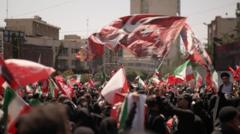
Mass mobilization ceremonies organized by autocracies rarely function as genuine expressions of public grief. Instead, they operate as heavily subsidized mechanisms designed to project domestic control and institutional continuity during moments of systemic vulnerability. The week-long funeral procession for Iran’s late Supreme Leader, Ayatollah Ali Khamenei—following his assassination in a February 2026 airstrike—is not an emotional farewell. It is an active state deployment of political theater intended to mask a deep legitimacy crisis, consolidate power under a newly appointed successor, and recalibrate the regime’s deterrent posture amid ongoing geopolitical conflict.
Evaluating this transition requires stripping away the ideological rhetoric of "resistance and revenge" to examine the concrete logistical data, structural deficits, and strategic trade-offs defining the Islamic Republic’s new reality.
The Mobilization Cost Function and Public Friction
The regime's primary domestic objective during a leadership transition is the presentation of overwhelming consensus. However, the physical reality of the 2026 funeral ceremonies reveals a widening gap between state resource allocation and organic public participation.
To evaluate the true scale of domestic support, the state’s mobilization effort can be modeled through a complex function of public expenditures, forced attendance, and artificial incentives vs. actual civic alignment.
Total Mobilization Output = f(State Resources + Mandated Turnout) - Public Friction
- State Resources: The expansion of public transit capabilities—with the Tehran metro network recording seven million trips within a 36-hour window—combined with the provision of free meals, public holidays, and coordinated transport fleets.
- Mandated Turnout: The systematic requisitioning of government employees, security personnel, and state-affiliated networks to occupy central venues like the Imam Khomeini Grand Mosalla.
- Public Friction: The compounding drag of severe domestic inflation, declining household purchasing power, and widespread civilian resentment regarding the diversion of public funds into multi-city ceremonial logistics while basic dietary proteins become inaccessible to ordinary families.
Independent visual analysis from Tehran indicates that despite these extensive efforts, attendance metrics lagged significantly behind historic precedents. When Ruhollah Khomeini died in 1989, an estimated one-sixth of the national population swarmed the capital organically, causing structural crowd collapses. The 2026 gatherings, by contrast, required strategic camera angles and restricted perimeters to conceal empty spaces within the designated prayer grounds. The state can buy logistical throughput, but it can no longer reliably manufacture genuine mass compliance.
The Hidden Sovereign: Strategic Absenteeism and the Leadership Deficit
The most critical data point of the entire funeral cycle is an absence. Ayatollah Mojtaba Khamenei, fast-tracked to power by the Assembly of Experts in March 2026 following his father's death, has remained completely hidden from public view. While his brothers (Mostafa, Meysam, and Masoud) were prominently displayed alongside President Masoud Pezeshkian and Quds Force Commander Esmail Qaani, the new Supreme Leader skipped his own father’s state procession.
This operational choice highlights a fundamental vulnerability in Iran’s current command-and-control framework. The regime faces a distinct optimization paradox:
The Visibility vs. Survival Dilemma
Domestic Legitimacy (Requires Maximum Public Exposure)
                         vs.
Systemic Continuity (Requires Total Operational Security against Kinetic Threats)
Intelligence reports indicating that Mojtaba Khamenei suffered severe injuries and facial disfigurement in the initial February airstrike compound this problem. His continued isolation creates a severe symbolic deficit. In an autocracy where the ruler's physical presence serves as the ultimate proof of divine endorsement and state stability, governing via written decrees—such as his recent re-appointment of hardline Judiciary Chief Gholam Hossein Mohseni Ejei—weakens the office's psychological authority.
By prioritizing physical survival over ceremonial visibility, the new leadership tacitly acknowledges that its operational environment remains fundamentally compromised by foreign intelligence networks.
Institutional Anchors and the Hardline Consolidation
To compensate for a physically compromised and invisible Supreme Leader, the regime is rapidly reinforcing its institutional foundations. The rapid reappointment of Mohseni Ejei to another five-year term as head of the judiciary is an explicit signal of internal stabilization.
This move reveals the domestic security architecture designed to bridge the transition gap:
- The Judicial Shield: The judiciary acts as the primary instrument for suppressing internal dissent. Retaining an ultra-conservative loyalist ensures that any domestic unrest arising from economic hardship or political transition is met with immediate, lethal legal pushback.
- The Praetorian Guard: The visible alignment of Revolutionary Guard (IRGC) Chief Ahmad Vahidi and Quds Force Commander Esmail Qaani at the funeral prayers demonstrates that the military-industrial wing of the state remains unified behind the office of the Supreme Leader, regardless of the individual occupying it.
- The Bureaucratic Elite: The public presence of pragmatic figures like Parliament Speaker Mohammad Bagher Ghalibaf and former President Mahmoud Ahmadinejad signals an elite-level pact to maintain systemic cohesion while the country negotiates an exit from active hostilities.
The Paradox of Rhetoric and Diplomatic Realism
While state-sanctioned crowds chanted for immediate military retribution against Washington and Tel Aviv, the actual policy outputs originating from the Office of the Supreme Leader tell a drastically different story.
The regime is currently executing a dual-track strategy designed to manage its structural weaknesses while preserving its core interests:
| Dimension | Public-Facing Ideology | Operational Reality |
|---|---|---|
| Strategic Goal | Projecting unyielding resistance and military defiance. | Preserving regime survival and lifting economic sanctions. |
| Tactical Execution | Coordinated mass chants, aggressive media broadcasts, and calls for asymmetric assassinations. | Authorizing a formal memorandum of understanding with the United States. |
| Geopolitical Stance | Threats to permanently disrupt the maritime shipping lanes of the Strait of Hormuz. | Engaging in structured negotiations to prevent further kinetic degradation of state leadership. |
This clear divergence underscores the transactional nature of the regime's current stance. The aggressive rhetoric acts as a necessary political distraction for the hardline domestic base, providing the diplomatic cover required for the leadership to negotiate a settlement from a position of perceived strength.
The long-term stability of this transition depends entirely on the new leader’s ability to move past this temporary consolidation phase. Relying on an invisible executive, enforced judicial control, and performative mass rallies is structurally unsustainable. If Mojtaba Khamenei fails to establish a visible, uncompromised physical presence within the coming months, the perceived weakness at the top will invite further internal fractionalization among the IRGC elite and embolden sustained domestic resistance from a heavily fatigued population. The regime's immediate survival is secure; its long-term structural viability remains highly volatile.