National defense procurement is fundamentally a tension between short-term industrial delivery and long-term geopolitical interoperability. When Canadian Prime Minister Mark Carney announced that Germany’s Thyssenkrupp Marine Systems (TKMS) secured the 60 trillion won ($39.3 billion) Canadian Patrol Submarine Project (CPSP), the decision was widely framed as a narrow loss for South Korea’s "One Team" consortium of Hanwha Ocean and HD Hyundai Heavy Industries. However, an objective, data-driven analysis reveals that this outcome was not a failure of industrial execution or technological readiness. Instead, it exposes the structural ceiling that non-aligned or non-NATO defense exporters face when attempting to penetrate deeply integrated Western security ecosystems.
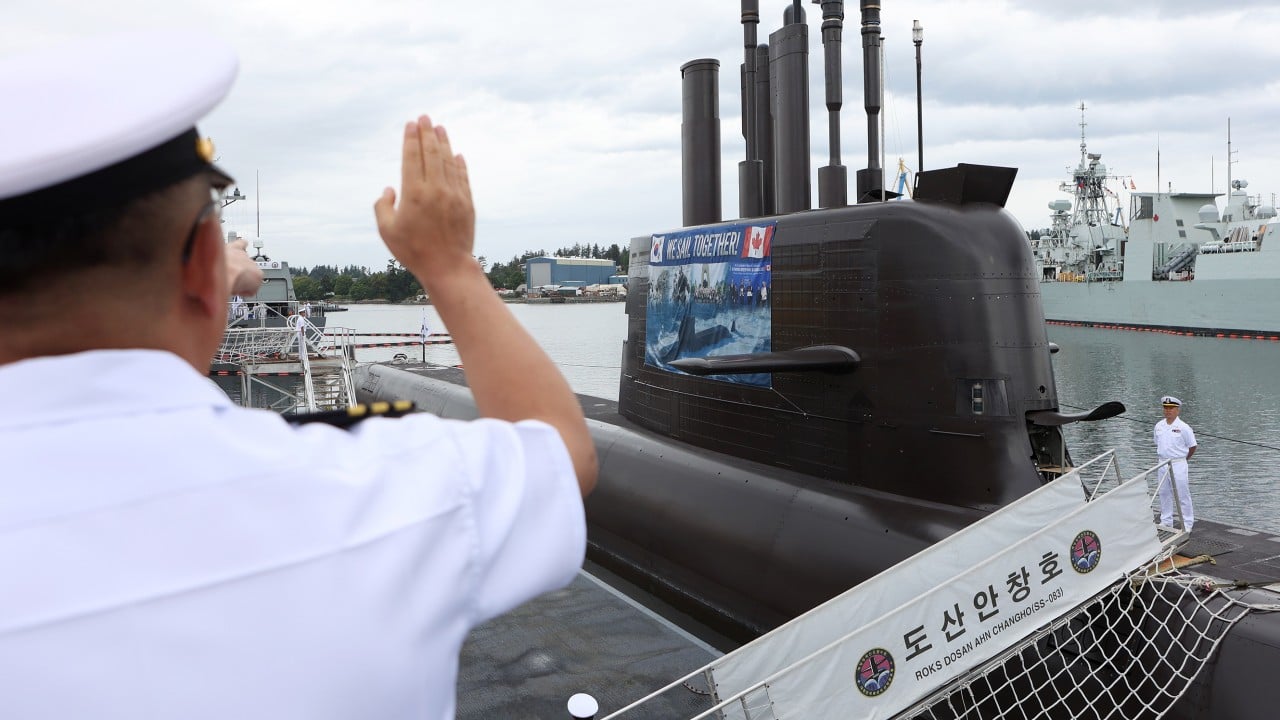
South Korea’s proposal, centered on the KSS-III Batch-II platform, offered superior manufacturing velocity and aggressive industrial offsets, even dispatching a 3,000-ton Dosan Ahn Chang-ho-class submarine 14,000 kilometers across the Pacific to demonstrate operational maturity. Despite these variables, Canada prioritized the strategic integration of the German-Norwegian 212CD platform. Understanding this choice requires breaking down the modern naval procurement equation into three distinct pillars: industrial throughput, lifecycle offset math, and the NATO interoperability premium.
The Industrial Throughput Asymmetry
The primary competitive advantage of South Korea's defense industrial base is its compressed manufacturing lifecycle. Western defense contractors frequently grapple with structural bottlenecks, skilled labor deficits, and supply chain fragmentation. South Korean shipbuilders, conversely, operate within a highly integrated maritime manufacturing ecosystem that consistently delivers complex naval platforms on time and within budget.
The architectural foundation of the South Korean bid relied on the KSS-III Batch-II, an active, operational platform featuring advanced lithium-ion batteries and fuel-cell Air-Independent Propulsion (AIP). This configuration yields specific operational metrics:
- Submerged Endurance: Lithium-ion battery architecture combined with fuel-cell AIP substantially increases underwater station-keeping duration compared to legacy lead-acid systems.
- Production Velocity: South Korea’s synchronized shipyard operations allow for simultaneous hull section fabrication, reducing the time from steel-cutting to commissioning by an estimated 20% to 30% relative to European counterparts.
TKMS countered this with the Type 212CD platform, a design co-developed by Germany and Norway. While the 212CD benefits from the pedigree of the established Type 212A, it is a highly customized, scaled-up variant requiring significant non-recurring engineering and testing. From a pure engineering and production timeline standpoint, the South Korean consortium presented a lower-risk profile for a Canadian navy desperate to replace its aging Victoria-class fleet. The rejection of the South Korean bid indicates that Canada was willing to absorb production timeline risks in exchange for long-term strategic alignment.
The Limits of Non-Defense Offset Economic Packages
To compensate for its status as a non-NATO supplier, South Korea deployed an unprecedented multi-sector economic mobilization strategy. Codenamed "Project Beaver," the offset package sought to alter the cost-benefit analysis of the Canadian government by linking the defense contract directly to broader industrial development.
The financial architecture of Project Beaver was extensive. Managed by Hyundai Motor Group and Hanwha, the proposed package included:
- Capital Investment: A committed $3.1 billion injection into Canada's domestic clean energy sector.
- Infrastructure: The construction of a hydrogen liquefaction plant in British Columbia and an initial network of 32 commercial charging stations across Western Canada, expanding by an additional 160 units post-2035.
- Manufacturing & Jobs: A dedicated hydrogen freight truck assembly facility in Ontario, projected to create up to 9,000 direct jobs, alongside broader commitments estimating 200,000 to 430,000 job-years over the contract lifespan.
- Commodity Offsets: Agreements to purchase 3.4 million tons of Canadian Liquefied Natural Gas (LNG) annually and a $9 billion commitment to critical mineral extraction.
[South Korean Offset Strategy: Project Beaver]
├── $3.1B Clean Energy Injection
├── B.C. Hydrogen Liquefaction Plant
├── Ontario Freight Truck Facility
└── $9B Critical Minerals & LNG Offsets
This massive economic package illustrates a distinct vulnerability in South Korea's export model: the necessity to over-subsidize defense bids through unrelated industrial sectors. Germany’s TKMS countered with a more traditional, defense-centric economic package valued at an $86-billion economic boost. For Canada, the German offer provided direct reinvestment into the domestic defense industrial base, which aligned better with its immediate defense obligations under NATO's 2% GDP spending mandate.
The immediate consequence of the failed bid is a rapid re-evaluation of these non-defense commitments. Hanwha and Hyundai are scaling back or cancelling the majority of conditional components within Project Beaver, demonstrating that cross-industry bundling is an unsustainable long-term strategy for securing sovereign defense contracts.
The NATO Interoperability Premium
The decisive factor that neutralized South Korea’s advantages was the structural rigidity of the NATO alliance framework. Submarine warfare is no longer an isolated, platform-versus-platform domain; it relies on integrated acoustic data sharing, secure tactical data links, and common logistics pipelines.
Canada's maritime strategy requires continuous deployment across the Atlantic, Pacific, and Arctic oceans, frequently operating in tandem with American, British, and northern European forces. By selecting the TKMS 212CD platform, Canada integrates directly into an established North Atlantic submarine ecosystem. This choice delivers two specific operational efficiencies that a South Korean platform could not replicate:
1. Shared Logistics and Maintenance Blueprints
Because Germany and Norway are actively deploying the 212CD, Canada can tap into an existing European supply chain. This commonality significantly reduces the lifecycle cost function by distributed procurement of spare parts, shared drydock training methodologies, and standardized maintenance, repair, and overhaul (MRO) protocols.
2. Acoustic Intelligence and Cryptographic Sync
NATO submarine operations depend on highly sensitive, classified communication architectures and shared acoustic signature libraries. Introducing a South Korean hull design into this network would require complex, time-consuming modifications to fit proprietary NATO cryptographic and data-link hardware. The 212CD comes pre-configured for this environment, eliminating the technical friction of cross-alliance systems integration.
Ultimately, the procurement choice was governed by an invisible tariff: the cost of integrating a non-NATO platform into a NATO architecture exceeded the cost advantages of South Korea's superior manufacturing speed and economic offsets.
Navigating Post-CPSP Global Tenders
The Canadian bidding process has permanently altered the global perception of South Korean naval engineering. By outcompeting traditional naval powerhouses like France’s Naval Group, Spain’s Navantia, and Sweden’s Saab to reach the final shortlist alongside Germany, the Hanwha-Hyundai consortium proved its technical parity with the world's premier submarine builders. The "K-Defense" apparatus can convert this high-profile near-miss into a long-term export engine by adjusting its target selection and partnership models.
The strategic play moving forward requires a clear divergence based on the target market's geopolitical alignment.
For future tenders within the NATO sphere, South Korean shipbuilders must abandon standalone bids and instead pursue joint development or sub-component integration models with established European primes. By positioning themselves as hull-fabrication or battery-subsystem subcontractors, they can bypass alliance-driven political barriers while monetizing their manufacturing speed.
Conversely, in non-NATO littoral environments where rapid delivery and cost-efficiency take precedence over Western alliance integration, South Korea should aggressively deploy the KSS-III blueprint. Immediate priorities should focus on the Philippines' maritime modernization program and impending replacement cycles in South America, specifically Chile and Colombia. In these markets, unencumbered by NATO's strict interoperability demands, South Korea's value proposition—rapid delivery timelines, operational lithium-ion technology, and flexible financing—remains unmatched.