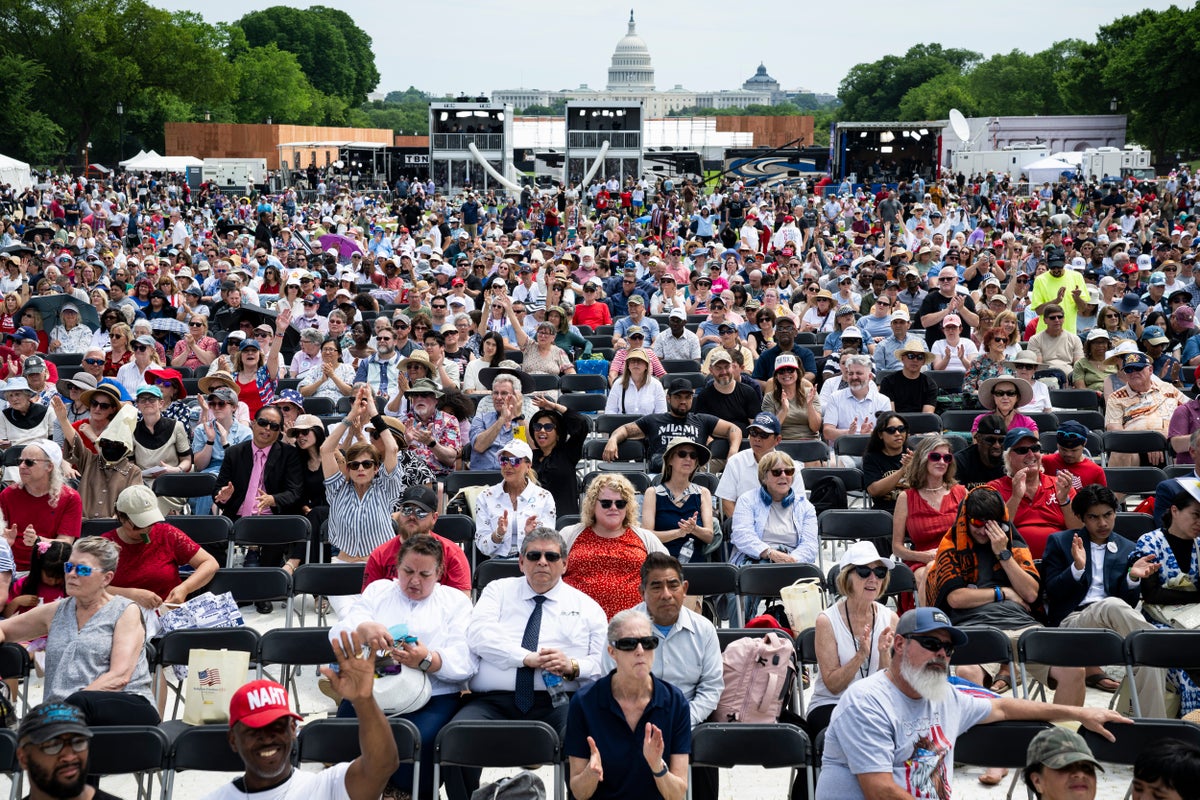
Industrial-scale public events expose vulnerable municipal infrastructure to concentrated operational risks. The May 17, 2026, Rededicate 250 event on the National Mall—organized by Freedom 250, a public-private partnership established under the Trump administration—serves as a primary case study for this vulnerability. While standard news reporting focuses heavily on political optics and conflicting narratives regarding a 30-gallon fuel spill, an objective operational analysis must isolate the structural mechanisms of the incident: the failure points of temporary power generation, the hydrology of localized containment systems, and the economic allocation of remediation liabilities.
Evaluating this event requires looking past the rhetorical debate between equipment vandalism and systemic negligence to map the precise pathway of the contaminant. The core issue lies not in the gross volume of the petroleum released, but in the specific intersection of temporary industrial equipment placement and sub-surface water collection infrastructure.
The Closed-Loop Hydrology Bottleneck
The National Mall utilizes an advanced, environmentally sustainable water management framework designed to mitigate stormwater runoff. Underneath the surface sit four massive cisterns engineered to capture, store, and recycle rainwater specifically for regional turf irrigation. These sub-surface reservoirs possess a combined maximum capacity of 250,000 gallons.
The primary structural flaw exposed during the event was the spatial convergence of temporary heavy machinery positioning and the drainage intake footprint of these cisterns. Industrial events require immense temporary power grids, typically delivered via diesel-powered commercial generators. The operational breakdown followed a predictable mechanical progression:
- Fluid Liberation: A breach occurred within the auxiliary fuel line architecture of the commercial generators stationed on the Mall turf.
- Surface Migration: Due to gravity and the lack of secondary localized containment berms, the liberated fuel bypassed surface soil absorption.
- Infrastructure Infiltration: The runoff entered the dedicated stormwater collection channels that feed directly into the underground cisterns.
[Generator Fuel Line Breach]
          │
          ▼
[Uncontained Surface Runoff]
          │
          ▼
[Stormwater Drainage Intake]
          │
          ▼
[Cistern Water Supply Contamination]
This sequence illustrates a profound compounding effect. A volume of fuel initially reported at approximately 30 gallons—a relatively minor spill in open-world terms—gains exponential disruptive leverage when introduced into a closed-loop water conservation system. Because hydrocarbons float and disperse rapidly across water surfaces, a localized 30-gallon release can effectively compromise thousands of gallons of stored, untreated water, rendering the entire volume unusable for irrigation due to the risk of chemical turf scorching and broader soil contamination.
The Operational Attribution Bifurcation
Determining the root cause of the fluid liberation reveals a sharp divergence in institutional reporting. Freedom 250 management, through official statements, attributed the line breach to targeted external tampering. Spokespersons stated that temporary lighting and power generation equipment had been repeatedly subjected to deliberate vandalism, directly causing the severed fuel lines.
Conversely, field assessments from Interior Department officials challenged the scope and origin of the incident, disputing the initial volume metrics and pointing toward a standard mechanical or procedural failure. In engineering analysis, these competing claims are categorized under two distinct risk profiles:
- Physical Security Vulnerabilities: If the vandalism hypothesis is correct, the event architecture suffered from a perimeter security failure. Temporary industrial power networks require continuous monitoring, physical fencing, and tamper-evident locking mechanisms on all fuel transport lines when deployed in high-traffic public areas.
- Operational Maintenance Failures: If the mechanical failure hypothesis is correct, the breach represents a classic quality-control breakdown. Commercial generators experience significant vibration during peak load cycles. Without rigorous preventative maintenance scheduling, proper line coupling, and heavy-duty braided lines, vibrational friction can induce rapid fatigue failure in fuel delivery systems.
Regardless of the human element, the lack of secondary engineering controls remains the definitive operational bottleneck. Standard industrial best practices for deploying high-capacity generators on sensitive civil land require the mandatory utilization of double-walled fuel tanks and secondary containment diking capable of holding 110% of the total internal fluid capacity. The failure to isolate the equipment from the surrounding drainage topography guaranteed that any line breach would result in immediate infrastructure infiltration.
Remediation Economics and Liability Frameworks
The mobilization of environmental cleanup assets on the National Mall highlights the immediate operational response required to mitigate subsurface contamination. Industrial remediation firms, including Lewis Environmental and Rain for Rent, deployed specialized equipment to the site, including heavy-duty vacuum trucks, storage trailers, and mobile command centers.
The technical execution of the cleanup relies on a multi-phase mechanical extraction strategy:
Phase One: Phase Separation
Because diesel fuel possesses a lower specific gravity than water, it forms a distinct, floating layer on top of the cistern reservoirs. Remediation teams utilize specialized skimmers and oleophilic (oil-attracting) mats to extract the concentrated hydrocarbons from the surface without drawing in vast quantities of water.
Phase Two: High-Volume Fluid Extraction
To clear the system completely, massive vacuum trailers must pump out the contaminated water column. This process generates substantial logistics overhead, as thousands of gallons of emulsified fuel-water mixtures must be safely transported to certified hazardous waste treatment facilities for processing and legal disposal.
The primary financial question shifts to the structural allocation of these remediation costs. Under standard National Park Service (NPS) permitting guidelines, the liability architecture is clear and structured. Commercial permits for large-scale demonstrations or celebrations mandate that the permit holder maintain comprehensive commercial general liability insurance.
The National Park Service structurally enforces a "polluter pays" model. While Freedom 250 has asserted that the site has been fully remediated in cooperation with federal authorities, the long-term fiscal impact depends entirely on whether the NPS pursues complete indemnification for infrastructure inspection costs. If the event planners and their logistics vendors (such as Event Strategies Inc.) are held legally responsible for the failure of their subcontractors' equipment, the total cost functions will extend far beyond simple vacuum truck rentals to include system-wide testing of the Mall's automated irrigation network to ensure zero residual hydrocarbon contamination remains within the sub-surface plumbing.
The incident underscores a critical lesson for future municipal event planning: when temporary industrial power grids intersect with advanced sustainable infrastructure, standard safety margins are insufficient. Future regulatory frameworks must mandate absolute spatial isolation between power generation clusters and civil drainage points.