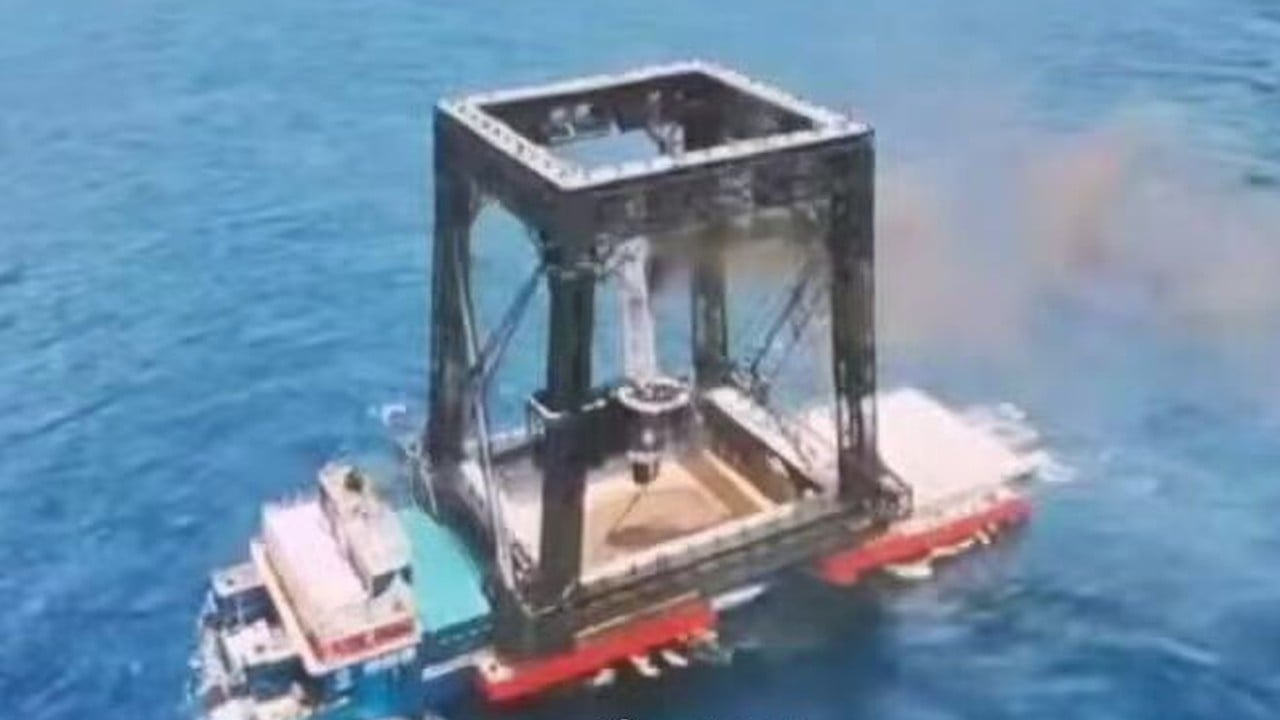
The global paradigm of vertical takeoff, vertical landing (VTVL) rocket recovery has operated under a single technological consensus for over a decade: deployable landing legs compressing under the structural weight of a decelerating booster on a rigid pad. The maiden flight of China’s Long March 10B from the Wenchang Commercial Space Launch Site fundamentally challenges this engineering orthodoxy. By executing the world’s first successful orbital-class, net-based recovery of a first-stage booster via an offshore wire-capture apparatus, the China Academy of Launch Vehicle Technology (CALT) has introduced an alternative structural optimization framework for reusable spaceflight.
Evaluating this milestone requires moving past superficial geopolitical narratives to dissect the mechanical, thermodynamic, and economic trade-offs of the Long March 10B architecture. This transition from expendable infrastructure to a partially reusable fleet serves a highly specific tactical objective: building the high-cadence supply chain required to populate China's national satellite internet megaconstellations.
The Mass-Fraction Equation: Hook-and-Wire vs. Deployable Legs
To understand why CALT opted for a net-based capture system over traditional landing legs, one must analyze the rocket’s mass-fraction budget. Every kilogram allocated to recovery hardware is a kilogram subtracted from the vehicle’s maximum payload capability to Low Earth Orbit (LEO).
In a traditional VTVL system like SpaceX’s Falcon 9, the recovery apparatus demands significant structural weight:
- Four deployable carbon-fiber landing legs.
- Pneumatic actuation systems and high-pressure helium tanks.
- Internal structural reinforcement at the base of the booster to transfer intense localized landing shock into the main airframe.
The Long March 10B circumvents these specific mass penalties by shifting the structural burden from the flight vehicle to the maritime recovery platform. The booster substitutes heavy landing legs for rigid, high-strength landing hooks integrated into its upper airframe. When the first stage descends vertically onto the LingHangZhe (Navigator) recovery vessel, these hooks engage a specialized, tension-controlled wire network.
This structural distribution alters the engineering math. The wire network acts as an external deceleration energy absorber, dissipating the booster's residual kinetic energy through mechanical braking systems on the ship rather than hydraulic struts on the rocket. The primary flight-side modification is reduced to localized reinforcement around the hook attachment points. This architecture theoretically preserves a superior dry-mass fraction for the first stage, optimizing its 16-metric-ton payload capacity to a 200 km LEO in reusable configuration.
Thermodynamics and Propulsion Dynamics of the Descent Phase
The structural advantages of a legless booster mean nothing if the vehicle cannot survive the harsh environmental inputs of re-entry and deceleration. The Long March 10B flight profile relies on a complex thermodynamic and propulsive sequence that begins approximately six minutes post-launch, following first-stage separation.
Propellant Rheology and Tank Dynamics
Executing a controlled vertical return requires multi-engine restarts under highly dynamic conditions. The first stage of the Long March 10B is powered by seven YF-100K engines utilizing a liquid oxygen (LOX) and RP-1 kerosene propellant combination. During the unpowered coast phase preceding the entry burn, the propellants in the tanks experience microgravity slosh, which risks introducing gas bubbles into the engine turbopumps—a condition that causes catastrophic cavitation and engine failure upon ignition.
To mitigate this, the vehicle relies on a dual-pronged management strategy:
- Baffled Propellant Tanks: Internal mechanical baffles structurally suppress large-scale fluid movement, ensuring liquid remains settled over the feedlines.
- Autogenous Pressurization: Gaseous oxygen and heated fuel are routed back into their respective tanks to maintain strict, predictable ullage pressure, ensuring stable propellant mass flow rates during high-acceleration re-entry burns.
The Thermal Protection Bottleneck
Unlike its methane-fueled second stage, which utilizes a single YF-219 engine, the first stage burns RP-1 kerosene. This introduces a distinct operational bottleneck: coking. Kerosene combustion leaves behind heavy carbon and soot deposits inside the engine's cooling channels and injector faces when subjected to intense re-entry heat.
While the structural wire-capture system solves the mass-fraction problem on paper, the long-term economic viability of the Long March 10B relies heavily on the refurbishment cycle of its YF-100K engines. If the soot accumulation requires exhaustive teardowns and chemical flushes between flights, the cost savings of the physical recovery will be cannibalized by operational maintenance overhead.
Maritime Capture Constraints and Guidance Precision
Landing a 5-meter-diameter booster on a moving platform in the South China Sea requires a significant tightening of guidance, navigation, and control (GNC) error tolerances compared to landing on a wide, static concrete pad.
[Orbital Ascent] ➔ [Stage Separation] ➔ [Re-entry Burn] ➔ [Aerodynamic Guidance] ➔ [Terminal Burn & Net Engagement]
The GNC system must process real-time aerodynamic and maritime inputs to guide the booster into a precise spatial window measured in centimeters. The net apparatus does not chase the rocket; the rocket must fly directly into the structural coordinates of the netting.
This creates a distinct operational envelope:
- Aerodynamic Control: Grid fins at the top of the booster provide the necessary aerodynamic control authority through the dense layers of the atmosphere, modulating lift to counteract crosswinds over the ocean.
- Sea-State Vulnerability: The physics of a net-capture system introduce high sensitivity to sea states. Excessive pitch, roll, and heave of the recovery vessel can change the relative height and angle of the wire network within seconds. This introduces an operational bottleneck: launches must be delayed if wave action at the recovery site exceeds the dynamic compensation limits of both the booster's terminal guidance system and the ship’s active stabilization systems.
The Strategic Play: Fleet Scaling and Constellation Deployment
The true metric of success for the Long March 10B program is not the technical novelty of its sea-recovery mechanism, but its scalability. China's commercial and state space sectors are racing to deploy massive low-Earth orbit communications networks to rival Western capabilities. Populating these constellations requires a high-frequency launch cadence that is impossible to sustain with an entirely expendable fleet due to factory production limitations and high per-launch capital expenditures.
By validating first-stage reusability on its maiden flight, the Long March 10B establishes the blueprint for accelerating deployment cadences. However, a single successful recovery is a proof of concept, not a mature logistics chain.
The near-term deployment strategy hinges on three quantifiable milestones:
- The Refurbishment Delta: Demonstrating a turnaround time from sea recovery to the next launch pad integration of under 30 days.
- Engine Duty Cycles: Proving the YF-100K engines can execute at least five high-stress launch-and-recovery cycles before requiring component replacement.
- Asset Utilization: Scaling the fleet of LingHangZhe class recovery vessels to decouple launch schedules from the transit times required for ships to return to port, unload recovered boosters, and reset their mechanical wire networks.
The Long March 10B has successfully decoupled rocket recovery from Western structural conventions. The operational reality now depends entirely on the upcoming secondary flight iterations, where the vehicle must transition from an engineering breakthrough to a reliable, industrial workhorse.