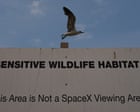
The operational footprint of private aerospace infrastructure requires a structural trade-off between domestic space launch capabilities and regional environmental stability. The June 2026 federal lawsuit filed by a coalition of environmental groups, led by the Center for Biological Diversity, against the U.S. Fish and Wildlife Service (USFWS) exposes the friction inherent in high-velocity industrial zoning. The litigation challenges the federal approval of a 1,375-acre land exchange in Cameron County, Texas, between the federal government and Space Exploration Technologies Corp. (SpaceX).
To evaluate the economic, operational, and ecological outcomes of this transaction, the situation must be stripped of rhetorical posturing and analyzed through a quantitative and structural framework. This requires examining the asset-valuation mechanisms used by the federal government, the logistical imperatives driving SpaceX’s industrial expansion, and the ecological fragmentation metrics that define the legal battleground.
The Operational Mechanics of the Real Estate Exchange
The transaction is structured as a bilateral asset exchange designed to consolidate fragmented holdings for both entities. The geographical and spatial allocation of the exchange reveals distinct strategic priorities for the public and private entities involved.
+-----------------------------------------------------------------------------+
|                            ASSET EXCHANGE MATRIX                            |
+-----------------------------------------------------------------------------+
| TRANSFER OF SURRENDERED PRIVATE HOLDINGS                                    |
| FROM: SpaceX Private Ownership                                              |
| TO:   U.S. Fish and Wildlife Service (National Wildlife Refuge System)      |
| SIZE: 683 Acres                                                             |
| LOCATION: Laguna Atascosa Boundary / Northeast Rio Grande Valley            |
| ECO-RATING: High-Quality Habitat Matrix                                     |
+-----------------------------------------------------------------------------+
|                                     ||                                      |
|                                     \/                                      |
+-----------------------------------------------------------------------------+
| DIVESTITURE OF CONSOLIDATED PUBLIC LAND                                      |
| FROM: Lower Rio Grande Valley National Wildlife Refuge                      |
| TO:   SpaceX Private Ownership                                              |
| SIZE: 712 Acres                                                             |
| LOCATION: South of State Highway 4 / Adjacent to Starbase Launch Complex    |
| ECO-RATING: Low-to-Medium Quality (Due to Industrial Proximity)             |
+-----------------------------------------------------------------------------+
The USFWS justified the transaction by deploying a net-conservation benefit methodology. Under the federal agency’s assessment framework, the land parcels were categorized using a standardized ecological quality tier system:
- The Acquisition Portfolio (683 Acres): Sourced from SpaceX’s private holdings, these parcels are located further north, near the Laguna Atascosa national wildlife refuge and the northeastern edge of the Rio Grande Valley. The USFWS classified 100% of these 683 acres as high-quality habitat. The strategic goal from the regulatory perspective is the mitigation of landscape-scale fragmentation by absorbing isolated private inholdings into a contiguous federal management system.
- The Divestiture Portfolio (712 Acres): Comprising public land within the Lower Rio Grande Valley National Wildlife Refuge, this acreage sits directly south of State Highway 4, bordering the active SpaceX Starbase launch and manufacturing facilities. The USFWS classified 497 acres of this tract as poor-quality habitat and 215 acres as medium-quality habitat, primarily due to existing industrial externalities.
The core divergence between the federal assessment and the environmental litigation lies in how baseline values are calculated. The USFWS model uses a static spatial evaluation, concluding that acquiring 683 acres of pristine, unmarred habitat in exchange for 712 acres of already degraded, industrial-adjacent land yields a long-term net benefit for regional conservation.
Conversely, the legal challenge rests on a dynamic impact model. The plaintiffs argue that transferring public acreage directly to an aerospace corporation converts a passive, low-impact buffer zone into an active zone for heavy manufacturing, propellant storage, and orbital launch operations. The baseline evaluation error, according to the lawsuit, is the failure to calculate the compounding environmental externalities generated when these 712 acres are integrated into an active aerospace complex.
The Cost Function of Aerospace Industrial Agglomeration
To understand why SpaceX aggressively pursued this land swap, one must analyze the operational constraints of the Starbase facility. Orbital launch infrastructure is governed by strict safety margins and logistical requirements. The production and flight-testing of a 400-foot, two-stage methane-oxygen propellant launch vehicle require large physical exclusion zones.
SpaceX's industrial footprint faces a primary geographic bottleneck: the operational perimeter is constrained by the Gulf of Mexico to the east, the international border to the south, and fragmented federal wildlife refuge tracts to the north and west.
The acquisition of the 712-acre federal tract solves a critical industrial optimization problem for SpaceX by addressing two structural challenges:
Elimination of Internal Inholdings
Managing an industrial facility interspersed with public land requires constant coordination with federal authorities to prevent regulatory violations. By absorbing these public tracts, SpaceX eliminates internal jurisdictional boundaries. This converts a fragmented patchwork of land ownership into a continuous, privately controlled industrial block.
Expansion of the Safety and Operations Perimeter
The proximity of the 712-acre tract to State Highway 4 and the existing launch pad provides the necessary physical space to scale up manufacturing infrastructure. This expanded footprint allows for increased propellant storage capacity and larger hardware staging areas, while keeping vital operations safely clear of public property.
The economic pressure to secure this land is further heightened by SpaceX's accelerating operational tempo. In 2025, the Federal Aviation Administration (FAA) authorized an increase in the maximum annual launch cadence at Starbase to 25 flights per year—a fivefold increase from prior regulatory caps.
An increased launch frequency alters the facility's cost function. Each orbital launch attempt requires closing State Highway 4 and beach access areas under safety protocols, which triggers local legal challenges regarding public access rights. By expanding its private land holdings around the launch complex, SpaceX changes the legal framework of its physical footprint. This shifts its position from a facility operating adjacent to protected state lands to an integrated, self-contained aerospace hub.
Landscape Fragmentation Metrics and Ecological Cascades
The environmental coalition's legal strategy relies heavily on landscape ecology principles, specifically the quantification of habitat fragmentation. The core of their argument is that raw acreage totals are an insufficient metric for evaluating ecological health. Instead, environmental preservation requires analyzing structural connectivity across a landscape.
When contiguous habitats are broken down into isolated islands, the perimeter-to-area ratio rises significantly. This structural shift triggers several clear ecological consequences:
The Edge Effect Escalation
As a habitat is subdivided, the newly created edges face higher exposure to external disturbances. In the Cameron County ecosystem, these disruptions include artificial light pollution, high-decibel acoustic vibration, thermal stress from engine exhaust, and structural runoff from concrete pads. These factors degrade the habitat quality of the remaining public land far beyond the nominal boundaries of the SpaceX property.
Disruption of Wildlife Corridors
The Lower Rio Grande Valley National Wildlife Refuge serves as a critical biological corridor for rare and endangered species, including the ocelot (Leopardus pardalis) and the jaguarundi (Herpailurus yagouaroundi). These apex predators require large, uninterrupted home ranges to maintain genetic diversity and find food. Introducing a large industrial complex directly into these pathways creates a physical barrier, effectively splitting the biological corridor in two.
Chronic Acoustic and Kinetic Stress
The legal arguments cite the real-world impacts of rapid industrial growth, pointing to the environmental damage caused by early Starship test flights. The sudden structural failures of launch infrastructure and the resulting distribution of debris over surrounding tidal flats highlight the unpredictable nature of testing experimental space hardware.
Furthermore, ongoing litigation from regional homeowners emphasizes the wider reach of these operations, noting that the low-frequency sonic booms generated during two-stage rocket tests can cause measurable structural vibrations miles away from the launch site.
The legal challenge argues that the USFWS violated the National Environmental Policy Act (NEPA) by issuing a Finding of No Significant Impact (FONSI) based on its Environmental Assessment, rather than requiring a comprehensive Environmental Impact Statement (EIS). An EIS would force regulators to model the long-term, cumulative degradation caused by frequent launches, rather than treating the land swap as a simple, isolated real estate transaction.
The Jurisdictional Conflict Over Public Commons
The dispute over the Cameron County land swap reflects a broader, systemic conflict between corporate industrial expansion and the statutory protections governing public land. This transaction is not an isolated incident; it follows a similar asset exchange in 2024, where the Texas Parks and Wildlife Commission transferred 43 acres of Boca Chica State Park to SpaceX in exchange for 477 acres near the Laguna Atascosa refuge.
A distinct pattern emerges when analyzing these transactions together:
+-----------------------------------------------------------------------------+
|                         RESERVE CONDENSATION PATTERN                        |
+-----------------------------------------------------------------------------+
| REGIONAL CONSERVATION IMPACT:                                               |
| Public land is steadily moved away from the coastal launch zone and         |
| concentrated into interior northern reserves.                               |
+-----------------------------------------------------------------------------+
|                                  |                                          |
|                                  v                                          |
+-----------------------------------------------------------------------------+
| PRIVATE INDUSTRIAL CONSOLIDATION:                                           |
| SpaceX systematically acquires the coastal areas, converting public         |
| recreational spaces and ecological buffers into high-density industrial     |
| infrastructure.                                                              |
+-----------------------------------------------------------------------------+
This structural shift creates an inevitable legal tension between two competing priorities:
The State’s Police Power and Innovation Mandate
The federal and state administrations justify these land exchanges by highlighting their duty to support domestic aerospace innovation, national security capabilities, and economic growth. From this perspective, consolidating public holdings into higher-quality interior tracts serves the public interest, while simultaneously freeing up critical coastal zones for strategic industrial use.
The Public Trust Doctrine
Conversely, the plaintiffs invoke the Public Trust Doctrine and specific constitutional protections, such as the 1959 Texas Open Beaches Act, which was enshrined in the state constitution in 2009. Their argument asserts that certain natural resources—like coastal beaches, state parks, and wildlife refuges—are inherently public assets. They contend that the government lacks the constitutional authority to divest these lands to private corporations, regardless of any interior land compensation offered in return.
Strategic Forecast and Regulatory Outcomes
The resolution of the federal lawsuit against the USFWS will establish a critical legal precedent for how industrial zones and public lands interact across the country. Based on administrative law trends and the current structure of the transaction, two primary scenarios emerge for the future of the Cameron County spaceport:
Scenario A: Administrative Remand and Operational Delay
The federal court may rule that the USFWS's Finding of No Significant Impact was arbitrary and capricious under NEPA guidelines due to an insufficient analysis of the cumulative impacts of the launch cadence. This outcome would pause the land swap and force the agency to conduct a full Environmental Impact Statement.
For SpaceX, this creates a major operational bottleneck. It would delay infrastructure expansion plans near State Highway 4 for two to four years, forcing the company to optimize its current, constrained footprint to meet its ambitious launch schedules.
Scenario B: Validation of Agency Discretion and Accelerated Expansion
The court may defer to the technical expertise of the USFWS, upholding the net-conservation benefit model and allowing the land swap to proceed. This outcome would immediately validate SpaceX’s consolidated land holdings.
With full ownership of the 712 acres, SpaceX would quickly build out the automated manufacturing facilities, expanded propellant storage systems, and additional launch support structures needed to sustain a high-frequency launch model. This expansion would firmly establish Starbase as a privately controlled, highly integrated industrial city, shifting the surrounding public refuges into permanent buffer zones.
The ultimate outcome of this conflict will depend on how the court balances raw acreage compensation metrics against the long-term ecological impacts of industrial fragmentation. As the lawsuit moves through the federal court system, it highlights a definitive reality of modern industrial planning: the speed of commercial technological advancement will continuously test the boundaries of established environmental law and public land management.