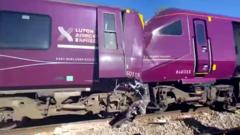
The collision between two East Midlands Railway (EMR) passenger services at Elstow, near Bedford, represents the first fatal multi-train accident on a British mainline this century. One driver is dead, 11 individuals have sustained life-threatening injuries, 22 are seriously injured, and 56 have minor injuries. This structural failure demands an investigation beyond immediate operational headlines. To evaluate how a modern, multi-billion-pound rail network permits a rear-end collision between two high-speed trainsets, the event must be deconstructed through three precise analytical pillars: signaling integrity, kinetic energy dissipation, and emergency asset deployment.
The incident occurred at approximately 17:15 on June 19, 2026, south of the Elstow interchange. It involved the 15:50 Nottingham to London St Pancras service (utilizing a Class 810 Aurora bi-mode trainset) and the 16:40 Corby to London St Pancras service (utilizing a Class 360 electric multiple unit). Early diagnostic data indicates that the Class 360 unit struck the rear of the stationary or slower-moving Class 810 train. In a network governed by automated safety logic, this layout points directly to a systemic breakdown in line-capacity management and interlocking protocols.
The Fail-Safe Break Down: Interlocking and Attenuation Mechanisms
Modern rail networks operate under strict spatial separation principles. Under normal parameters, a train cannot enter a block—a designated segment of track—unless the signaling system verifies that the block ahead is entirely clear. The occurrence of a rear-end collision proves that this safety loop was breached. There are two primary engineering hypotheses for this breakdown:
- Adhesion Failure and Braking Distance Degradation: The coefficient of friction between the steel wheel and the steel rail drops drastically under specific environmental conditions, such as leaf-grease accumulation or sudden dampness. If the Class 360 driver received a restrictive signal aspect (red or yellow) but experienced wheel-slide, the actual braking distance would exceed the theoretical safety overlap calculated by the signaling infrastructure.
- Data Transmission Corruption within TPWS/AWS: The Train Protection and Warning System (TPWS) is engineered to automatically apply emergency brakes if a train passes a red signal or approaches a speed restriction too quickly. If a trackside transmitter failed to communicate with the train’s on-board receiver, or if the system suffered a localized power or software fault, the automated intervention window vanished.
The physical outcome of this failure is a function of kinetic energy ($E_k = \frac{1}{2}mv^2$). When the Class 360 impacted the Class 810, this energy had to be absorbed structurally. Modern rolling stock incorporates crumple zones and energy-absorbing couplers designed to compress progressively. However, when the kinetic energy exceeds the structural threshold of these crush zones, the forces are transferred directly to the passenger cabin.
This manifests as severe interior deceleration. Unrestrained passengers are propelled into structural fixtures at the delta velocity of the impact. This mechanism explains the high density of severe trauma—broken limbs, facial lacerations, and spinal injuries—reported by survivors in the leading carriages of the trailing train and the rear carriages of the leading train. The structural integrity of the Class 810 Aurora, which entered service recently, will face intense scrutiny regarding how its rear frame managed the impact compared to older rolling stock design models.
The Major Incident Function: Resource Triaging under Logistics Pressure
The East of England Ambulance Service declared a "Major Incident" immediately upon assessing the scale of casualties. In emergency medicine and municipal logistics, a major incident designation alters the operational objective from optimized individual patient care to maximizing overall survival rates across a population.
The medical response function can be categorized into three distinct triage tiers:
- Triage Category 1 (Immediate / P1): The 11 individuals designated with "very serious" injuries. These patients present with compromised airways, massive internal hemorrhaging, or severe neurotrauma. They require immediate surgical or intensive care stabilization and were evacuated via six deployed air ambulances to major trauma centers (such as Addenbrooke's or the Royal London Hospital).
- Triage Category 2 (Urgent / P2): The 22 individuals classified as "seriously injured." These patients present with stabilized open fractures, severe concussions, or thoracic trauma that requires hospitalization but allows for short-term delay during transport logistics.
- Triage Category 3 (Delayed / P3): The 56 individuals with minor injuries. These patients require superficial wound care, psychological stabilization, or minor diagnostic screening. They were managed at a temporary casualty clearance station established at Progress Park, preventing the immediate saturation of local emergency departments.
The primary operational constraint during this phase was regional hospital capacity. Bedford Hospital and the Luton and Dunstable University Hospital implemented emergency diverts for non-critical public admissions. This protocol isolated their emergency rooms to process the surge of P1 and P2 casualties systematically, avoiding a secondary systemic failure within the healthcare delivery system.
Structural Bottlenecks and Line Recovery Protocols
The suspension of all East Midlands Railway services to and from London St Pancras creates an immediate economic and logistical bottleneck on the Midland Mainline. Restoring this infrastructure requires a sequential multi-agency protocol that cannot be expedited without compromising legal and safety standards:
- Evidence Preservation and Forensic Mapping: The Rail Accident Investigation Branch (RAIB) and the British Transport Police hold statutory control over the site. Investigators must download data from the On-Train Data Recorders (OTDR), map the physical debris field, measure the friction profile of the rails, and analyze track circuit logs to verify signal states at the exact timestamp of the collision.
- Rolling Stock Extraction and Track Remediation: Once forensic clearance is granted, heavy recovery cranes must lift the derailed carriages. The physical impact damages the ballast layer, deforms steel rails, and disrupts underground signaling telemetry. Network Rail engineers must reconstruct the physical permanent way before any test trains can run.
- System-Wide Operational Audits: Before EMR can resume full-speed operations, the signaling software governing the entire sector must undergo a rigorous check to ensure the fault was localized rather than systemic across the wider network topology.
The financial impact spans beyond repair capital. The suspension breaks down commuter corridors, forces freight diversions, and triggers massive regulatory penalty clauses under the rail network's performance-regime frameworks.
The Technical Directives for Rail Infrastructure
The immediate requirement for the Office of Rail and Road (ORR) and Network Rail is an immediate review of European Train Control System (ETCS) rollout timelines. The traditional multi-aspect signaling utilized on lines like the Midland Mainline provides static safety buffers. It lacks the continuous, real-time speed monitoring and automated variable braking adjustments offered by digital in-cab signaling.
Operators must adjust their risk functions regarding low-adhesion seasonal risks. If braking performance varies predictably under fluctuating environmental conditions, static signal spacing must be dynamically extended using automated defensive scheduling software. Relying on human driver intervention during an unmonitored systems failure introduces an unacceptable point of failure into high-capacity rail corridors.



