Small unmanned aerial systems (sUAS) have fundamentally altered modern kinetic conflicts, shifting the economic calculus of asymmetric warfare. The primary challenge in defeating these threats lies not in the lack of kinetic or non-kinetic mechanisms, but in the scaling laws of production and unit-cost economics. GuideTech’s recent $2.3 million contract for subsystem integration inside a new "drone-killer" platform highlights a critical inflection point in defense procurement: the transition from bespoke, low-yield experimental prototypes to standardized, sub-component architecture designed for high-rate production.
Understanding the strategic implications of this transaction requires breaking down the component-level economics of counter-unmanned aerial systems (C-UAS), the specific engineering bottlenecks in sensor-to-shooter pipelines, and the structural constraints of mid-tier defense supply chains.
The Micro-Economics of Asymmetric Interception
The core vulnerability of legacy air defense frameworks when facing sUAS threats is the cost-exchange ratio. Deploying a traditional surface-to-air missile costing upwards of $100,000 to neutralize a commercial off-the-shelf (COTS) quadcopter modified for ordnance delivery costing $1,500 introduces a negative economic spiral.
A sustainable C-UAS framework relies on three fundamental operational variables:
- Cost-per-Engagement (CPE): The fully loaded marginal cost of the neutralizing agent (whether ammunition, directed energy, or electronic jamming) plus the depreciated wear on the launch platform.
- Probability of Kill ($P_k$): The statistical likelihood that a single engagement cycle successfully neutralizes the target threat vector.
- Magazine Depth: The total number of ready-to-fire interceptors or engagement cycles available on a single platform before requiring physical replenishment.
A $2.3 million contract allocation indicates a focused procurement of localized internal systems—likely high-frequency radio frequency (RF) front-ends, edge-compute processing units, or specialized telemetry modules—rather than the rollout of a complete, field-ready vehicle fleet. In defense manufacturing, capital of this scale is typically allocated toward initial low-rate initial production (LRIP) runs or specialized sub-assembly engineering phases.
Engineering Architecture of the Modern Drone-Killer
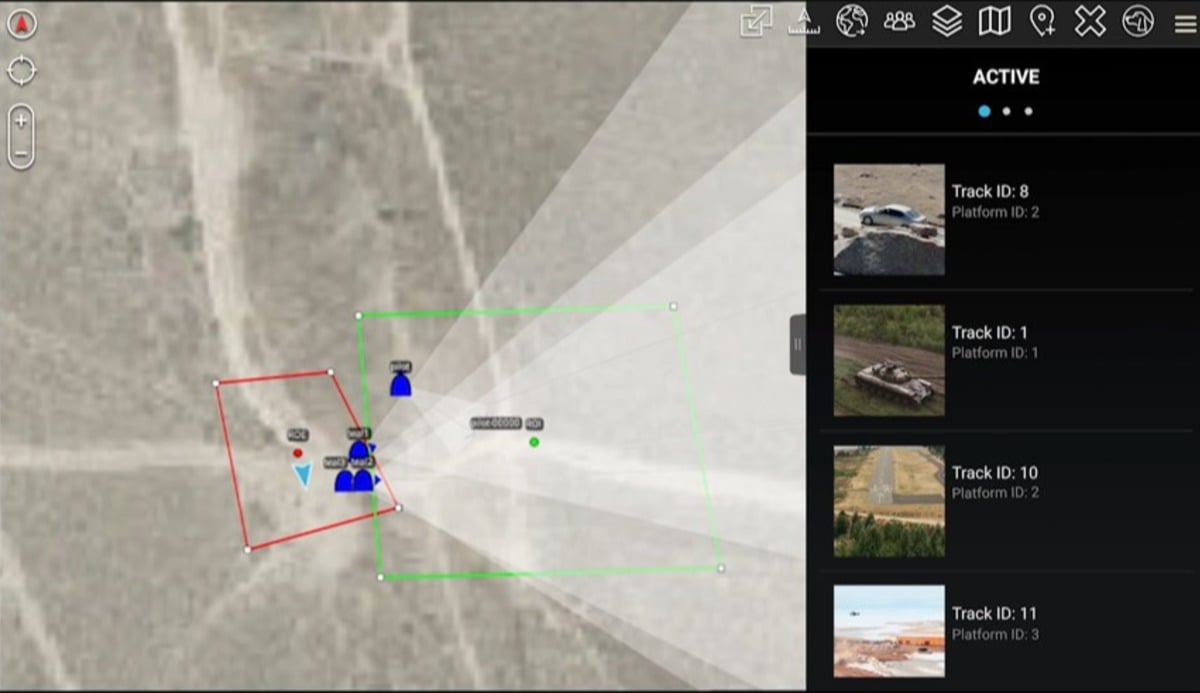
To evaluate where GuideTech’s technology fits inside a modern interception platform, the system must be separated into its distinct functional layers. A mobile, hard-kill or soft-kill C-UAS platform operates via a closed-loop execution chain.
[Passive/Active Detection] -> [Sensor Fusion & Tracking] -> [Kinetic/Non-Kinetic Defeat]
Sensor Fusion and Edge Computation
The first structural bottleneck occurs at the detection phase. Commercial drones operate with small radar cross-sections (RCS), minimal thermal signatures, and low acoustic profiles. A competent drone-killer relies on multi-modal sensing, combining X-band or Ku-band radar, electro-optical/infrared (EO/IR) tracking cameras, and passive RF direction finding.
The integration task—where sub-contractors like GuideTech typically provide specialized value—involves processing these disparate data streams locally. Transmitting raw sensor data to a centralized command node introduces latency and exposes the system to electronic warfare interference. The edge-compute architecture must execute real-time target classification, separating avian clutter from rotary-wing threats, and calculate automated fire-control solutions within milliseconds.
The Interception Mechanism Bottleneck
Once a track is established, the platform must deliver a defeat mechanism. The current market is bifurcated into two primary approaches:
- Directed Energy Weapons (DEW): High-energy lasers (HEL) and high-power microwaves (HPM) offer a near-zero cost-per-engagement and deep magazines, but suffer from atmospheric attenuation, thermal management limits, and extended dwell times required on target.
- Kinetic Interceptors: Programmable airburst ammunition, automated shotguns, or specialized counter-drone micro-missiles provide rapid neutralize times but are strictly limited by magazine capacity and hardware cost.
Given the $2.3 million valuation of the GuideTech deal, the scope points toward equipping a specific subset of automated tracking or navigation subsystems rather than primary directed-energy power plants, which require significantly higher capital expenditures for thermal and electrical infrastructure.
Supply Chain Realities and Scaling Vulnerabilities
The transition from a validated bench prototype to a field-deployable asset introduces severe manufacturing friction. Mid-tier defense tech firms face unique challenges when scaling hardware destined for electronic warfare environments.
Component Obsolescence and COTS Dependence
To maintain rapid development cycles, many defense innovators rely on commercial high-performance silicon, field-programmable gate arrays (FPGAs), and RF chipsets. While this accelerates initial deployment, it exposes the production line to global semiconductor supply shocks and rapid obsolescence cycles. A system engineered around a specific commercial FPGA may require a total hardware redesign if the foundry deprecates that component architecture within a 24-month window.
Environmental Rigor vs. Weight Constraints
Systems deployed on mobile drone-killer platforms must survive extreme vibrational profiles, wide thermal variances, and high electromagnetic interference (EMI) environments. Shielding sensitive processing components against external jamming while keeping the physical footprint small enough for integration onto light tactical vehicles creates a profound engineering trade-off. Every ounce of shielding added to an electronics enclosure directly reduces the payload capacity or operational range of the host platform.
Strategic Allocation of Capital
A $2.3 million contract win should not be analyzed as a comprehensive procurement solution, but rather as an indicator of a broader, modular defense strategy. Modern defense ministries are actively avoiding vendor lock-in by enforcing Open Systems Architecture (OSA) mandates. By buying discrete, high-performance sub-components from specialized providers like GuideTech, prime contractors can assemble modular platforms that can be rapidly upgraded as threat capabilities evolve.
The primary risk to this operational model lies in the integration interface. When software protocols, data rates, or mechanical connectors vary across sub-vendors, the timeline for deployment expands exponentially. The success of the underlying drone-killer platform depends entirely on whether the software wrappers governing GuideTech's components adhere strictly to standardized data distribution services.
Operational deployment data from active theaters indicates that drone tactics evolve on a week-by-week basis, shifting frequencies, changing autonomous flight behaviors, and utilizing multi-directional swarm profiles. Consequently, the value of hardware procurement no longer resides solely in the physical chassis or the kinetic payload; it resides in the adaptability of the underlying processing architecture to ingest over-the-air software updates that counter new threat signatures in near-real-time. Prime contractors must prioritize procurement pipelines that treat hardware as a reusable substrate for rapidly evolving, software-defined capabilities.