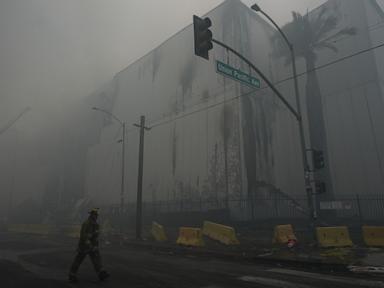
Industrial cold storage facilities are designed to defeat thermodynamics, sealing millions of pounds of perishable inventory within heavily insulated, airtight shells. Yet, when a structural fire breaches these environments, the very engineering principles that preserve inventory transform the facility into an inextinguishable thermal battery. The June 2026 fire at the 500,000-square-foot Lineage Logistics facility in Boyle Heights, Los Angeles, demonstrates this operational vulnerability. Containing 85 million pounds of frozen food, the incident highlights a critical systemic failure mode where traditional fire suppression methodologies are neutralized by cold chain engineering.
To evaluate the structural and economic risks of these incidents, industrial operators must analyze the mechanics of insulation-driven thermal containment, hazardous material integration, and subsequent biohazard lifecycle costs.
The Core Thermal Containment Paradox
Standard logistics warehouses rely on passive ventilation and accessible structural frameworks that allow rapid tactical intervention. Cold storage architecture utilizes a specialized structural matrix designed entirely for thermal efficiency, creating distinct operational challenges during a structural failure.
The Thermal Enclosure Insulation Barrier
Cold storage facilities feature walls and ceilings lined with thick layers of expanded polystyrene (EPS) or polyurethane foam panels sandwiched between metal sheets. While optimizing energy efficiency, these materials create an impenetrable thermal envelope. During an internal or external breach, this insulation blocks the dissipation of heat. The energy is reflected inward, accelerating flashover conditions.
Standard firefighting protocols dictate venting a roof to release toxic gases and improve interior visibility. In a cold storage environment, the depth and density of the ceiling insulation render rapid ventilation impossible. The structure acts as a closed thermodynamic system, trapping smoke and heat, driving internal temperatures to extremes while blocking external water applications from reaching the seat of the fire.
High-Density Vertical Staging Vectors
To maximize cubic foot utilization, modern cold storage operations employ dense steel rack configurations extending up to 65 feet vertically. The spatial configuration of these racks introduces two critical failure vectors:
- The Chimney Effect: Tight vertical interstitial spaces between densely packed pallets act as natural flues, drawing heat and flames upward through the product stacks.
- Structural Collapse Risk: The structural integrity of high-bay steel racking degrades rapidly under sustained thermal exposure. Once temperatures exceed $500^\circ\text{C}$, structural steel loses roughly half its yield strength. In a cold storage fire, weight loads are exacerbated by water absorption from defensive suppression efforts, creating a high probability of catastrophic rack collapse that prevents personnel from entering the facility.
Hazardous Material Concurrency and Anhydrous Ammonia Risks
Cold storage operations require high-capacity industrial refrigeration loops, typically utilizing anhydrous ammonia ($NH_3$). While highly efficient for thermal regulation, the integration of extensive chemical coolant lines into a burning structure increases operational hazards.
[Roof-Mounted Solar Array Ignition]
               │
               ▼
[Thermal Envelope Penetration] ──► [Insulation Foam Combustion]
               │
               ▼
[Structural Rack Deformation] ──► [Anhydrous Ammonia Line Rupture]
               │
               ▼
[Atmospheric Toxification & Flammability Cascade]
Anhydrous ammonia possesses a narrow flammability range (15% to 28% by volume in air) but becomes highly explosive when mixed with lubricating oils within the refrigeration system. A structural breach that ruptures pressurized refrigeration lines creates an immediate secondary explosion hazard.
Furthermore, ammonia gas is highly toxic to human tissue upon inhalation or contact. The release of a pressurized ammonia cloud during the early stages of the Boyle Heights incident forced tactical retreats and necessitated localized shelter-in-place mandates. The presence of this chemical risk shifts the tactical framework from offensive interior suppression to defensive containment, relying on aerial water drops to scrub the air and lower ambient temperatures.
The Roof-Mounted Energy Inversion
The push for carbon-neutral supply chains has led to the widespread installation of industrial solar photovoltaic (PV) arrays across the expansive flat roofs of cold storage facilities. This engineering choice introduces a direct ignition vector over a highly combustible insulation layer.
Third-party solar arrays generate high-voltage direct current (DC) power that cannot be easily isolated or shut off while the sun is shining. If a mechanical breakdown or installation defect occurs during testing or operation, localized electrical arcing can quickly ignite the underlying roofing membranes.
The physical weight and surface area of solar arrays present a secondary challenge: they form an armor-like layer over the roof. This barrier prevents water from penetrating the ceiling structure and prevents firefighters from cutting ventilation holes, sealing the burning foam insulation beneath a layer of active electrical generation components.
The Post-Incident Biohazard Lifecycle
The financial and operational consequences of a cold storage fire extend far beyond the immediate structural damage. The termination of the refrigeration cycle initiates a complex, high-liability waste management challenge involving millions of pounds of decomposing organic matter.
When power fails and structural integrity is compromised, 85 million pounds of frozen meat, poultry, and produce undergo rapid thermal degradation. This decay creates a secondary operational phase governed by strict biohazard protocols:
Phase 1: Thermal Degradation ──► Phase 2: Anaerobic Off-gassing (H2S / CH4) ──► Phase 3: Leachate Containment & Runoff Mitigation
- Anaerobic Decomposition: The mass of rotting proteins creates an anaerobic environment, generating toxic and flammable gases including hydrogen sulfide ($H_2S$) and methane ($CH_4$). This transition creates an ongoing atmospheric hazard long after the open flames are extinguished.
- Leachate Management: Decomposing organic matter generates highly contaminated liquid runoff, known as leachate. This liquid carries high biological oxygen demand (BOD) and pathogenic risks. If left unmanaged, it can enter local storm drains and contaminate regional water systems.
- Extraction Logistics: Because structural instability prevents the use of standard heavy machinery inside the building, operators must systematically dismantle the exterior walls. Debris and spoiled inventory must be extracted chunk by chunk, categorized as biohazardous waste, and transported to specialized facilities for deep-burial landfill disposal or incineration.
Systemic Risk Mitigation Protocols
Managing the vulnerabilities of industrial cold storage infrastructure requires moving away from reactive emergency response toward specialized engineering and preventative design.
Operators should evaluate retrofitting facilities with non-combustible thermal barriers, such as multi-layered gypsum board assemblies, positioned directly between the roof deck and solar mounting hardware to prevent external electrical fires from reaching the internal insulation layer. Furthermore, automated isolation valves must be integrated into anhydrous ammonia loops to automatically segment and isolate localized lines when a drop in pressure or a sudden rise in temperature is detected.
Finally, high-density storage areas should utilize early-warning very early smoke detection apparatus (VESDA) systems calibrated for sub-zero environments. These systems can detect pre-combustion particulate matter before thermal runaway occurs within the structural envelope, allowing operators to intervene before a localized electrical fault turns into an uncontainable industrial disaster.


