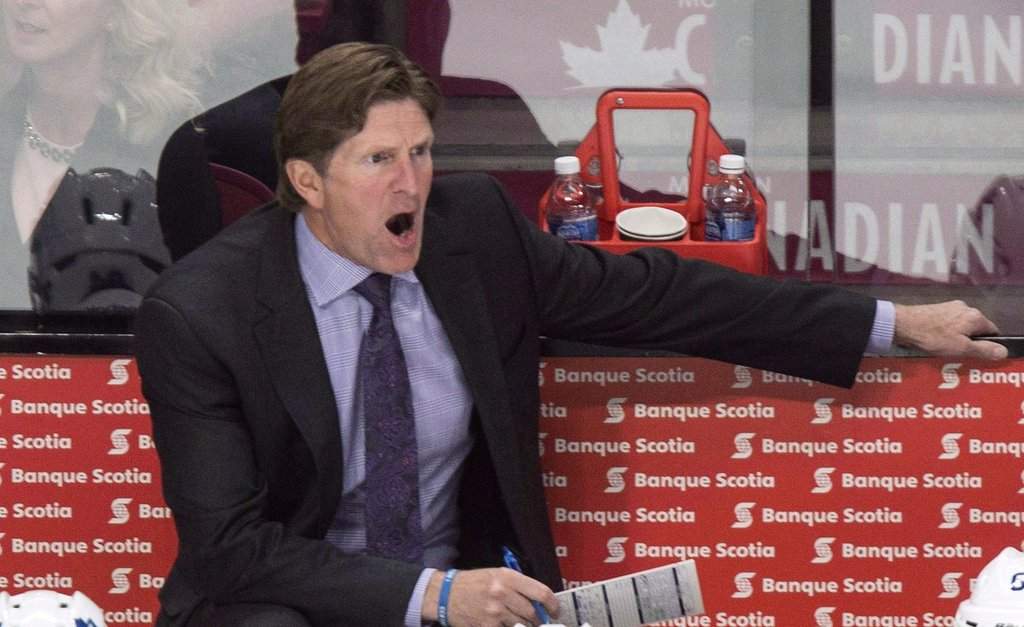
The Edmonton Oilers' appointment of Mike Babcock as their 19th head coach operates on a high-stakes calculus: balancing a championship window against known institutional and cultural liabilities. By replacing Kris Knoblauch—following a 2026 first-round playoff exit against the Anaheim Ducks—Edmonton management is executing a high-risk optimization strategy. The goal is clear: maximize the championship efficiency of a roster anchored by Connor McDavid and Leon Draisaitl during their physical primes.
To understand how a coach who has not overseen an NHL bench since 2019—and who resigned from the Columbus Blue Jackets in 2023 before coaching a single regular-season game—secured the league's most scrutinized vacancy, one must look past simple chronological timelines. The hiring is the product of three distinct variables: tactical capital depreciation, behavioral governance risk, and organizational desperation.
The Strategic Framework: Corporate Asset Underperformance
The primary catalyst for this hiring is structural underperformance relative to roster valuation. Despite consecutive appearances in the Stanley Cup Final in 2024 and 2025, the Oilers failed to capture the championship, culminating in a severe regression during the 2025–26 campaign where they finished second in the Pacific Division (41-30-11) and suffered an early postseason exit.
The operational breakdown under the previous coaching regime can be categorized into two major deficiencies:
- Defensive Structural Degradation: The Oilers' systems failed to insulate their goaltending, leaving the roster highly vulnerable to transitional counter-attacks.
- Asset Management Inefficiency: Elite point-production capabilities were concentrated heavily within the top six forwards, leaving the bottom six under-utilized and structurally deficient during high-leverage defensive zone starts.
Babcock’s historical record presents an attractive statistical profile for an organization attempting to solve these exact structural bottlenecks. Over 17 NHL seasons, Babcock compiled a regular-season record of 700-418-183. His tactical blueprint relies on strict positional rigidity, heavy forechecking metrics, and zone-entry denial systems. The organizational hypothesis is that Babcock’s structural discipline will artificially raise the defensive floor of a top-heavy roster.
The Path of Capital and Conduct: A 24-Year Chronology
Babcock’s trajectory to Edmonton is not a linear progression of merit but a volatile cycle of elite tactical output followed by steep behavioral liabilities.
[2002-2005: Anaheim] ---> [2005-2015: Detroit] ---> [2015-2019: Toronto]
   (System Building)          (Championship Peak)        (Systemic Friction)
                                                                 |
[2026: Edmonton]     <--- [2023: Columbus]       <--- [2020-2022: U Sports]
 (The Risk Gamble)         (Privacy Violations)         (Institutional Exile)
The System-Building Era (2002–2005)
Hired by the Mighty Ducks of Anaheim on May 22, 2002, Babcock engineered an immediate 40-27-15 regular-season turnaround, optimizing a defensive roster to reach the 2003 Stanley Cup Final. This era established his core tactical thesis: high volume low-to-high passing plays and aggressive puck-retention schemes.
The Championship Peak (2005–2015)
Taking over the Detroit Red Wings on July 15, 2005, Babcock inherited an elite veteran core. Over a decade, he recorded a 458-223-105 mark, capturing the Stanley Cup in 2008 and reaching the Final again in 2009. His international resume reinforced this peak, securing consecutive Olympic gold medals with Team Canada in 2010 and 2014. During this span, his operational authority was absolute, insulated by consistent regular-season success.
Systemic Friction and Value Capital Depreciation (2015–2019)
The Toronto Maple Leafs signed Babcock to a record-breaking eight-year, $50 million contract on May 20, 2015. While the team achieved three postseason berths, they failed to advance past the opening round. The first major bottleneck occurred here: a widening gap between Babcock's rigid psychological tactics and a younger generation of players. He was terminated on November 20, 2019, after a 9-10-4 start to the season.
Institutional Exile and the Columbus Collapse (2019–2023)
Following his dismissal from Toronto, serious behavioral liabilities surfaced. Reports emerged that Babcock forced a rookie Mitch Marner to rank his teammates' work ethics and subsequently disclosed that list to veterans, fracturing dressing room cohesion. Former players, including Johan Franzen, detailed extreme psychological stress under his management.
Exiled from the NHL, Babcock spent time as an unpaid adviser at the University of Vermont (2020–21) and head coach at the University of Saskatchewan (2021–22). The Columbus Blue Jackets attempted to rehabilitate his NHL career by hiring him on July 1, 2023. Five weeks later, a podcast report revealed Babcock demanded players hand over personal mobile devices to review private photos under the guise of character assessment. Following an intense NHL Players' Association (NHLPA) investigation into privacy violations, Babcock resigned on September 17, 2023, before training camp opened.
The Cleared Runway: Regulatory Risk Mitigation
Edmonton's front office could not execute this contract without navigating a complex regulatory landscape. On June 10, 2026, amid intense rumors linking Babcock to the vacant Oilers position, the NHLPA requested a formal league review of his actions in Columbus.
The league’s determination, finalized on June 18, 2026, stated that its investigation concluded there was "no current basis to restrict his employment in the league." This declaration cleared the legal and regulatory hurdle for the Oilers, shifting the burden of risk entirely onto the club's internal operations and corporate brand equity. To provide structural support and tactical continuity, the Oilers simultaneously appointed D.J. Smith—Babcock’s former assistant in Toronto and a veteran bench boss—as associate coach.
Measuring the Regression: The Post-2009 Playoff Bottleneck
A critical error made by traditional media is attributing Babcock's hiring to modern tactical superiority. Evaluating his resume using advanced postseason data reveals a significant performance bottleneck.
The core vulnerability in Babcock's profile is a prolonged period of diminishing returns in high-stakes environments:
- The Post-2009 Postseason Deficit: Since losing the Stanley Cup Final in 2009, Babcock’s teams have failed to advance past the second round of the playoffs.
- The First-Round Cap: His last playoff series victory occurred in 2013 with Detroit.
- Modern Postseason Efficiency: Since 2014, Babcock owns a 12-20 postseason record. His historical 90-74 playoff record is heavily weighted by the elite Detroit rosters of the mid-2000s, raising serious questions about his ability to adapt to modern game-management dynamics.
The Strategic Prescription
The Edmonton Oilers have a limited operational runway. Connor McDavid enters the first season of a two-year, $25 million contract signed in late 2025. This creates an immediate 24-month window to maximize championship output before facing massive extension costs or roster churn.
To prevent this hire from devolving into an institutional crisis like the one seen in Columbus, the Oilers' executive leadership must deploy an aggressive risk-containment strategy. First, isolate Babcock's authority strictly to on-ice tactical execution, stripping him of any unchecked influence over player personnel management or private workplace conduct. Second, establish an uncompromised, independent communication channel between the team's leadership group—specifically McDavid and Draisaitl—and General Manager Ken Holland to quickly detect and neutralize dressing room friction. Finally, leverage associate coach D.J. Smith as the primary operational bridge for day-to-day player relationships, using his communication style to buffer the head coach's old-school tendencies.
If these internal guardrails fail to contain the cultural risks, the organization must be prepared to cut ties immediately. The margin for error is non-existent; any systemic cultural failure over the next two seasons will directly compromise the franchise's ability to retain its generation-defining core.