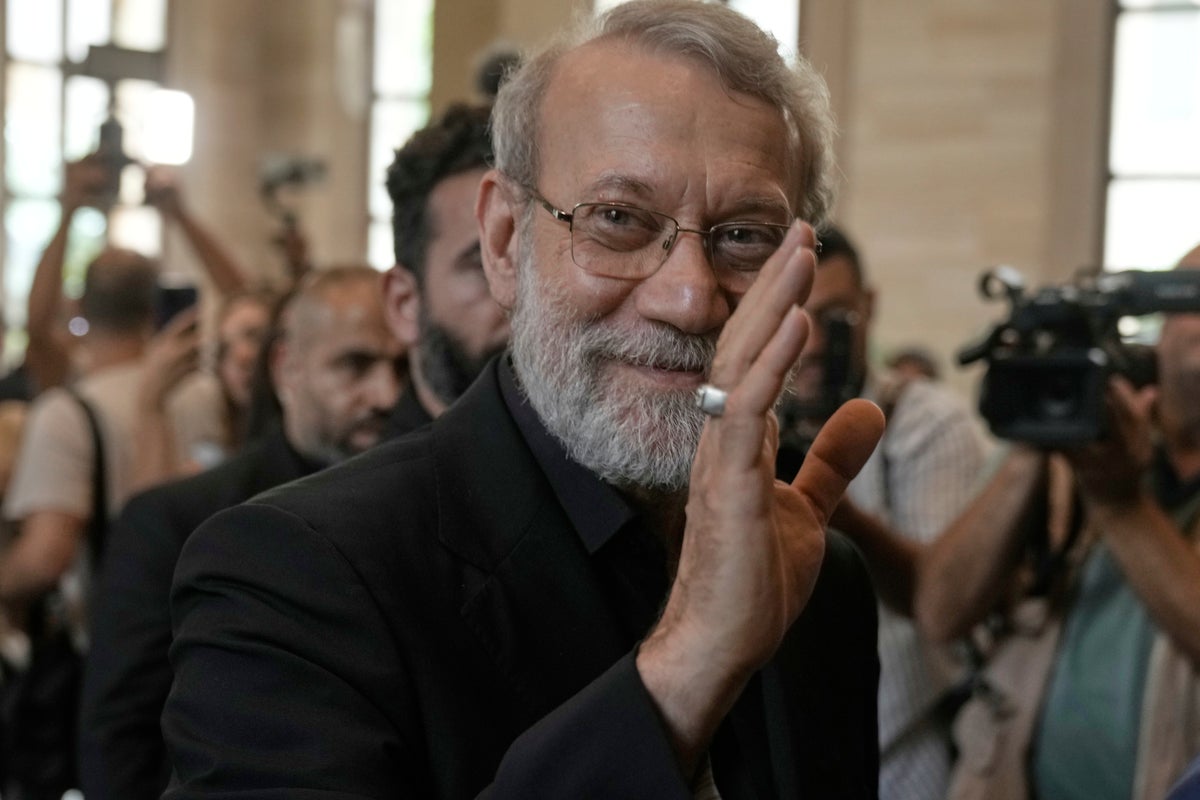
The Western media loves a "strongman" because it saves them the trouble of understanding a bureaucracy. They see a tall man with a silver beard and a background in the Islamic Revolutionary Guard Corps (IRGC) and immediately reach for the "security chief" template. It is lazy. It is wrong. And if you are making geopolitical bets or trying to understand the pulse of the Middle East based on the "Ali Larijani is a radical threat" narrative, you are already behind the curve.
Larijani is not a blunt instrument of terror. He is the ultimate institutionalist—the consummate "Man of the System" who has spent decades navigating the treacherous friction between Iran’s clerical absolutism and its desperate need for technocratic survival. Calling him a security threat who wants to "eliminate" world leaders misses the entire point of his career. He isn't the guy who pulls the trigger; he’s the guy who writes the manual on how to keep the gun from exploding in the shooter's hand. Building on this idea, you can also read: Why the Green Party Victory in Manchester is a Disaster for Keir Starmer.
The IRGC Label is a Distraction
Every profile of Larijani starts with his rank in the IRGC. It is a classic move designed to trigger a specific response in a Western audience. Yes, he was in the Guard. So was almost every male of his generation who wanted a career in public service after the 1979 revolution. To view Larijani through a purely militaristic lens is like viewing a Fortune 500 CEO solely through the lens of their time in the ROTC.
Larijani’s real power comes from his pedigree and his intellect, not a uniform he hasn’t worn in decades. He is the son of a Grand Ayatollah. His brothers have held the highest seats in the judiciary and the executive branch. He holds a PhD in Western Philosophy with a focus on Immanuel Kant. Think about that for a second. While the "strongman" narrative suggests a radical extremist, the reality is a man who spent his formative years deconstructing the Critique of Pure Reason. Analysts at NPR have provided expertise on this situation.
He is a philosopher-bureaucrat. His weapon of choice is not a missile; it is the calculated, agonizingly slow process of legislative consensus.
The "Elimination" Quote: Context is King
When headlines screamed that Larijani "threatened Trump with elimination," they were participating in a choreographed dance of mistranslation and theatrics. In the Persian political idiom, "elimination" from the political scene or the "dustbin of history" is standard rhetorical flair. It is the Iranian version of saying a politician is "finished."
Does Larijani hate US foreign policy? Absolutely. Is he a friend of the West? Not in the way a neoliberal would hope. But he is a rational actor. He understands the mechanics of the JCPOA (the Iran Nuclear Deal) better than almost anyone in Tehran. He was the one who steered it through a hostile parliament (the Majlis) against the screams of the actual hardliners who called him a traitor for even talking to Americans.
If you want to find the "strongmen," look at the commanders in the field. Larijani is the one they have to check with to see if their budget will be approved.
Why the "Hardliner" Label is a Financial Failure
If you are an investor or a policy analyst, labeling Larijani a hardliner is a mistake that will cost you money or credibility. In the Iranian political spectrum, he is a "Principleist," but of the pragmatic variety. This is a crucial distinction.
- The Radical Hardliners: Want isolation, a resistance economy, and zero engagement with the West.
- The Pragmatic Conservatives (Larijani’s Camp): Want the survival of the Islamic Republic through controlled modernization and selective engagement.
Larijani is the bridge. He is the one who understands that for Iran to survive, it needs the $25-billion-plus infrastructure deals that only come with a degree of international normalcy. He was the key architect of the 25-year strategic partnership with China. That isn't the move of a "security chief" looking for a fight; it’s the move of a strategist looking for a hedge.
I have watched analysts misread this for twenty years. They see a beard and a stern face and assume "No." Larijani is the king of "Maybe, but on my terms."
The Kantian Revolutionary
Let’s talk about that PhD again. You cannot understand Larijani’s approach to the West without understanding his philosophical grounding. He isn't driven by the blind zeal of a foot soldier. He is driven by a cold, analytical view of sovereignty.
To Larijani, the Western international order is a series of logical propositions that Iran must either solve or circumvent. When he served as the chief nuclear negotiator, he frustrated his European counterparts not with religious dogma, but with tedious, high-level legalism. He would spend hours debating the definition of a single word in a treaty.
This isn't "strongman" behavior. This is "High-Level Consultant" behavior. He is the guy you hire to find the loophole in a 500-page contract.
The 2024-2026 Shift: Why He Matters Now
For a few years, Larijani was sidelined. The hardliners in the Guardian Council disqualified him from running for president because his family ties were deemed too "international" and his brand of pragmatism too "liberal" for the current era of the Supreme Leader’s succession planning.
But look at what is happening now. As the "Resistance Economy" stutters and the threat of a full-scale regional war looms, the System is quietly whispering for the pragmatists to return to the room. Larijani hasn't gone away; he has been rebranded as a special envoy. He is the shadow diplomat sent to Damascus and Beirut when the situation requires more than just a drone strike.
He is the "fixer." When the IRGC breaks something, Larijani is sent in to negotiate the settlement.
The Flaw in the "Elimination" Narrative
The competitor article wants you to be afraid of a man who makes threats. I am telling you to be wary of a man who makes deals.
The danger of Ali Larijani isn't that he will start a war. The danger—for Western interests—is that he is talented enough to stabilize Iran’s position, secure Eastern alliances, and outmaneuver Western sanctions without ever firing a shot. He is the personification of "soft power" within a "hard" regime.
If you are looking for a villain in a Tom Clancy novel, keep reading the "security chief" headlines. If you want to understand how the Iranian state actually functions, start looking at Larijani as the CEO of a distressed asset who is slowly, methodically, and brilliantly restructuring the debt.
Stop Asking if He is Dangerous
The question "Is Ali Larijani dangerous?" is the wrong question. It’s a binary question for a non-binary world.
The right question is: "Is Ali Larijani necessary?"
For the Supreme Leader, the answer is yes. For the survival of the clerical state, the answer is yes. He is the pressure valve. He is the intellectual weight that prevents the ship of state from tipping over into total chaos. He is the man who can talk to a cleric in Qom in the morning and a diplomat in Beijing in the afternoon, and make both believe he is on their side.
He is not the "strongman" threatening the world. He is the architect of a world where the West’s influence is just one of many variables he has already accounted for in his calculations.
Stop reading the caricatures. Start reading the logic. Larijani isn't the one coming for your "elimination." He is the one making sure you are irrelevant before you even realize the game has started.
The era of the shouting revolutionary is over. The era of the Kantian negotiator is here. Get used to it.
Check the board again. You’re playing checkers. He’s been playing three-dimensional chess since the eighties, and he still has all his pieces.