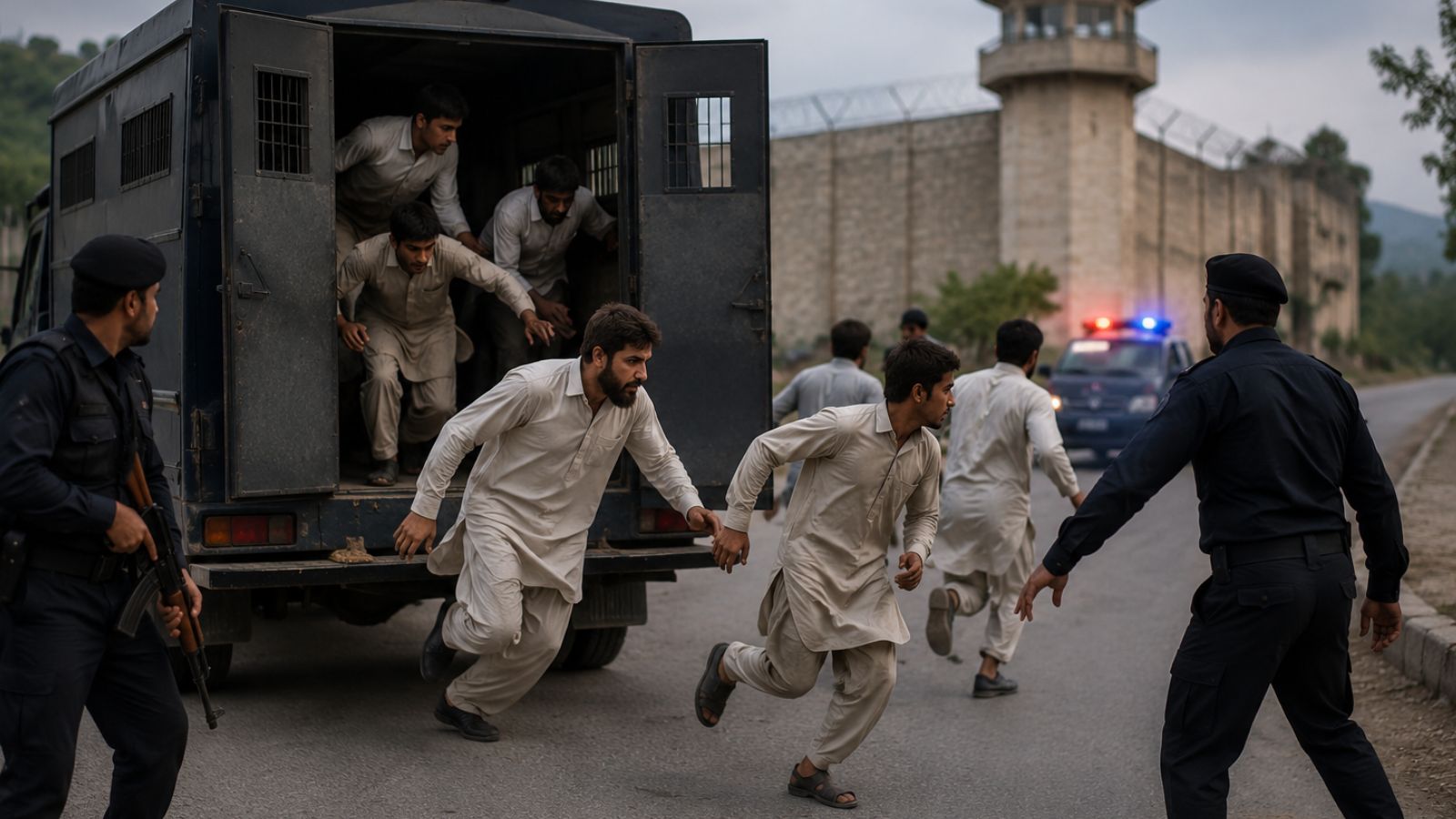
Prison transport vans in Pakistan aren't supposed to be action movie sets. Yet, on a mundane Monday journey from Kahuta to the high-security Adiala Central Jail, a routine transfer turned into chaos. Fourteen under-trial prisoners managed to completely overpower their guards and vanish into thin air near the Sihala area of Rawalpindi.
This isn't just a localized police failure. It's a flashing red warning light about systemic rot in prisoner transit protocols. When thirty-six inmates are packed into a single vehicle with a handful of guards, you aren't just running a transport route. You're practically begging for a security disaster.
The breakout happened at a transit marker known as Chakian Stop. The escapees used a mix of coordinated violence and raw distraction tactics. Here is how the entire situation unraveled, why the system failed so spectacularly, and what needs to happen immediately to secure the remaining fugitives.
The Sihala Ambush and the Chilli Powder Weapon
Security officials often overlook the simplest vulnerabilities. In this case, the breakdown began when a violent altercation erupted among the thirty-six prisoners packed inside the van. Fights in transit are a classic misdirection technique, designed to force the vehicle to a halt. It worked perfectly.
When the van pulled over and the unsuspecting guards opened the rear door to restore order, the prisoners struck. Inmates threw red chilli powder directly into the eyes of the security staff. Blinded and reeling from the pain, the guards stood no chance. Fourteen prisoners pushed past them, tumbled out of the vehicle, and ran.
The police officials involved—identified later in the First Information Report as driver Imtiaz Ahmed, Head Constable Tahir Mehmood, and Constables Muhharam Shahzad, Shafqat Ahmed, and Nazeer Ahmed—scrambled to react. They pulled their weapons and tried to give chase, but the head start was too massive. By the time Sihala police and a larger contingent arrived, most of the escapees had melted into the surrounding terrain.
A Systemic Pattern of Transit Failures
If you think this is a one-off incident, you haven't been paying attention to Pakistan's correctional track record. Just earlier this month, an under-trial prisoner calmly walked out of Benazir Bhutto Hospital in Rawalpindi after exploiting negligent security guards. Go back a year, and you find a massive jailbreak at District Prison Malir in Karachi where over two hundred inmates managed to escape. That specific failure cost the provincial prisons chief his job.
The underlying problems across all these events are identical.
Critical Understaffing and Poor Escort Ratios
Putting five police officers in charge of thirty-six under-trial prisoners is a statistical nightmare. The math simply doesn't work. If a fraction of those prisoners decide to riot, the guards are instantly outnumbered and overwhelmed.
Absence of Routine Searches Before Transit
How did under-trial prisoners get their hands on red chilli powder inside a secure transport vehicle? The answer is obvious. The guards failed to conduct thorough physical pat-downs before loading the inmates at Kahuta. Loose clothing and a complete lack of basic oversight allowed a weapon to walk right into the van.
Inadequate Defensive Equipment
Guards rely almost exclusively on firearms. When faced with a non-lethal, blinding substance like chilli powder, they have no secondary defensive measures. They don't wear protective eyewear, and they don't have immediate backup communication systems that alert nearby stations automatically when a van stops.
The Hunt for the Missing Ten
Rawalpindi City Police Officer Syed Khalid Mahmood Hamdani immediately ordered a massive manhunt. Law enforcement managed to recapture four of the fourteen escapees during the initial chaotic hours following the break, but ten remain at large.
The search grid has expanded rapidly. Police have set up special pickets at four sensitive geographic points connecting Rawalpindi to Azad Kashmir. One crucial choke point is the Azad Pattan police picket, located within the limits of the Kahuta police station. Personnel at these checkpoints are on high alert, checking vehicles round the clock.
The geography of the area works against law enforcement. The terrain surrounding Sihala and the routes leading toward Azad Kashmir offer plenty of natural cover. If these remaining ten individuals manage to cross regional borders, tracking them down becomes a multi-jurisdictional headache.
Fixing a Broken Transport System
We can't keep pretending that old security protocols work for modern transit threats. If the Ministry of Interior and local police departments want to stop these embarrassing security breaches, they need to change how prisoners move.
First, rewrite the guard-to-prisoner ratio. A single van should never carry thirty-six inmates without a secondary escort vehicle trailing closely behind. If an incident occurs, the trailing vehicle can secure the perimeter without the primary guards needing to open doors blindly.
Second, implement mandatory pre-transit screenings. Every single inmate leaving a court or a local lockup must undergo a rigorous search. Metal detectors and physical checks must be standardized to intercept contraband, whether it's a blade or a packet of spice.
Finally, install internal partition cages within transport vans. Prisoners shouldn't be sitting in a single open compartment where they can conspire, fight, or gang up on staff. Dividing the vehicle interior into smaller, isolated cells prevents large-scale coordination.
The inquiry into the Sihala escape is ongoing, and departmental action against the negligent staff is guaranteed. But firing a few constables won't fix the core issue. Until the police department treats prisoner transit as a high-risk tactical operation rather than a simple driving chore, more vans will stop, and more prisoners will run.