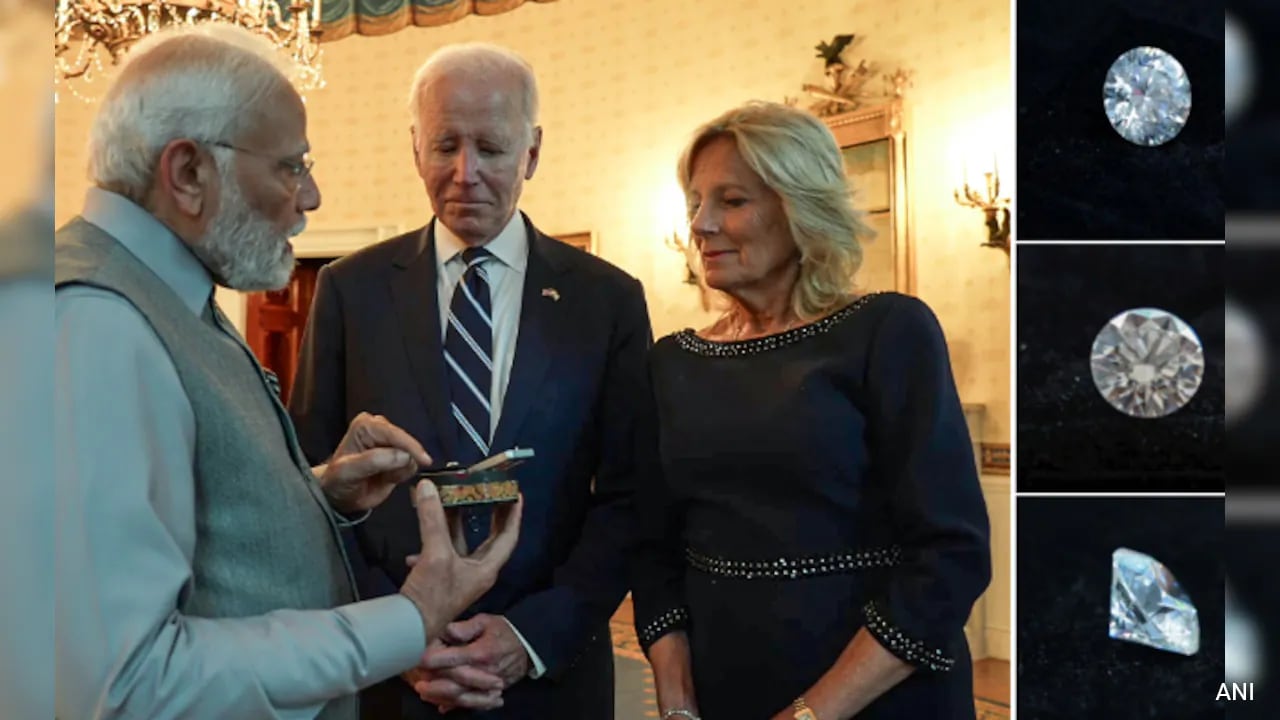
The light in the State Dining Room of the White House does not so much illuminate as it gold-plates. Under the soft glow of historic chandeliers, amidst the clinking of fine china and the low murmur of geopolitics, a small velvet box changed hands.
It was June 2023. Prime Minister Narendra Modi of India was on an official state visit to Washington, a moment fraught with immense strategic weight. Pundits were analyzing semiconductor supply chains, defense pacts, and visa backlogs. But in that specific room, the focus shifted to something microscopic, brilliant, and entirely synthetic.
Jill Biden opened the box. Resting inside was a 7.5-carat diamond.
To the untrained eye, it was simply a magnificent rock. Brilliant cut. Exquisite clarity. A "gorgeous, big gift," as the First Lady would later recount with genuine awe to an audience of tech executives and educators. But look closer, past the blinding sparkle, and you find a masterclass in modern statecraft, environmental theater, and the subtle art of the political message.
This was not a gem mined from the dark depths of the earth by exploited labor. It was a diamond grown in a laboratory in Surat, Gujarat. It was a piece of high-tech poetry masquerading as luxury.
The Anatomy of a Sparkle
To understand why this gift matters, you have to look at how a diamond is born.
For centuries, the narrative of the diamond was one of deep time and immense pressure. Carbon trapped miles beneath the Earth's crust, baked by geothermal heat over billions of years, and brought to the surface by volcanic eruptions. It was a story of scarcity. That scarcity drove empires, funded wars, and created an industry built on the romance of the eternal.
A lab-grown diamond flips that script entirely.
Inside a sealed chamber in India, scientists recreated the heart of a star. Using a process called Chemical Vapor Deposition, they introduced a tiny seed of carbon into a plasma reactor. They flooded the chamber with methane and hydrogen gases. They cranked up the heat to thousands of degrees, ionizing the gas into a roaring plasma soup.
Carbon atoms began to rain down, layer by microscopic layer, onto the seed. It is a slow, methodical accumulation. An exercise in patience. Over weeks, atoms bind together in the exact same tetrahedral cubic crystal structure as a natural stone.
The result is chemically identical, physically identical, and optically identical to a mined diamond. Even a seasoned gemologist cannot tell them apart without highly specialized, multi-million-dollar spectroscopic equipment. It is not fake. It is not cubic zirconia. It is a diamond, born of human ingenuity rather than planetary luck.
The choice of 7.5 carats was not an accident either. It was a deliberate nod to India’s 75th year of independence. Every facet of the stone was designed to reflect a modern, self-reliant nation that no longer just exports raw materials, but engineers the future.
The Invisible Stakes of a Green Stone
Diplomacy is a game played in the margins. Every gesture is parsed, every menu item scrutinized, every gift weighed for its symbolic payload.
When a foreign leader gives a gift to a host country’s family, the traditional move is to showcase heritage. A silver vase, a hand-woven tapestry, a piece of ancient art. These are safe choices. They look backward, celebrating what a culture was.
Modi’s gift to Jill Biden looked forward. It was an aggressive, brilliant advertisement for India’s green technology sector.
Consider the energy calculus. The diamond was grown using solar and wind energy. In an era where the White House is pushing a massive domestic green transition, handing the First Lady a zero-carbon, eco-friendly luxury item is a brilliant piece of alignment. It says, We see your goals, and we are already building the technology to meet them.
But the real genius lay in how it addressed an industry in crisis.
The traditional diamond mining sector has long been plagued by ethical nightmares. Blood diamonds funding civil wars in Africa. Decimated landscapes. Open-pit mines that can be seen from space, leaving permanent scars on the earth. By placing a flawless, ethically pure, lab-grown alternative into the hands of the American First Lady, India positioned itself as the ethical savior of a luxury market facing a generational shift.
Younger consumers do not want the baggage of the earth's trauma on their ring fingers. They want beauty without guilt. The 7.5-carat gift was a signal to the massive American consumer market that India is ready to supply that demand at scale.
The Human Echo
When Jill Biden spoke about the diamond later at a National Science Foundation event, her reaction was telling. She didn't deliver a dry speech about trade agreements. She talked about the sheer, undeniable beauty of the object.
"It was a gorgeous, big gift," she said. Her voice carried the genuine surprise of someone who had witnessed a marvel.
That is the emotional core that dry news reports missed. The diamond wasn't just a political chip; it was an object of profound human fascination. It bridged the gap between the cold sterility of a physics lab and the warm, aspirational world of human desire.
Think of the scientists in Gujarat. For weeks, they monitored the plasma chambers, tweaking temperatures, checking gas flows, ensuring that no impurities ruined the lattice of carbon. They knew where this specific stone was going. They knew it would sit on a table in Washington under the gaze of the world’s most powerful people. The pressure to deliver perfection must have been immense.
And they did. The stone was graded as having excellent cut quality and VVS1 clarity—meaning even under ten-times magnification, it is nearly impossible to find a flaw.
Beyond the Glitter
We live in a world suspicious of grand gestures. When politicians smile and shake hands, we look for the catch. We look for the hidden agenda.
The catch here is that the diamond trade is undergoing a seismic disruption. Lab-grown diamonds have caused prices for natural stones to plummet. Traditional mining giants are scrambling to rebrand, trying to convince the world that "real" means "mined."
By embracing the lab-grown revolution so publicly, the Indian government made a definitive bet on the future. They signaled that the old monopolies on luxury are breaking down, replaced by a democratization of brilliance.
But sitting in that room, as the velvet box was closed and tucked away into the archives of state gifts, the grand economic theories faded into the background. What remained was the simple story of human capability.
We no longer have to rip open the earth to find something beautiful. We can grow it in a lab, power the process with the wind and the sun, and fashion it into a gift fit for a world stage. The 7.5-carat diamond wasn't just a present for Jill Biden. It was a glittering manifest of what happens when human intelligence decides to outshine nature itself.